

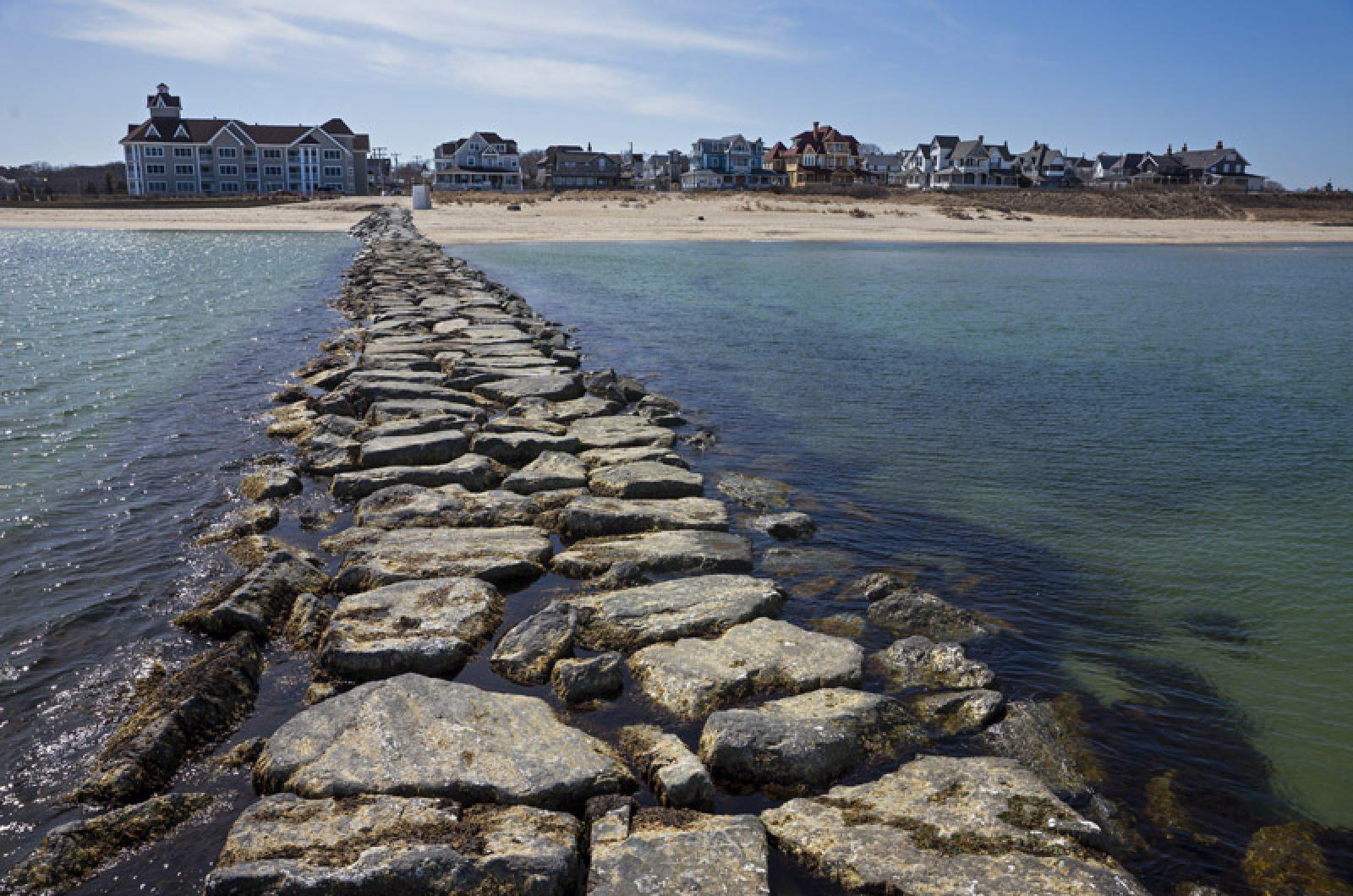
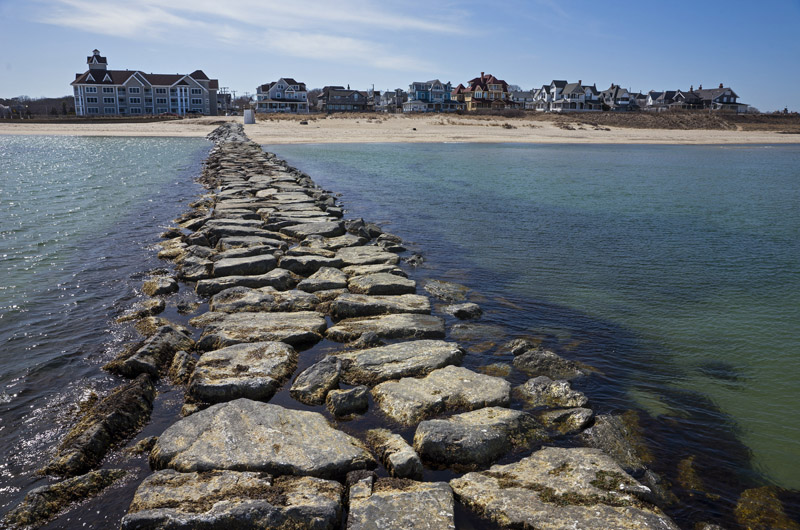
Inkwell Beach is at risk of washing away. It is one of 23 state-listed beach erosion hot spots.
Much like the Flying Horses and the Ocean Park bandstand, Inkwell Beach is a historic and cultural Oak Bluffs icon. Yet unlike those structures, beaches live and breathe; they are in constant motion, eternal flux. Unfortunately, due to man’s tinkering with nature, Inkwell Beach is at risk of washing away. It is one of 23 state-listed beach erosion hot spots.
Oak Bluffs has both short and long term plans underway to preserve Inkwell Beach.
Beaches are this Island’s most valuable recreational and economic resource. They are now at increased risk of erosion due to the impacts of climate change — more frequent storms, stronger storm surge, flooding and sea level rise. The health of Inkwell Beach is also impaired by a lack of natural sand and by the existence of hard coastal structures — the seawall behind it and the groins (small jetties) that extend seaward from the shore.
Here is what happened to Inkwell Beach: way back when, the East Chop bluff naturally eroded and the bluff sand washed south along the shore, building up the popular downtown beaches along Sea View avenue. To protect the bluff, a stone revetment was built at its base. The revetment locked the sand in place. Meanwhile, jetties were installed at the harbor entrance and groins were built to trap sand on other beaches, both public and private. The flow of natural sand to Inkwell Beach disappeared.
In addition, the seawall behind Inkwell Beach causes sand loss. The solid concrete wall — as opposed to sloping, vegetated dunes — deflects wave energy and washes away the sand in front of it.
Once self-sustaining, Inkwell Beach must now be actively managed. For the beach to survive it needs sand. And the only available source is recycled sand, which makes the protection of this beach quite a challenge.
In June the Little Bridge Inlet at Sengekontacket Pond will be dredged. Sand removed from the inlet (sand that eroded from the beaches) will be earmarked for Pay and Inkwell Beaches, and possibly State Beach, to replace sand lost in winter storms. Existing permits allow sand to be placed above the mean high water mark, so for the time being the sand will be spread along the existing beach.
In recent years the town has received complaints that recycled beach sand on Inkwell Beach contains too many rocks and shells. But that’s what beaches are made of; sand is formed by the wearing down of rocks and shells. Without them the soft sand would wash away even faster than it already does. Northeast facing beaches naturally contain more rocks and shells than south-facing beaches (like South Beach) and southern beaches (like those in Florida).
There has been discussion about screening or raking some of the rocks and shells to make the beach sand softer. But a mechanical beach rake would possibly remove too many rocks and shells and put the beach at further risk. Compromise will be the key to creating an attractive beach while also protecting its environmental values.
Sand placed on the beach last year was from a one-time source, dredged as part of the Lagoon Pond drawbridge project. The sand was deemed inappropriate and was removed. Exquisite care will be taken from here on to insure that sand placed on the beach is suitable for recreation.
In the long term, the town is planning a project to place sand below mean high water at Jetty Beach, the old North Bluff Beach, and Pay and Inkwell Beaches. At the Inkwell, plans include realigning the existing groins to better keep sand on the beach. The groin between Pay and Inkwell will be shortened and the groin south of Inkwell will be lengthened. Sand will be placed seaward of mean high water to the end of the groins, creating a wider and better protected beach. A wider beach will also better protect the road and houses above the seawall. There will be opportunity for public comment on this project.
Sand will have to be added every few years. A challenge is finding and paying for the sand. The town is encouraging the state to allow the mining of sand from the ocean for use on beaches. Most coastal states allow sand mining to preserve beaches and protect the valuable tourism economy. Massachusetts must find a way to allow sand mining while also protecting marine habitats.
Local, state, and federal permits are required. If and when these permits are granted, the town will aggressively seek funding for the groin work and sand. A seasonal resident has graciously offered to help raise funds for Inkwell Beach sand and the town is grateful for the support.
Oak Bluffs is blessed with free, in-town, public beaches. The selectmen, conservation commission and parks department respect the historic, social, recreational, and economic importance of Inkwell Beach. In this 21st century, creative and science-based planning is required to protect our shoreline. The town is committed to a proactive, long-term game plan to preserve Inkwell Beach.
Elizabeth Durkee is the conservation agent for the town of Oak Bluffs.
Comments
I have been a summer visitor
Ralph Baker New JerseyI have been a summer visitor for 30 plus years, I really appreciate this updates regarding a Island I call my summer paridise
I ARRIVED ON MV IN 1942.OUR
RICH WASHINGTON OAK BLUFFSI ARRIVED ON MV IN 1942.OUR BEACH WAS THE INKWELL.IN THOSE DAYS THERE WAS A LONG PIER WITH LOWER LEVELS ON BOTH SIDES WITH LADDERS FOR SWIMMERS ATTACHED NEXT TO THE STAIRS.THE SOUTH JETTY HAS NOT CHANGED MUCH.THE NORTH JETTY WAS CLOSE TO THE SAME LENGHT BUT WAS ADDED TO SOMETIME IN THE 60'S .THERE WAS A 6-7FT SQUARE RAFT BETWEEN THE JETTIES ABOUT 35 FEET OUT FROM THE BEACH.THE WATER WAS ABOUT 30 FT FROM THE WALL.THE WATER UNDER THE RAFT WAS 6-7 FT DEEP.THE WATER SEAWARD OF THE RAFT GRADUALLY DROPPED PAST 15 FT.THE BEACH SAND WAS CLEAN. TODAY THE PIER AND RAFT ARE GONE. THE SOUTH JETTY IS STILL THE SAME AND THE NORTH JETTY IS AT LEAST TWICE IT'S ORIGINAL SIZE. A LARGE BEACH ON THE PAY BEACH SIDE HAS FORMED.THE WATER BETWEEN THE JETTIES IS AROUND 3 FT DEEP TO THE END OF THE SOUTH JETTY AND BOTH SIDES OF THE NORTH JETTY. BASED ON THE ABOVE INFO, WE ARE ALL NOW MARINE ENGINEERS.THE EXTENDED JETTY CHANGED THE FLOW MOVING SAND HERE AND TAKING FROM THERE.MINING IS NOT NEEDED.ADJUST THE EXTRA LONG JETTY AND DREDGE THE SHALLOW SAND BACK ONTO THE BEACH.IT'S CLEAN! IT'S FREE!
Good article ! But what about
Diane Oak bluffsGood article ! But what about Pay Beach ??? No stairs and what is there for beach access is a accident waiting to happen ! Does OB Have Money for a potential lawsuit ?
Erosion is a natural process
BS OBErosion is a natural process process that's been going on forever, as has climate change. To say it's a result of "man's tinkering" is nonsense.
What part of "the seawall
Jeff OBWhat part of "the seawall behind Inkwell Beach causes sand loss. The solid concrete wall-as opposed to sloping vegetated dunes-deflects wave energy and washes away the sand in front of it." did you NOT understand? Building a concrete seawall is, in this case, "man's tinkering" I don't think the explanation in the article could be any clearer.
Man made structures such as
Steve McQuiggan ChilmarkMan made structures such as sea walls, revetments, groins, and jetties have a great effect on erosion. As stated in the article, they can starve sand from some beaches while accelerating it elsewhere. It's a fact.
Thank you, Elizabeth Durkee,
Devin Reston EdgartownThank you, Elizabeth Durkee, for insight into this important issue. I feel much better informed about Oak Bluffs position on sand mining. I must admit, I was confused after attending the MVC meeting regarding the issue in November. I couldn't agree more with your statement, "In this 21st century, creative and science-based planning is required to protect our shoreline." Sadly, we must embrace the future of a changing climate and take steps that are prudent to the interests of the community and its seasonal resort economy, while being mindful of the precious ecology of this place.
Add new comment