

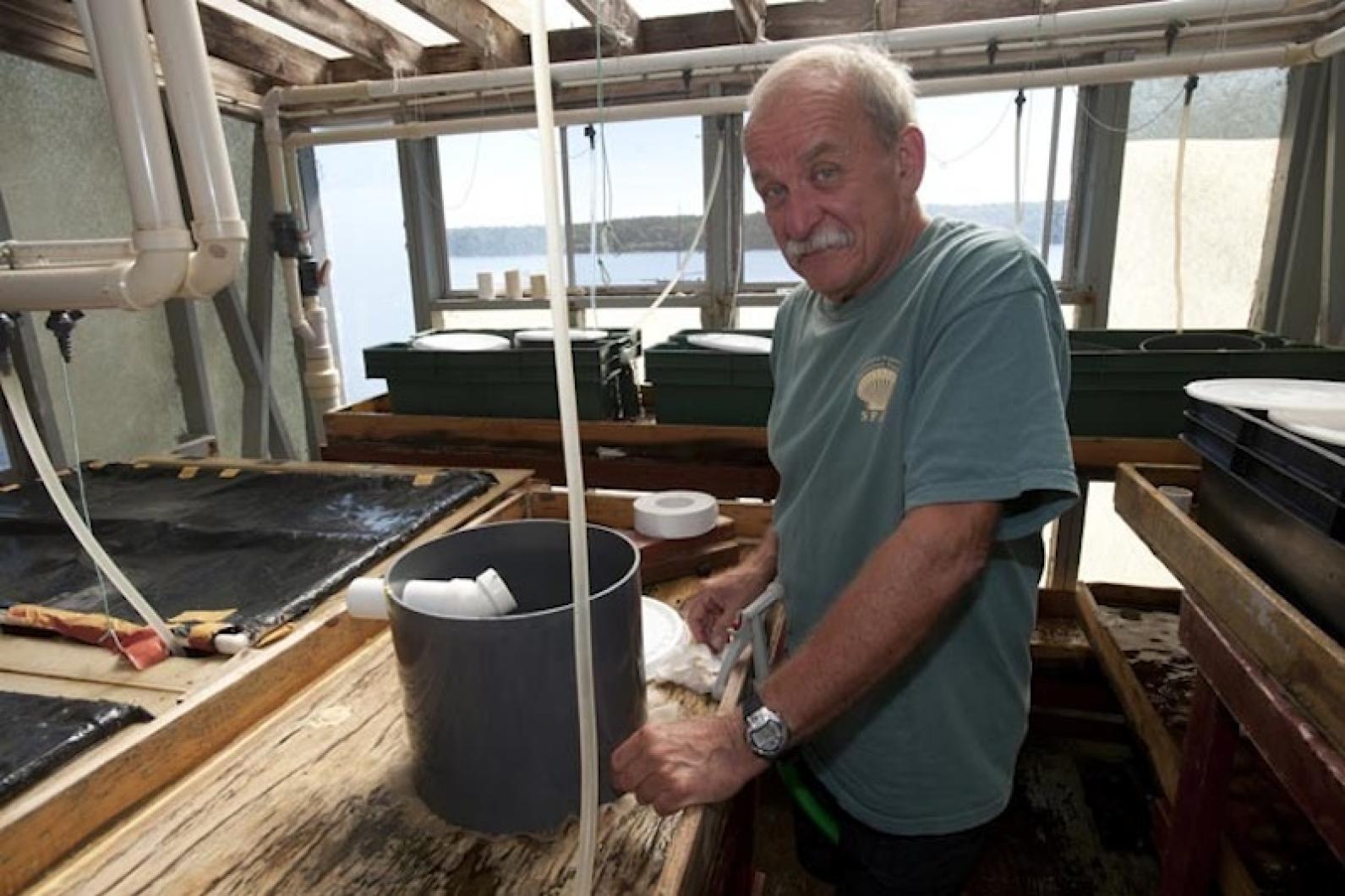
<p>For the past year, the Martha’s Vineyard Shellfish Group, along with Scott Lindell of the Marine Biological Laboratory in Woods Hole, have been quietly working on a project to breed golden mussels as a distinctive Vineyard product.</p>
The rainbow cliffs of Gay Head, the commercial fishing boats of Menemsha, the ever-present MV bumper stickers, and other Vineyard icons may soon encounter a new kid on the block: golden mussels.
For the past year, the Martha’s Vineyard Shellfish Group, along with Scott Lindell of the Marine Biological Laboratory in Woods Hole, have been quietly working on a project to breed golden mussels (a variation of the common mussel, Mytilus edulis) in the hope of creating a brand identity for the Vineyard and bolstering the local shellfishing economy.

Scott Lindell of the Marine Biological Laboratory said golden mussels taste and act like blue mussels.

Scott Lindell of the Marine Biological Laboratory said golden mussels taste and act like blue mussels.
Golden mussels exist naturally around the Vineyard, but not in large numbers, and their shells often fade with age. The goal of the project is to create a unique product for local mussel growers.
“If the Vineyard could develop its own gold brand of mussels it might be something that would be cherished,” said Mr. Lindell, who is director of the scientific aquaculture program at MBL and helped get the project started in 2013.
Scallop farmers in the northeast and in Asia already use selective breeding to create pink, purple, orange and white scallop shells. But Mr. Lindell was unaware of other communities that are breeding golden mussels.
The process involves finding samples in the wild and putting them together so they can breed. The shellfish group did two spawnings at its nursery last year, resulting in many baby golden mussels. “From that you can grow them up and select the most gold, along with the ones that maybe grow the fastest, and cross those with each other,” said shellfish group special projects coordinator Emma Green-Beach, who is managing the project.
“It’s really similar to any of the basic selective breeding that’s been done in agriculture on farms forever,” she added. “It doesn’t require any chemicals, it doesn’t require any super-fancy genetic manipulation.” The process itself would be easily transferable to other aquaculture farms.
The goal is to develop a strain that grows quickly to market size and doesn’t lose its color. The shellfish group plans to eventually add some of the mussels to an aquaculture farm in Vineyard Sound.
Ms. Green-Beach said the seed that makes it through this winter might be available for market in the fall, but added that it was too soon to know what people might be willing to pay. She hoped to get feedback from seafood dealers in the near future. As a local aquaculture product, “it could very well get a higher price,” she said.
“It tastes and acts just like a regular blue mussel,” said Mr. Lindell, who pointed out that the cultivated seed is as durable as wild seed.
“Mussels are served in the shell, so it would have a distinct table appearance and possibly, in the right kind of restaurant, might provide the grower with some added value to the product,” said Rick Karney, director of the shellfish group.
The golden mussel project is funded by a mini-grant from the Northeastern Regional Aquaculture Center in Maryland. Ms. Green-Beach said the long-term success of the project would depend on continued funding.
“Selective breeding takes multiple generations, and isn’t something you can achieve within one small grant that lasts two years or so,” she said. So far, the long-term outlook for the project remains unclear.
More than 90 per cent of the mussels consumed in the U.S. are imported, mostly from Canada, contributing to an annual seafood trade deficit of more than $10 billion. The shellfish group and the MBL are among a small group of organizations funded by NRAC to develop offshore mussel farms that could help revitalize local fishing economies. The Island’s first offshore blue mussel farm, in Vineyard Sound, was recently taken over by Menemsha Fish Market owner Stanley Larsen.
The golden mussel project would serve largely the same purpose.
“That special gold color, you can’t select in the wild,” said Mr. Lindell. “And if it gives you a better price in the marketplace, it may be worth growing it for that purpose alone.”
Comments
What a tease, no pictures of
Judy Katama & PAWhat a tease, no pictures of this golden critter?
this is hilarious, i can go
wow edgartownthis is hilarious, i can go harvest mussels on the island on my own that are exactly the same as "golden mussels". this is a way to exploit the islands resources. it will lead to over harvesting and a rape of the local mussels to sell them as " golden mussels". its a joke. this will bring in washashores from everywhere trying to make a buck. way to go for whoever came up with this money making scheme and publish it here on the internet. you just ruined another beautiful aspect of the island!
hope you have a license to
Town employee chilmarkhope you have a license to harvest those mussels. The point of this is for a commercial product which will be grown on a farm and not collected out of the wild. Wild mussel collection for a commercial industry doesn't make sense, it's too hard, so it's doubtful that the wild populations will be impacted much if at all. Natural selection has probabally worked against this particularly colored mussel because they stand out more than the darker colors meaning that they might not be as productive in this environment due to predation outside of a farming system. Yes these mussels already occure naturally but being someone who works within the Shelfish industry for many years now, I haven't seen very many in the wild. It would be very interesting to see them on my plate regardless of an added price which is not a guarantee but still cool! It's something new and if it supports the local economy from the Shelfish to food industrys on the island I support it. I do agree not all progress is good but you don't know until you try. Worked for the many colored scallops we have around the island and I don't see people complaining about seeing pretty pink and yellow shells on the beach. Great job Emma I fully support. If you need any help you know who to call!
what about invasive and
Gail Farrishwhat about invasive and destructive nature of this particular mussel?
I believe the invasive one is
Golden mussel?? VHI believe the invasive one is limnoperna fortunei, common name - golden mussel, a freshwater mussel that originates in Asia, is highly invasive and is causing problems in the Amazon. I assume the group would not be working with this species but you bring up a good point. Perhaps they should choose another name!
This is Mytilus edulis, the
Beth DarrowThis is Mytilus edulis, the same species of mussel that grows wild in MV, and the parent mussels for the seed would be taken from the wild, then the seed would be cultivated in captivity. No different than selectively breeding for yellow carrots, for example. It's still a carrot.
The article states that the
Ridiculous VHThe article states that the golden mussel is just like a blue mussel and there is no evidence of any markets paying more for golden mussels. Therefore, years of funding are being spent on a highly speculative project that does not actually contribute anything to the Island. Even the project managers state that they do not know if People will be willing to pay extra for a differently colored shell when there is already a market for the popular and well known blue mussel that already is actively fished on island. Perhaps this would have been a useful market study to perform before investing years of money and time in such a frivolous project. It is my hope that the grant funding this project is privately funded and there are no tax payer dollars involved in this ridiculous project.
But what if half the mussel
Chris ChappyBut what if half the mussel eaters see a blue and black shell and not white and gold shell?
Very good question!
Mary OhioVery good question!
Oh Chris we all know now no
Sus western MAOh Chris we all know now no matter what we see the mussel will be blue/black. Lol
Not all change is progress.
Chris Daly AquinnahNot all change is progress. (And, PLEASE, don't introduce any non-native species or varieties.)
They are native, they're just
EdThey are native, they're just bred to have a different color.
Chris! Read the article again
Erich EdgartownChris! Read the article again. The third para clearly states that the golden mussel is a naturally occurring species in Vineyard waters. As far as grant funding, I believe this is just a small piece of a larger project to develop a mussel aquaculture fishery here on the island. This project has been going on for some time. Just being another supplier of blue mussels on the marine block is nothing special, for mussel farming is going on in Maine and New Hampshire. This is obviously a look at developing a unique product that signifies the uniqueness of the island.
Good job Rick! I look forward to seeing an article on this in Aquaculture North America or Hatchery International (wink,wink).
Thank you Ed, and Erich. They
Emma Oak BluffsThank you Ed, and Erich. They are completely native and naturally occurring throughout the range of our blue mussel, Mytilus edulis, just a different color morph of the same species. Breeding gold mussels (not the Asian species!) is just like saving the seeds from the best tomato you grew in your garden last year. This is part of a much larger effort to promote mussel aquaculture on the Vineyard and all of Southern New England, and the budget for this part of the project is very, very small. To "wow" from Edgartown, I can assure you this is not a money making scheme and in no way will ruin another beautiful aspect of the island. Washashores wanting to make a buck will have to apply for an aquaculture lease like anyone else that wants to grow shellfish. Anyone else can buy a license from the town to harvest mussels and other shellfish to feed their families. We support aquaculture and wild shellfish fisheries, and this project is investigating the hatchery production of a naturally colored, local mussel that may enhance the value of aquacultured mussels. One chef on the island, has actually contacted us looking to purchase these locally grown golden mussels, which indicates that our speculations of a desired product may not be too far off. Many billions of tax dollars have gone into agriculture research over the decades, and I dont think it is a ridiculous thing to invest some money in aquaculture, where much of our food will come from in the near future. According to the FAO, cultured seafood is expected to exceed wild caught seafood in 2018. Please read the article carefully, and if you have more questions, call us at MV Shellfish Group, or send me an email [email protected].
Sounds like a great and
Beth Darrow NCSounds like a great and delicious project! Specialty shellfish (e.g., oysters) are becoming quite popular among "foodies", and I think Martha's Vineyard is the perfect spot to cultivate a specialty bivalve, especially since it's a native species. Good luck with the project - would love to see (and taste) some!
Having been the chair of the
Gef Flimlin Galloway NJHaving been the chair of the committee that reviewed this project and suggested it be funded, I must tell those who question the potential for market, that the person on the committee who pushed it over the top was a very large seafood marketer. His company moves seafood from NY to NC from their base in Washington DC. His thought was that if there was going to be aquaculture, then there should be new and different products coming out. He said that if the golden mussel could be grown, then he could sell the hell out of it. So for a change, the impetus for this research came from the sector that sells the seafood instead of the biologists who thought it would be cool to do this. Quit beefin', eat seafood!!!
Great project and great
Scott SE MAGreat project and great opportunity for value-added products and keeping the rapidly - becoming - extinct waterman (or woman!) employed. The level of federal, state and local regulatory review for these efforts is significant and errs on the side of caution...indeed the level of review and oversight for these innovative first-adopter projects is greater than what's required for the establishment of a gas station. It's past time that we enhanced the hunter-gather dominated approach to the world's greatest resource. Pursuing environmentally appropriate aquatic farming is a responsible step that's good for our communities, our economy and the environment itself.
Add new comment