

<p>An Island-based group that includes fishermen, a documentary filmmaker and a world-renowned oceanographer are leading an unprecedented effort to create three marine protected areas in waters south of the Vineyard.</p>
An Island-based group that includes fishermen, a documentary filmmaker and a world-renowned oceanographer are leading an unprecedented effort to create three marine protected areas in waters south of the Vineyard.
A special designation under federal law, marine protected areas are in place all over the country in both fresh water and ocean areas.
The Vineyard project has been spearheaded by Dr. Sylvia Earle and her nonprofit Mission Blue, which aims to establish marine protected areas around the globe called Hope Spots. Ms. Earle is a widely respected oceanographer and National Geographic explorer in residence. She was recently honored on the Vineyard for her work in studying and protecting marine ecosystems worldwide.
The Vineyard-based plan calls for halting all commercial fishing in three areas south of the Island. The areas under consideration include the Nantucket Lightship site, a vast ocean area 100 miles east of Menemsha, an area known as banana shoals south of the Vineyard, and a third area southeast of Squibnocket Point. All three areas are historically rich fishing and spawning grounds for flounder, cod, tautog, yellowtail, fluke and mackerel.

Chart shows three areas under study as possible marine sanctuaries.
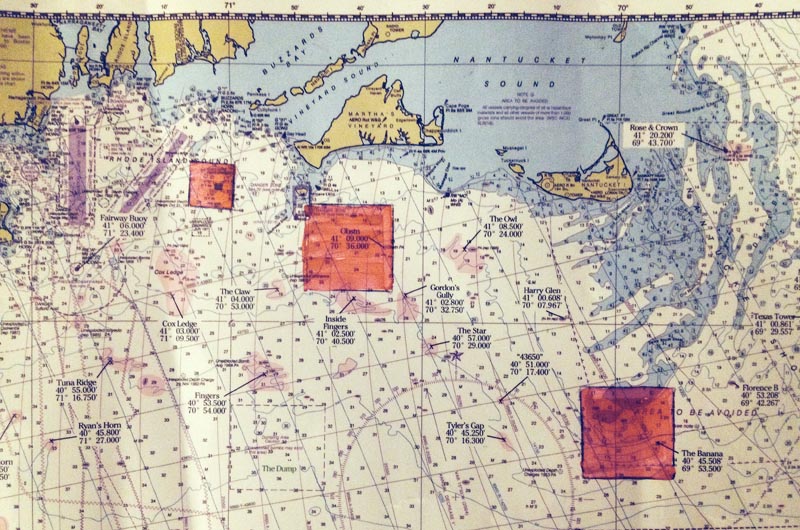
Chart shows three areas under study as possible marine sanctuaries.
“It’s best to start in your backyard,” Ms. Earle said in a telephone interview Thursday. “For America, it makes a lot of sense to look at a place that has a very long tradition of being close to the sea with a whole era of whaling and fishing and communities and livelihoods, people who really understand more than most why the ocean matters.”
The idea of designating three areas off the Vineyard has been under quiet discussion for three years and is expected to take another three years to complete. But a decision by the National Oceanographic and Atmospheric Administration (NOAA) in June that allows community groups to nominate areas of concern in their region brings the possibility much closer to reality, organizers say.
Islanders involved in the effort include Bob Nixon, a documentary filmmaker and Menemsha businessman, and Buddy Vanderhoop, a charter fisherman. Three years ago over Labor Day weekend a group met with Ms. Earle at the Home Port restaurant, which Mr. Nixon owns with his wife Sarah Nixon. A spokesman for NOAA also attended.
Mr. Nixon recalled the conversation that led to the meeting.
“The fishermen, Buddy, all of these guys see what’s going on and Buddy in particular said, you have to do something with all these trawlers, they’re just hammering everything,” he said. “I said, I’d love to have Sylvia come talk to us,” he recalled. Ms. Earle had previously served on the board of the Woods Hole Oceanographic Institution and had done many dives in Island waters.
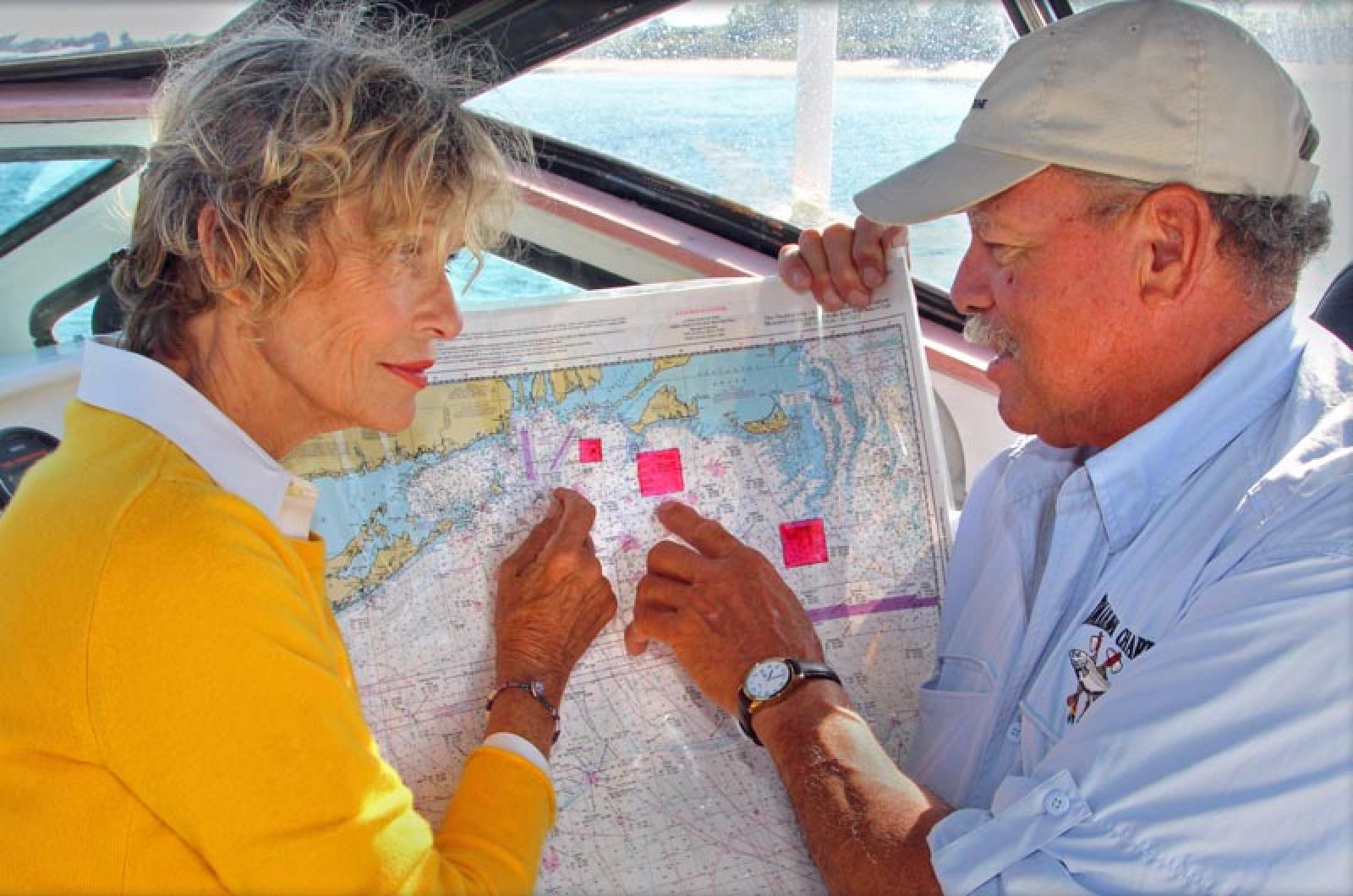
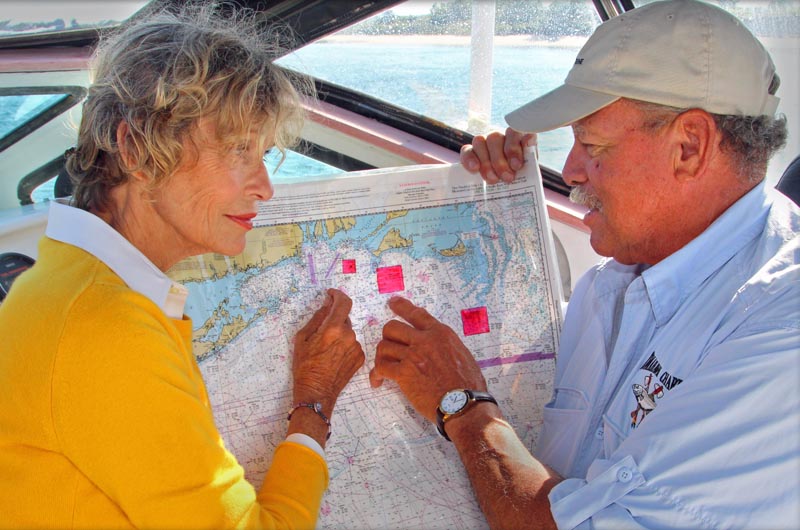
The group of fishermen and scientists became acquainted and quickly found common ground, Mr. Nixon said. Soon they were rolling out maps and discussing the idea of a marine protected area near the Vineyard.
He said the three areas targeted for designation have been dubbed the blue necklace.
Over the next year, Ms. Earle and a group of Mission Blue scientists will survey the three areas to assess the potential Hope Spots. The surveys will be a part of the nomination application to NOAA. The last time an underwater survey of the area was completed was in 1993 by NOAA. Ms. Earle was the lead scientist.
“We thought it would be incredible to dive on some of these areas because no one has ever dived on them,” Mr. Nixon said. “Previous studies did catch data and bottom analysis, but that’s it.”
The team of divers from Ms. Earle’s team, the Vineyard and elsewhere, will make about 20 dives over the course of the next year, taking still photographs, filming and getting a close look at the quality of the habitat. A test dive was scheduled for Thursday afternoon.
To be considered, the area under nomination must either contribute to the ecological and biological productivity of the area, support economic uses, have public use or be a submerged maritime heritage resource site. The application must also include management practices with an emphasis on the community support for the initiative. NOAA reviews each application on a case-by-case basis.
Ms. Earle lauded the decision by NOAA to open up nominations to communities where people are closely acquainted with the habitat, such as fishermen. Mission Blue is hoping to connect other organizations and community groups to spearhead similar nominations elsewhere.
She said concern over loss of local fisheries has grown dramatically in recent years, largely provoked by what she called “the industrial extraction of ocean wildlife” by commercial vessels in nearby waters.
“They are taking too much and destroying habitats in the process,” she said. “It’s just common sense when you pull back and look at it, which is what we’re helping to make happen. Here’s the evidence, here are the facts, here are the trends . . . and look to the future if we continue at the level we are at. It’s time to rethink the policies that were set in motion when we thought the ocean was too big to fail, that our job was to take as much as we could as fast as we could.”
Mr. Nixon is a film director and conservationist whose latest film, Mission Blue, is based on Ms. Earle’s life work. A free screening of the film was held in Menemsha last week; it will be released as a Netflix documentary on Friday this week.
Among other things, Mr. Nixon said he hopes to enlist underwater cameramen he has worked with on previous projects to join the exploration.
He also said he fully expects backlash, including possibly from sea scallopers and large trawlers.
“It’s very much a David and Goliath situation with our shore-based fishermen,” Mr. Nixon said. “It’s the industrial fleet going out there and hammering these fish.”
Buddy Vanderhoop, a well-known commercial fisherman from Aquinnah who works out of Menemsha, said the prospect of creating marine protected areas around the Vineyard represents renewed hope for saving the fishery.
“People have been taking, taking, taking and people fishing in places where they spawn,” he said, speaking from the docks at Menemsha on Thursday. “You just can’t keep taking and have no place for the fish to spawn and reproduce. You’re shooting yourself in the foot.”
He noted that there are no protected areas around the Vineyard.
“It’s pretty vital to have protected areas for fish to spawn so you don’t run out of fish,” Mr. Vanderhoop said. “We can’t keep taking and taking. You have to give fish a safe haven so they can propagate.
“We have to give them a fighting chance so our kids can have fish as well. It’s not all about greed.”
An earlier version of this story reported that Scott McDowell and Jennifer Clarke, among others, were involved with this project. The Gazette has since learned that they are not involved and the story has been corrected.
Comments
I highly commend the work of
RCW BostonI highly commend the work of Ms. Earle, Mr. Nixon and my good friend Buddy Vanderhoop for spear heading this effort. My hope is that all those who fish and enjoy the waters around the Vineyard will work feverishly to support this effort. The clock is ticking!
I would hardly call the
John Rice Marstons MillsI would hardly call the majority of those being called commercial fishermen, commercial fishermen.
It's amazing and how so much
Dick Grachek MysticIt's amazing and how so much wrong information can get crammed into one short article. But just in case there are some people interested in more accurate information, I will do my best to pass some on. "...these trawlers, they’re just hammering everything." Well no, simply not true. The boats fishing off of the Vineyard this summer were local (mostly Point Judith, RI) independent family owned fishing vessels. They are working on Squid, a very tightly controlled fishery, in fact trimester II quota has been reached last week and the fishery has been shut down. In addition to the Squid these vessels were permitted 100Lbs. of Fluke per trip---that's it, not much more maybe a handful of Whiting were what was landed from these trips. That's not exactly "just hammering everything".
Ms. Earle, “the industrial extraction of ocean wildlife” by commercial vessels in nearby waters. “They are taking too much and destroying habitats in the process,” she said - I'm sorry to differ with you Your Deepness, but New England groundfish have been underfished for years due to mindless regulations based on inaccurate and incomplete surveys and very sloppy science. On average the landed groundfish catch is a paltry 25% to 40% of the NOAA scientists' sanctioned Total Allowable Catch yearly. It's not underfished due to lack of fish either, studies by UMass School for Marine Science and Technology, Mass. Fisheries Institute, College of William and Mary's Virginia Institute of Marine Science, have surveyed the yellowtail Flounder for instance and found that NOAA is working on data that shows only a fraction of the fish found by these cooperative vetted assessments(NOAA since 2009 has refused to consider at least three studies that happen to contradict their data). In terms of destroying habitat there are studies that show biodiversity and fish populations are actually enhanced by fishing especially bottom trawling; and in addition studies show that the dynamic bottom quickly recovers from any trawling effects. Most boats these days are using semi-pelagic trawl doors that have little contact with the bottom and the net does not dig the bottom but skips along it causing the fish to rise and fall back into the net; so really we are not destroying the habitat---that's just another Frank Luntz type anti-fishing talking point. To read up on various studies concerning trawling effects on the bottom please see (http://www.savingseafood.org/conservation-environment/analysis-conserva…)
Fishing is regulated under the Magnuson Stevens Act Reauthorization 2006 and is up for another Reauthorization this year. Not exactly "...policies that were set in motion when we thought the ocean was too big to fail, that our job was to take as much as we could as fast as we could.”
The industrial destruction of ocean wildlife that you might divert some of your energy and funding towards are the (200) 650 foot tall wind turbines slated for RI Sound right off your island and the oil companies' seismic blasting just approved, a prelude to oil and gas extraction in the area.
Marine Protected Areas have not demonstrably helped the fish or the environment. Areas on Georges Bank have been closed for 18+years as well as the Nantucket Lightship Closed Area preserved for over 20 years. The latest NEAMAP inshore survey has found healthier and more plentiful aquatic life outside the area than inside.
The U.S. fisheries are the most stringently regulated in the world. Actually, thanks to a privatization and commodification regulatory scheme called “catch shares”, New England and the Mid-Atlantic have lost 80% of their fishing fleet over the last two decades. These are not market-capitalized corporate factory ships; these are weather-dependent, range-restricted, family-funded, local small boat fishing operations. They are generational icons and vital to a sense of place and identity in these coastal fishing ports and communities. These are local small businesses and with their land based support operations employ thousands and feed millions with the lowest carbon footprint per pound of the healthiest cleanest protein on the planet. And like too many of our family farms, many fishing vessels and businesses are already gone and are never coming back.
A commercial fisherman catches fish to supply food for people who cannot afford to charter a boat with a captain guide. Nobody has more at stake when it comes to healthy fish stocks.
For additional reading and references Here is Brian Rothschild's paper on "The Overfishing Metaphor", which was posted on Saving Seafood, April 10, 2011 (http://www.savingseafood.org/science/paper-by-umass-brian-rothschild-sa…);
And Ray Hilborn's article "Let Us Eat Fish", on the health and status of the fisheries in the NY Times, April 14, 2011 (http://www.nytimes.com/2011/04/15/opinion/15hilborn.html?_r=2).
I'm interested to read a
cami bonavitacola Lenox, MAI'm interested to read a response from Sylvia Earle for whom I have a professional respect.
I too would be interested
Dick Grachek MysticI too would be interested Cami, I think Bob Nixon gave one for her below.
I don't know if you're
Steve ChilmarkI don't know if you're correct or not, but I stopped reading at , the condescending "Your Deepness".
Steve don't wonder if I'm
Dick Grachek MysticSteve don't wonder if I'm correct or not; just do some of the reading from the links provided. But please don't stop reading because of my "condescension", this situation is much larger and more crucial than my demeanor or your being offended. And I must say it was very sensitive of you to be offended by my using Ms. Earle's unofficial title "Her Deepness" however, it happens to be a title often bestowed on her---just Google. But aside from that, I think her conflating local fishermen with the actual "industrial" ocean plunderers the oil industry, the wind industry, and "vertically integrated" monster fishing corporations---such as the China Fishery with fleets of 300' factory catcher processors, a mega-conglomerate Hong Kong market capitalized industrial giant owned by Pacific Andes---and comparing local trawlers to forest clear cutters is far worse than condescending, it's terribly disrespectful, destructive, and self-serving---and ironically quite shallow. And it's simply not accurate. And pardon me for the sarcasm, but can't help being a bit sarcastic and angry when we have been, for decades, fighting this relentless drumbeat of this kind misinformation and anti- fishing agenda that's contained in the article. Making fallacious talking point declarations, instead of finding out what really is going on by talking to fishermen or some unbiased scientists (there are a few), like I said, is much worse than condescending. See a website called Centerforsustainablefisheries.org and feel free to contact that organization further for some accurate information concerning local fishing operations.
While it seems to be absent
Nils Stolpe New Smyrna Beach, FLWhile it seems to be absent from any reporting regarding Dr. Earle, she is on the board of Kerr-McGee, and energy development company that was acquired by Anadarko Petroleum. Anadarko Petroleum was recently fined $5.15 Billion by the U.S. Department of Justice for environmental affronts (a minimum of 5.15 billion dollars worth of affronts) committed by Tronox, a subsidiary paint manufacturer that Kerr-McGee tried to distance itself from. According to the current web page of Bloomberg Business Week Dr. Earle is still on Kerr-McGee's board.
Dr. Earle is also a founder of and is still associated with DOER Marine, which seems to be focused on offshore energy development.
Dear Dick Grachek,
bob nixon menemshaDear Dick Grachek,
Thank you for your detailed comments regarding our plan to search for, dive to and document key fish spawning and feeing habitats. Our goal is to identify essential habitats and working to build a coalition to support designating them as marine protected areas. A central motivation for me is the belief that a series of marine safe havens will increase fish populations and help shore up our local commercial fishermen's way of life. It is clear we disagree on whether marine protected areas improve the fishing in surrounding waters but it seems we are aligned on many of issues and hope we can work together.
In reading the article I see a major disconnect was my not making it clear to the reporter that the "trawlers hammering the local fish populations" referred not to our local commercial fishermen but to the same industrial factory ships you suggest we focus on. " In "Mission Blue" you will see that we did " focus on the "industrialand "vertically integrated" monster fishing corporations" and took great pains to document the the industrial factory ships vacuuming up menhaden in Chesapeake Bay.
I second your comments about our local fishermen and apologize to any friends or neighbors who did not immediately know i was referring to the factory ships. My trying to bring attention to industrial harvesting is in support of the remaining small boat fishing families, such as those in Menemsha, who have deep respect for the marine environment and conservation.
The consequences of industrial fishing and the current management are as evident to me when i am out fishing with my kids as they are to the local commercial operators who have seen their quotas and incomes decline year after year. Everyone acknowledges we need to do something to restore the fish stock as our our local fishermen cannot hang on at the margins. To quote you again. "in fact trimester II quota has been reached last week and the fishery has been shut down. In addition to the Squid these vessels were permitted 100Lbs. of Fluke per trip---that's it, not much more maybe a handful of Whiting were what was landed from these trips."
As you point out the fishes "management" system is very complex. I am not a commercial fisherman or biologist just outdoorsman who pays attention. Once upon a time i was a fifteen year old fishing fanatic who read about the fishing mecca of Menemesha and hitchhiked from Philly cast off the jetty. Decades later I have not stopped casting but i have seen our waters go downhill. One of Sylvia Earles central messages is that the ocean is in real trouble but we can turn it around if we work together... but we have to do it now.
A few of us are trying to do that in our backyards by trying to fill in some blanks. To me only one thing is as susprising as our allowing factory ships to take huge bites at of our fish populations and that is how little we know about what goes on under water. For example several sites have been closed to fishing for decades but hardly any have been visited by human divers. I believe putting eyes and lenses on these areas can't be a bad thing. For example im still looking for a diver who has visited the sea floor at the vast closed area 3 . Yes its pretty far out in the atlantic but its seems diving down with cameras to document whats going on would be a useful- if chilly- exercise. Same with the other areas that seem to be essential elements of special value to our little understood but stressed undersea world.
I will call your office in the hope that we can stop meeting like this.
Best regards, bob nixon
But Bob, there are no
Dick Grachek MysticBut Bob, there are no "industrial trawlers" fishing on the grounds off of the Vineyard or Nantucket Shoals, never have been. But if you are advertising closing off swaths of local bottom because of “industrial trawlers hammering everything” it would follow that the industrial trawlers are local, right? The trawlers that you see from your beach “the industrial extraction of ocean wildlife” by commercial vessels in nearby waters (Dr. Earle) – seems to me ---and I’m sure to your audience--- that you are referring to boats like mine, a marginally profitable 36 year old 73footer, and by the way, which now uses semi-pelagic trawl doors that don't contact the bottom while fishing, and a light net with less water resistance and bottom contact---doors from Denmark, net and associated equipment cost: about $70,000 (a very big investment in a capital and credit starved business). It is boats like mine (the “commercial vessels in nearby waters”) and operations like mine that are effectively being choked out of business by inaccurate information regarding fishing that’s found in campaigns like "Mission Blue" and this article in the Gazette. Also, by the way, the bottom off of Nantucket shoals and Georges Bank has been videoed many times over the years; please see bibliography from (http://www.savingseafood.org/conservation-environment/analysis-conserva…) or the studies linked below. Dr. Earle might also be interested to know that we can't tow on corals, sharp rock ledges, kelp, soft mud, or really any bottom that is not smooth and clean, we have close to $100,000 worth of fishing gear constantly at risk. Also from a purely economic perspective, the less contact with the bottom we have the less fuel we burn. And even so, fuel takes 25% to 40% right off the top of gross revenues. If we were doing all the destructive plowing and clear cutting and bottom wrecking we're accused of, we'd have to tow a fuel tanker behind the boat for the ridiculous fuel consumption it would create. We return precisely to the same 150 foot wide strips called "tows" which have been fished for decades, some years not so much fish and other years the bottom is paved with them. Most local bottom is dynamic, i.e., natural tides, winds, surges, move more features around down there more than any fishing will ever do. Harris, Bradley; Cowles, Geoffrey; Stokesbury, Kevin, “Surficial sediment stability on Georges Bank, in the Great South Channel and on eastern Nantucket Shoals,” Continental Shelf Research, Volume 49, September 23, 2012, p. 65-72 and Lindholm, James; Auster, Peter; Valentine, Page, “Role of a large marine protected area for conserving landscape attributes of sand habitats on Georges Bank (NW Atlantic),” Marine Ecology Progress Series, Volume 269, March 24, 2004, p. 61-68 I've been in and around the fish business for well over 50 years and I've never seen so many fish in so many places as I have over the past few years. What has changed however is the water temperature and it has caused a northern migration of many species. Fish are temperature sensitive especially regarding their spawning activities, yellowtail Flounder, for example, do not like warm water; they will migrate and find better grounds for their spawn. Warm water will bring meager Yellowtail Flounder populations for a few years at least, of course the fisheries managers won’t address the facts involved with ocean warming so it’s all neatly wrapped up in “overfishing” and more draconian regulations. We are seeing fish off of Long Island that never before ventured North of Cape Hatteras, the Cod have moved to Canada and the Newfoundland fishermen are complaining about so many more Cod than they've seen in 40years and that these fish are eating their crab and shrimp (their money fish). And in the Gulf of Maine now infamous now for its lack of Cod (according to NOAA’s schlock science anyway) there are appearing Black Sea Bass, Blue Crabs (yes, of Chesapeake fame) and Squid; these are more southern fish and have never been seen in the Gulf of Maine, ever. Now let’s talk “industrial fishing”: China Fishery, a fleet of "industrial trawlers", 300’ industrial factory catcher/processor ships in fact, working off of Argentina, Chile, and northern Africa, Somalia, Namibia, etc. They (China Fishery and their ilk) buy up a developing country's fish quota, and an official or two, displace local fishermen (i.e., Somalia fishermen turned Pirates as immortalized by Hollywood). They (China Fishery) then set up a phony fish company in the country whose fish they are stealing in order to avoid any tariffs or bad publicity, wipe out the stocks in short order and sell the fish back to the starving people whom they stole them from in the first place, this Murphy Game makes their shareholders quite happy---and rich! (See Pacific Andes Holdings). Now please note, Dr. Earle and company, what the China Fishery and other market capitalized conglomerate fishing companies are doing around the world...is "industrial trawling" not what you see during the summer around the Islands. Bob, when you make a little oops...and forget to be specific when making statements like "they are hammering everything" and Dr. Earle talks about trawlers destroying the habitat, who do you suppose the general public thinks you are referring to? They look out from their beach “bungalows”, see my boat for instance fishing Squid and think...what do you suppose? That they think they’re looking at a local "artisanal", family owned, conservation-minded, overly-regulated, local boat providing fresh healthy fish for local markets as they’ve been doing for decades? No I don't think so...they see destructive, habitat wrecking, spawn interrupting, greedy, "industrial trawlers"..."towing nets the size of Boeing 747s"; "scooping everything in sight"; and "clear cutting the ocean bottom". That's the effect of little oversights like you've explained. This kind of anti-fishing sentiment is then super-charged by The Pew Un-charitable Trusts' unlimited funds (of oil money) and eventually results in Peter Shelley at Conservation Law Foundation threatening the regional Council and/or NOAA with lawsuits until they cower and squeeze out a few more unrealistic and convoluted fishery regulations. Your money and film making and "Star-power" rolled into an endeavor like "Mission Blue" have dire consequences on all the local fisheries and the environment. Pushing local fishing off of the traditional grounds only forces boats to go to other areas, burn more fuel, take more risks, and fish on new bottom. Local boats have been trawling on the "spawning bottom" that you are worried about since the mid-1940s. The fish come back each year to spawn and we catch some as they are moving back offshore---our season is truncated into tri-mesters (seems all the recent grads working at NOAA thought that schools of Squid had something to do with higher education) with very specific (some would say foolish) allocations since Squid are a “data-poor fishery” which means nobody has a clue how many Squid there are at any given time---but that doesn’t matter they stop us from fishing anyway, they are abiding by the precautionary principle although no one knows what the pre-caution is about. Squid for instance live for less than a year, and are prolific breeders most years. The majority of the large fish that are spawning return offshore actually to end their lives, it is during this offshore migration as they move south is when most fishing is done. It's the (200) 65 story tall wind towers and the mega-watts of electrical currents running all over the place that is coming soon to the waters off the Vineyard that will disrupt the spawn---not local fishing. Again if you and your entourage really want to protect the spawning areas that you are targeting with MPAs (there are local areas that actually have been closed for 20years and have not shown any beneficial effect on the stocks, i.e., Georges Bank and Nantucket Lightship closed areas) ---help us stop the hundreds of 650foot tall Wind Turbine Towers that will start to be constructed next year---right smack dab on the "spawning grounds" that you are so worried about. After that, help us stop the Oil Barons from seismic blasting and killing fish, mammals, and birds,in the process of turning our entire Continental Shelf (including all the "spawning grounds") into a gooey "industrial" Playland like the Gulf of Mexico and the now pretty much fishless Prince William Sound in Alaska (Exxon Valdez, remember?).
Anyone that has been
Dick Grachek MysticAnyone that has been following the back and forth here and is even the slightest bit interested by my point of view, you also might be interested in this report.
http://worldfishers.org/2014/08/21/new-report-ocean-grabbing/
I would like to thank the
Dick Grachek MysticI would like to thank the online editors at the Gazette for generously posting my long and ponderous comments. The ignorance about the New England and Mid-Atlantic fishing industries is astounding and quite frankly it is killing what I consider to be, along with organic farming, one of the last trustworthy sources of clean, nature raised, antibiotic-free, protein on the planet. People connected to the fishery sometimes have a hard time understanding the hostility directed towards them. I try to counter misinformation with as honest and vitriol-free response that I can manage and that's why the long and complicated comments. I believe most people are authentically concerned about the environment; but unfortunately the actual polluters, the real ocean villains, through vast media campaigns of anti-fishing propaganda, have managed to reverse roles with local fishermen and made them out to be the ocean villains. I would say to the reporter who wrote this article please talk to a commercial fisherman or two (not a fish guide to the stars) before propagating demeaning and corrosive information about an industry that apparently most people don't take the time to learn much about. Anyway, Thank you again to the online editor for seeing this through.
I don't understand why you
Dane Billings Westerly, RII don't understand why you are so opposed to this initiative Mr. Grachek? What is the harm in exploring these areas that are virtually unknown and seeing what we can do to protect them? Seems Nixon and Earle are trying to find common ground between the interested parties instead of polarizing groups so that nothing gets accomplished.
Marine Sanctuaries or Marine
Dick Grachek MysticMarine Sanctuaries or Marine Protected Areas Mr. Billings, that is my objection. MPAs are used as a mechanism to stop fishing, but usually precious little else. If it's about stopping exploitation by oil and gas and wind, I'm all for it; and if fishermen are not thrown off the grounds they've been fishing for generations, right on. But as you can read in the article it's about stopping fishing ("The Vineyard-based plan calls for halting all commercial fishing in three areas south of the Island") And would you say that making statements such as "you have to do something with all these trawlers, they’re just hammering everything" and “They are taking too much and destroying habitats in the process” and “People have been taking, taking, taking and people fishing in places where they spawn” and "...It’s not all about greed” are attempts at finding common ground? No 'fraid not, it's about our traditional local fisheries being dismantled by people with self-serving motives and by corporate privatization forces looking for the next economic driver. The fisheries are being destroyed by NGO lawsuit cowed National Marine Fisheries Service's baseless regulation upon regulation, working on admittedly incomplete and incompetent fish surveys, totally befuddling and needlessly convoluted population dynamics statistical computer modeling, and by donation seeking multi million dollar conservation "funds" making money from their extinction-of-the-week programs. Fishermen around the world are being driven off the most productive fishing grounds by wind, oil, gas, gravel, and minerals mining. One of the tools this dismantling process employs is Marine Protected Areas. As Simon Collins the recently appointed executive officer of the Shetland Fishermen’s Association commented as he discovered a similar dysfunctional management dilemma for Scotland’s Fisheries, “I have quickly come to lament the absurdity of a management system designed by consultants, environmental activists and celebrity chefs, rather than by those who have any idea how it could work”. Now I certainly have a vested interest, actually I believe we all have a vested interested in protecting one of the last true free enterprise independent family owned businesses, i.e., outside the corporations that pretty much have infiltrated every part of our lives. But don't take my word for it, just read some of the links I've provided, especially the above link above to the report on "ocean grabbing".
As a commercial fishermen out
Wesley Brighton ChilmarkAs a commercial fishermen out of Menemsha I am shocked to read this article. These "hope spots" will eliminate all 12 owner operator family business lobstermen working out of Menemsha. It will eliminate all of the owner operator fluke day boats and the last two owner operator squid boats we have left. As if that isn't enough, the commercial fishermen listed other than buddy vanderhoop, Scott Mcdowell, Jen Clark who are actually all charter fishermen are adimately against these "hope spots" I attended the meeting at the Homeport restaurant over three years ago when they proposed totally different spots none the less and though Sylvia Earle seems to be a pleasant lady, her perspective on fisheries management left me and ALL the other fishermen in the room feeling threatened. We have been regulated to death over the last 10 years, there are extremely healthy fish stocks out there. We have small owner operator boats. We rely on those fishing grounds to support our community. We were not interviewed on this article and it is an outrage. This is not reporting, this is back hand rhetoric. If you would like to ask Alec Gale, Warren Doty how they feel about those "hope spots" I suggest you actually ask, you will find similar sentiment. There are no greater conservationist than small owner operator fishermen, we clearly have an interest in our generational future.
Just for the record I was
Jennifer Clarke MenemshaJust for the record I was never interviewed, consulted, informed or made aware of this article and have no idea how or why my name was included in it. I'm thrilled to learn more about the topic as I care deeply about the local fishery. However this is not something I have been involved in or knew anything about until the article appeared and I began to receive phone calls regarding it.
Thanks to the reader, the
Editor Vineyard GazetteThanks to the reader, the story has been corrected.
The efforts of Dr. Earle and
Zach ChilmarkThe efforts of Dr. Earle and Bob Nixon are greatly appreciated by many people including myself in efforts to save the ocean from the overall underpopulated it has become over the course of my life time. In do good time more documents and articles will surface on this topic.
It is just now that I am
Martha Shaw Oak BluffsIt is just now that I am reading all these comments and suggest that the fishery stocks are not owned by men with fishing vessels, but are part of the commons that belong to all living things who inhabit the earth. The earth is one big ecosystem and everything we do in one place affects another. It is true that industrialized fishing since the industrial revolution has depleted the ocean's large pelagic fish and caused mayhem throughout the food web. To date, governance of IUU, and the establishment of Marine Protected Areas are the only immediate solution. Already many countries are designating their EEZ as MPAs. While local fishermen may feel that are being blamed for the gross overfishing throughout the world only to be ground up as fertilizer, cat food and fish feed, I suggest that artisan fishermen celebrate the fact that scientists and people from all walks of life are willing to collect data so that we know what we are dealing with. Lastly, I wish the language would not be so arrogant. If my family was in the rhinoceros hunting business for many generations it doesn't mean I can keep helping myself to rhino horns at the expense of my fellow man. Fishermen invest a great deal in their equipment, but what they catch is still owned by the commons. We romanticize fishing and many people with big boats think it entitles them to get their investment back by reducing quotas. This is a very usual model of economics. I can't go into your backyard and pick your apples just because I have a cherry picker. Let's see where we can find common ground. As an oceanographer, I am all for more data, not less.
Add new comment