



<p>Facing an unforeseen deadline for spending a major state grant, a town committee has stepped up the pace in the effort to restore Squibnocket Beach. The issue has been marked by intense environmental study and also politics.
Facing an unforeseen deadline for spending a major state grant, the town committee on Squibnocket is working to accelerate its efforts to restore Squibnocket Beach.
The committee learned last week that Chilmark’s $280,000 Coast Zone Management grant must be spent during fiscal year 2015, which ends June 30. It was previously thought that the grant period would end on May 30, 2016.
Committee chairman James Malkin emphasized the need to move forward “with all deliberate speed” in order to meet the deadline. Assuming the town approves a final plan at town meeting in April, he said, work on the project would need to be completed in a short two and a half-month time frame.
“The chances of that happening . . . are pretty slim,” he said at a meeting last Tuesday.
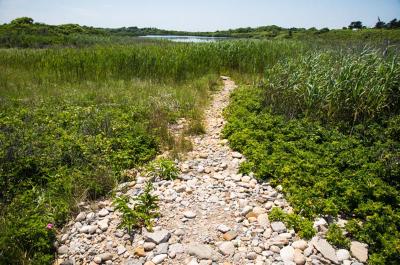
Coastal fen is one part of many-layered ecosystem at Squibnocket.
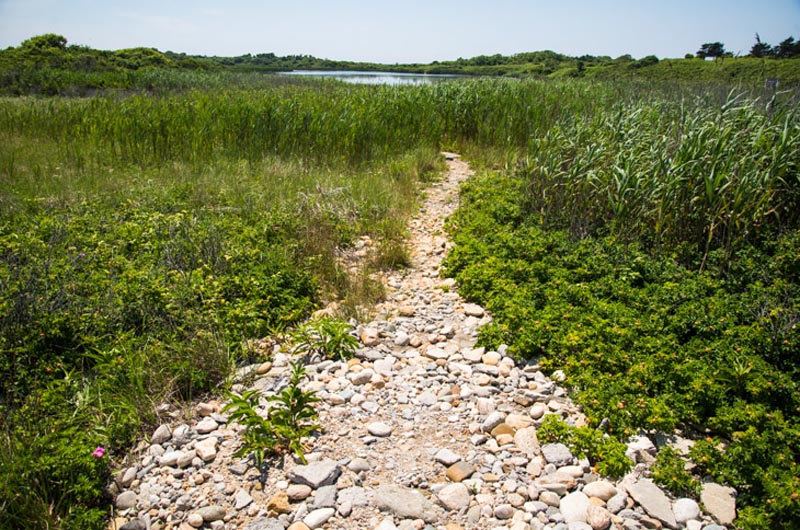
Coastal fen is one part of many-layered ecosystem at Squibnocket.
Selectman Warren Doty said if a plan is developed sooner, a special town meeting could be held in January or February. “It’s not a popular time for a meeting, and I don’t know how attendance would be, or how the town would feel about that, but it is an option,” he said.
The committee’s work so far has focused on gathering information from stakeholders, with a goal of providing an update at an October special town meeting. An article will need to be prepared by mid-September.
The issue has been marked by intense environmental study and also politics.
Squibnocket Beach was badly damaged during Hurricane Sandy nearly two years ago.
A plan to restore the beach that was backed by the selectmen and was the result of months of negotiations last year with homeowners at Squibnocket Farm was narrowly rejected at the annual town meeting in April in favor of more study. That plan would have removed a stone revetment, relocated the town parking, built a new access road and added a significant stretch of beach to the town holdings at Squibnocket.
Vocal opponents of the plan included homeowners in Blacksmith Valley, which overlooks Squibnocket.
Alternative proposals are now beginning to take shape. A group called Friends of Squibnocket, which includes Blacksmith Valley residents, presented the results of a site study to the committee last week. Wetlands delineations and projections of what the shoreline might look like if the revetment near the parking lot is removed are included. The group’s final proposal is expected to focus on building a dune ridge to protect a new roadway farther inland.
Tim Rich, former chief of police in Chilmark, outlined a plan that would involve the Friends of Squibnocket purchasing property for a new parking lot farther west, in an area less prone to erosion. Mr. Rich suggested a one-lane access road to Squibnocket Farm. But Warren Spector, a Squibnocket Farm homeowner, said that would be inadequate.
“The volume of traffic in July and August is immense,” Mr. Spector said. “It would be an enormous backup at both ends all July and August if we had one lane.”
Much discussion focused on the potential benefits of a dune ridge. Stanley Humphries, a coastal geologist at LEC Environmental Consultants who is working for the group, said an earlier dune ridge near the beach, as shown in a 1951 photograph, may have succumbed to human activities such as the removal of sand after storms.
Mr. Humphries has studied 12 sites along the south shore and found that dunes higher than 10 feet are generally well vegetated and self-sustaining. As sea level rises, dunes tend to migrate away from the shore, he said, but roads, revetments and parking lots can prevent such natural processes from occurring.
Roads and paths can allow storm water to flow around the dunes, eroding them from all sides, the geologist said.

Removing stone revetment and relocating town parking lot are under consideration.
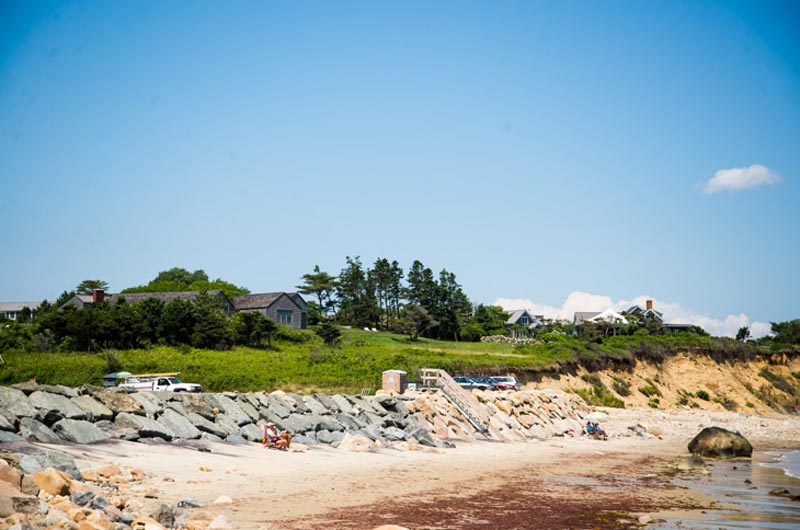
Removing stone revetment and relocating town parking lot are under consideration.
Tony Orphanos, a member of the Friends of Squibnocket, said stone revetments can encourage scouring beneath the stones, causing severe beach erosion.
Chris Murphy, a vocal opponent of the selectmen’s plan last spring, said he believes the Coastal Zone Management grant reflects the state’s interest in restoring the beach to its natural state.
“My understanding is that that money was essentially given to the town or made available to the town because the state wants to see what will happen when you remove a revetment,” Mr. Murphy said. “Everyone that has spoken about the revetment at the parking lot agrees that the revetment needs to go away.”
He suggested moving ahead with plans to remove the revetment while the committee continues its work.
But others said a comprehensive plan should be developed first. Committee member Steven Flanders said it would be premature to remove the revetment without having a plan for a new access road.
“I think you are going to find that the parking lot will become the beach and there will be no access to the causeway,” Mr. Flanders said. He also noted that the previous dune ridge was gone and questioned how well another one would protect the site.
The Friends of Squibnocket have argued that the situation does not present a crisis, since access to Squibnocket Farm has not been seriously interrupted in 20 years and could be restored in the case of an emergency. Mr. Orphanos said the greater risk would be rushing to address the problem before considering all the factors.
One Squibnocket Farm homeowner questioned whether access could in fact be restored in the case of an emergency. Mr. Humphries said depending on the emergency a state permit might be required to restore the road, but he expected it would be granted.
Almost three months after its first meeting, the town committee is beginning to analyze some of the information it has collected. Two experts from the Woods Hole Oceanographic Institution have agreed to serve as consultants, and committee members will shortly begin tying up loose ends, including staking out property boundaries and collecting town records.
The selectmen made a presentation to the committee three weeks ago, emphasizing elements of the town master plan relating to the beach. In light of that, Mr. Malkin said he plans to invite members of the planning board to make a presentation this month. The Friends of Squibnocket are due to make their final proposal on Sept. 16.
Comments
OK, looking at a map this
Curious in CT Derby CTOK, looking at a map this beach seems quite exposed and there really isn't anything between it and Europe. One good storm and anything Man does here will be out to sea in a couple of heartbeats. So it seems like you want a bunch of consultants to troop down there, write reports and seek approvals, generating a pile of paper and hot air. I thought you Islanders were a little more practical.
I would like to put my quote
Warren Spector ChilmarkI would like to put my quote in context. I was referring to Mr. Rich's suggestion of locating the parking further West and allowing beachgoers to drive over the causeway to drop off passengers and belongings. In that event, an one-lane causeway would be extremely crowded and would create traffic jams in high season.
How quickly could access be
Lover of Squibby ChilmarkHow quickly could access be restored in case of an emergency? Minutes in a medical emergency? How does that happen exactly? A fleet of dump trucks that stand by there just in case?
Do emergency vehicles get stuck in sand ever ?
Does anyone know where these stable sand dunes that the expert mentioned, are located??
NOA has a tower up near Squibby beach. They are studying the unusual tides up there.
come its like throwing
flounder bob chilmarkcome its like throwing shovles filled with sand into the sea...one can spend alot of money time and sweat.. for what mother sea will win every time keep doing what we hhve done fix after a huge storm to use the access road, and dont worry about the cars walk down to the sea 2 feet dont coast much. just because we have 280k dont mean we have to spend it Frivolously.
It is clear that the beach is
1952 Los Angeles, CAIt is clear that the beach is gone. Let it go. Let the Squibnocket Point landowners build a 2 lane bridge from Beach Road over to the point, remove the revetment, and let nature take its course. At one time, in the late 1600s, Squibnocket Pond was open to the sea where Long Beach is now. Maybe it should be open to the sea again.
Building a two-lane bridge is
Joanna ColeBuilding a two-lane bridge is "letting nature take its course"? It is not. That would be taking away the revetment and not building anything.
This is all very nice yet I
Peter Oak BluffsThis is all very nice yet I still cannot enjoy this beach!
You can go to squib as of
Upisland is where I am ChilmarkYou can go to squib as of sept 2nd. Enjoy.
How in the world is it ok for
Chris Potts Vineyard HavenHow in the world is it ok for Chilmark to receive funds collected from MA taxpayers when beach access to Squibnocket is restricted to Chilmark residents during the summer (and beach access is a stipulation of the grant)? Beach towns in other states have been forced to go to court over this issue -- and they've won. I'd love to protect Squibnocket, but don't dare spend my money and then tell me I can't step foot on this beach in the summer.
I'd like some basic facts.
Joanna Cole ChilmarkI'd like some basic facts. Who owns the road from State Road down to Squibnocket? Who owns the beach? Is Chilmark legally obliged to provide the Squibnocket Farm folks access to their land? Answers appreciated.
To the fellow who wanted "nature to take its course" -- we should just let the ocean wash over everything and NOT provide a road.
And to those who wish Squibnocket were public - I agree. I would like all beaches on this island open to everyone. I don't think it's going to happen. Meantime, public funds (roads, the coast guard, etc.) pay for a lot for these private beaches.
A couple of clarifications to
Wendy Jeffers ChilmarkA couple of clarifications to the article on Squibnocket are in order:
(1) Friends of Squibnocket LLC (FOS) will make a presentation on September 16, not September 26.
(2) FOS is not limited to Blacksmith Valley residents. Rather, it is made up of a diverse group of Chilmark landowners, all of whom enjoy using Squibnocket Beach. We suggest that you visit our website Squibnocket.Org for more information.
(3) The coastal geologist representing FOS, Stan Humphries, did not say that a State permit would be required to repair a main access road after a storm. He has repeatedly said that after a major storm, the Commonwealth will declare a State of Emergency and permitting for access repairs will be waived. The question at the August 26th meeting was how quickly a repair could be made after a no-name storm. Mr. Humphries replied that local Conservation Commissions have procedures in place for expedited repairs. Mr. Humphries’ comments on permits for repairs after a major storm is on the Squibnocket.Org website and the Town Committee’s website.
(4) Finally, this is not a “Race Against the Clock.” SquibComm Chair Jim Malkin has repeatedly emphasized the need to move forward “with all deliberate speed” but all of us involved understand that this is a complex issue with many ramifications. This is not about “her access” and “his views” but rather how best to accommodate a dynamic and rapidly evolving coastal landscape. The decisions and recommendations made by this committee will become the model for coastal roads and barrier beaches all over the island.
The presentation date in the
EditorThe presentation date in the story has been corrected and changed to Sept. 16. Thanks to the reader.
I recently came across a
David Hornblower SquibnocketI recently came across a picture of my twin brother and I standing in our back yard, with the beach behind us. Upon further study I discovered not just a few pockets of beach, but long, wide stretches of fine white sandy beach. Picture likely taken in late Summer, not likely at high tide. But the point I make is that beaches change over time depending on their susceptibility to weather events. All beaches are being impacted by global warming. So solutions should incorporate deviations from the statistical norm. Picture a bar chart with the most critical issues to the left along the y axis, (examples might include emergency access, ability to sustain heavy equipment at storm surge sea levels), and out to the right more aesthetic issues such as ability to go swimming, fishing, surfing). What are peoples' views on those needs? When the property was sub divided the Town and the conservation commission declared us homeowners on our own regarding indemnification during emergencies.
Back to the picture. Starting from the old herring way all the way round the mussel bed you can make out areas for passive recreational activities. So it's a pre Hurricane Bob (1991) picture. That was the storm that took out Money Hill, the Herring Way, and for the first time since the 1800's pushed through Long Beach into Squibnocket, by the cove. Prior to the revetment, repairs took around 48 hours, with local builders supplying the manpower, equipment, gravel and sand providing emergency relief. Clearly a long term solution is needed due to rising tides, and emphasis needs to be given to the planning component.
Add new comment