


Originally found in the northern climes of eastern Canada, the great cormorant’s distribution has changed.
Phalacrocorax carbo (pronounced fal-ah-crow-koh-rack) is the Latin name for the largest of a group of birds that are not well liked: the cormorants. The great cormorant’s Latin name loosely translated means “bald coal-colored crow.” This largest of the cormorant family comes primarily from Europe but is also found on the East Coast of the United States. Originally found in the northern climes of eastern Canada, the great cormorant’s distribution has changed. Not only does this cormorant now spend its winters in New England, but it also has been seen wintering as far south as South Carolina.
Known also as shag, this cormorant used to nest only in far northeastern Canada in this continent. Now there are records of this species nesting in New England, primarily in Maine although there is one record of a pair of great cormorants nesting on the Weekpecket Islands, which are part of the neighboring Elizabeth Islands.
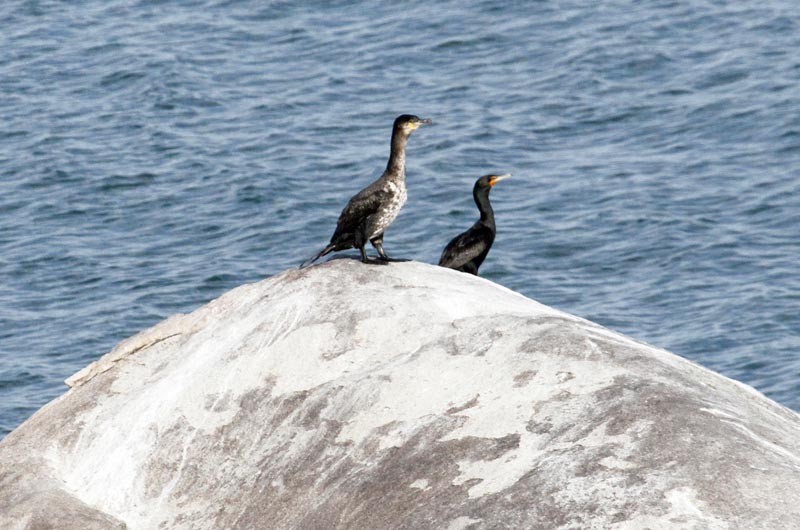
The great cormorant, with a wingspan of 63 inches, is larger than our common double-crested cormorant (wingspan of 52 inches). When perching, which is what both these species do frequently, the great cormorant stands three inches taller than the double-crested cormorant. During the fall, early winter and late spring the identification of these two species is difficult if you don’t see them together.

Flying adult great cormorants in breeding plumage.
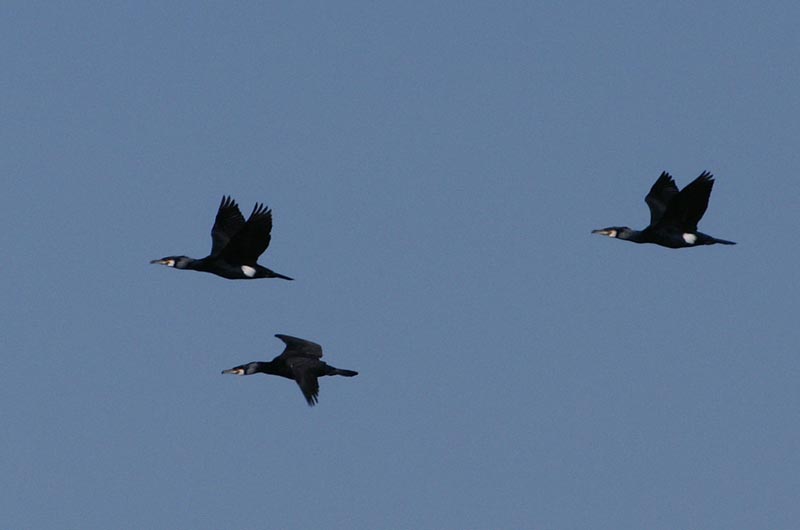
Flying adult great cormorants in breeding plumage.
The adult breeding plumage of the great cormorant is coal black with a white throat and hip patch and yellowish chin or gular pouch. In contrast, the double-crested cormorant is black with a greenish sheen and an orange chin or gular pouch. Sounds easy but it is not. You might notice the great cormorant has a block-shaped head while the double-crested is rounder, but it’s still tough unless the two species are together. Now to make things worse, the immatures are a bit confusing. The great cormorant has a gray neck and breast, followed by a white belly and a slight white patch behind the yellow chin. The double-crested cormorant has an all gray neck, breast and belly. If the light isn’t just right . . . well, you try it.
Normally the great cormorant has left the Vineyard by now to head north to its nesting grounds, which are on cliffs and ledges. However, on June 22, Lanny McDowell was able to take a photo of both great and double-crested cormorants on a rock off the beach at Great Rock Bite in Chilmark. What a great way to learn the differences between these two species.
The reason cormorants are not particularly well liked stems from this bird’s voracious appetite for fish. An efficient fisherman, the cormorants use their totipalmate (webbed between all four toes) feet for propulsion and squeeze their wings tightly against their bodies. They can swiftly dive to 10 feet and as deep as 30 feet in pursuit of prey. Often feeding with a flock of other cormorants, these birds can wipe out a school of fish in jig time. The fish consumed include haddock, cod, flounder, herring, bluefish, bass and an occasional eel or two. So if you were a fisherman or an osprey, would you like to compete with a flock of cormorants?
The best way to see one of the cormorant species is to find a jetty or rock pile where the birds are out and hanging their wings out to dry. The cormorant’s feathers are easily waterlogged, which helps them sink low in the water so they can stick their heads underwater to spy fish. However, once done fishing, the cormorants do not swim around; they get out to dry their wings.
Cormorants are long-lived species and can live between eight and 13 years, with one record of a 23 year old! They are attentive parents as both feed the chicks, and in hot weather they actually fill their gular pouches and crops with water and give their nestlings a shower to cool them off!
Bird Sightings
Flip Harrington and I spotted our first great blue heron of the season on Big Sandy in Tisbury Great Pond on June 24.
Tara Whiting was awakened by a belted kingfisher that brought her a small fish for breakfast. The kingfisher perched on the porch railing just five feet from her bedroom window on Tisbury Great Pond on June 24. Next door we had heard the kingfisher but had not seen it or been offered a fish!
Sarah Mayhew has attracted quite a menagerie of birds at her West Tisbury hummingbird feeder in the last 10 days: a ruby-throated hummingbird, a Baltimore oriole, a gray catbird, and, of all things, a downy woodpecker. Must be a good mix!
Karen Stanley heard a whippoorwill calling behind the youth hostel in West Tisbury during the last three weeks.
Portlandica plumage common and least terns were still being seen and photographed by Jeff Bernier and Lanny McDowell at Norton Point last week.
Patrick Mitchell called to report seeing an American woodcock on North Slope Lane in Chilmark, not once but twice last week.
Dick Jennings, while surveying the osprey pole on Oyster Pond Road, watched an American woodcock cross the road on June 21 — no doubt to get to the other side!
Jonathan Mayhew called last week saying he was observing a strange black bird with a heavy orangish bill. I suggested several options and Jonathan didn’t agree. Then I saw an email from Lanny McDowell saying that a tufted puffin (a West Coast puffin) had been seen for the first time in years on the East Coast in the Bay of Fundy. Flip Harrington and I took his boat up into Clam Cove and around Quitsa and Menemsha Pond, but never found the bird. We will never know!
Please report your bird sightings to [email protected].
Susan B. Whiting is the co-author of Vineyard Birds and Vineyard Birds II. Her website is vineyardbirds2.com.
Comments
Cormorants - not the native
Alex Friedman EdgartownCormorants - not the native species but imported ones from Asia - were housed by the thousands by the US Government during WWII in giant warehouses, fed by truckloads of fish gurry from New Bedford. This was for the War Effort, harvesting their guano for phosphorous, the essential ingredient in gunpowder. However, during the war, in the Pacific theater, the US forces came upon uninhabited atolls that were essentially mountains of phosphorous, and so they released all the captive cormorants. Used to captivity and being fed, most died. However, the scourge of cormorants we have today are the descendants of the few hardy individuals that survived.
They nearly destroyed all recreational and commercial fisheries in the Great Lakes until a cull was implemented. Cormorants are have also devastated aquaculture facilities around the country. They have NO PREDATORS. They are not a natural part of the North American marine ecosystem, and are voracious consumers of all species of juvenile fish. We brought them here, and when they were no longer useful, we turned them loose upon our estuaries and waterways. This is a human-introduced, invasive population. The scourge of cormorants is not a natural occurrence; it's a byproduct of military industry. Unchecked, cormorants will spell disaster for our coastal fish populations. It's time to restore the balance we so typically - and short-sightedly - upset in the natural world.
Alex,
Adam RichardsonAlex,
This is an interesting story, but it is almost entirely fabricated. The double-crested cormorant, which is the only cormorant species found away from the coast in North America, including the Great Lakes, is endemic to North America (found nowhere else in the world). It is impossible for a species to be both non-native and endemic in the same place. The story about phosphorous farms sounds far fetched, but plausible(?), however I have not found any information on this practice. Do you mind sharing your source? Great cormorants are found both in Asia and on the East Coast of North America, but as the article points out, they are native, generally only a visit our shores during the Winter, and in relatively small numbers. Great cormorants have not been responsible for the the vast majority of human-cormorant conflicts that you describe, real or perceived. I am not sure if you are deliberately attempting to spread misinformation or you are just misinformed yourself, but I suggest you revisit this topic and do some more thorough research before posting in the future.
My source for the phosphorous
Alex Friedman EdgartownMy source for the phosphorous farms was Paul Bagnall, Shellfish Constable for Edgartown - is he misinformed?
He, like myself, works on the water and witnesses first-hand the damage that Cormorants cause.
And I'm unsure as to which cormorant species would you like to discuss, as, like the author of the story, you seem to switch back and forth rather conveniently. You completely ignored my larger point, instead questioning my sources and semantic details. I don't advise turning an ecological and naturalistic debate into a personal one, and such a shift smacks of argumentative desperation. I stand by my words.
But without rancor, and in the collaborative spirit of all wanting a healthy and balanced ecosystem, I invite you and anybody else to come outside and observe nature - including your beloved cormorants - first-hand. Standing By
Add new comment