

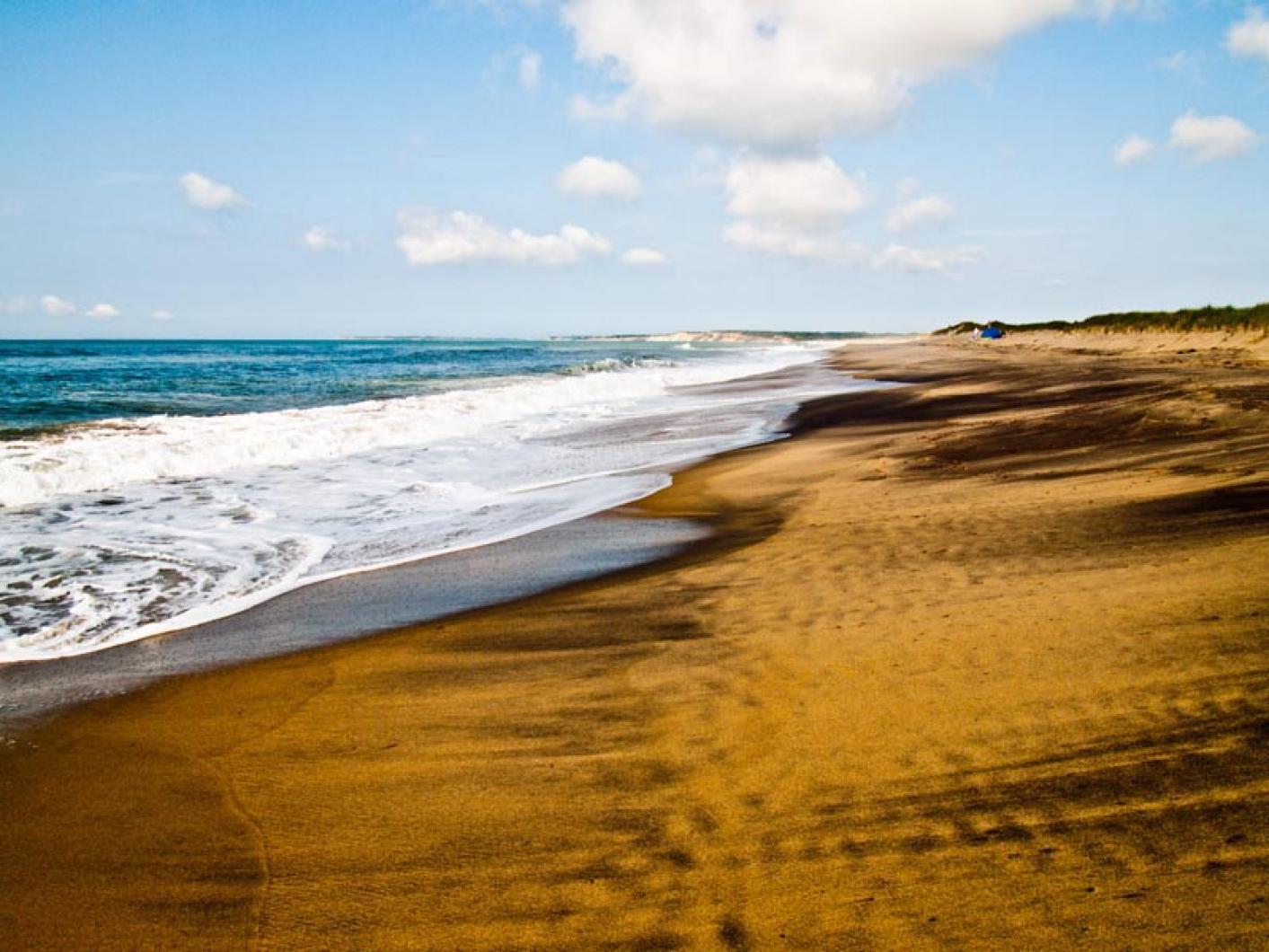
The story has it that 40 years ago this spring, Massachusetts state Sen. William (Billy) Bulger was on Nantucket and decided to go for a dip in the deep blue sea.
The story has it that 40 years ago this spring, Massachusetts state Sen. William (Billy) Bulger was on Nantucket and decided to go for a dip in the deep blue sea. As he went down to the shore and faced the horizon, he soon found out that lurking behind him was the devil, the one who came over on the Mayflower. In short order, Senator Bulger was summarily kicked off the beach. He had broken a colonial law trying to reach public water by stepping across private sand. Enraged, he asked the legislature and the courts for help. He might have had better luck asking his brother Whitey.
In 1641 the first families of the Massachusetts Bay Colony decided to lay down the laws. Of course, they did this after they took their colony name from the Native Americans who lived here, killed some, converted others to Christianity and took their land. This was an early example of a concept now called eminent domain.
Adapted as law by the General Court of the commonwealth was the following: “Every inhabitant that is a householder shall have free fishing and fowling in any great ponds and bays, coves and rivers, so far as the sea ebbs and flows within the precincts of the town where they dwell, unless the Freemen of the same town or the General Court have otherwise appropriated them, provided that this shall not be extended to give leave to any man to come upon others property without their leave.”
Eventually, this came to mean: “My property goes down to the sea and I can tell you to get off because I pay taxes on this swatch and you don’t.” In the United States this concept of beachfront as backyard applies only to Massachusetts and Maine, these two states being one unified territory back in 1641.
The first families allowed themselves beach rights, but since they were Puritans, they never used them for the pleasure to swim, surf, boat, tan, lounge or stroll. Beach rights meant fishing and fowling. In short, “my property includes my food supply.”
So they drew a line in the sand and then spent time, money and reams of yellowing paper defining conditions under which anyone else could cross it. The devil was truly in the details. After all, these were the people H. L. Mencken once described as having “the haunting fear that someone, somewhere, may be happy.” So today, towns use public funds to hire one party to stop a second party from entering the beach property of a third party. This is happening although the Puritans long ago faded onto the endangered species list, somewhere between Native Americans and moderate Republicans.
According to the Martha’s Vineyard Commission, about 65 per cent of our shoreline is now restricted, either held by individual landowners or beach associations.
Spending years rallying support, Mr. Bulger filed a bill to liberate the shores of Massachusetts. The bill would have given the public a right of passage up to the high-tide mark. Those water line boundaries have always been a source of confusion. First, property extended only to the high-water mark. Then it stretched from the mean high-water line to the mean low-water line. This was allegedly clarified to mean the rights went to any tidally exposed land out to 1,650 feet beyond the high-tide mark. Eventually these marks sounded like a Marx Brothers routine.
Equally mesmerizing are swimmers’ rights. You can swim through the waters of private property, but that’s it. According to a 1907 state court ordinance, a swimmer’s feet cannot touch dry land if it’s private. Heaven help those caught in a shipwreck or a riptide.
In 1991, the state Supreme Judicial Court gave Mr. Bulger a victory that was a bit pyrrhic. The law was changed to give the public the right to walk the shores between dawn and dusk, but first property owners would have to be compensated at fair market value for their de-privatization or deprivation. To follow through with this ruling, the state would have to sell Martha’s Vineyard back to New York or file for bankruptcy.
Financially, we seem stuck with this beach situation. Even if we tried a tax deal such as offering a landowner a rebate in exchange for an easement, each town would probably be up the public creek in a loss of operating capital.
So here’s your choice — if you want to tempt fate and walk along a private beach, you’d better be walking with a fishing rod on your shoulder and a creel belted to your waist. Or you can carry a blunderbuss and say you’re on your way to the Antiques Roadshow. Or you can buy a key to Quansoo at a cost in most states of a nice four-bedroom house on a half-acre lot. Or you can just rest your addled brain on a pristine public beach. By the way, pristine is an old New England term meaning devoid of concessions and plumbing.
Legal challenges will no doubt come up again. Meanwhile, colonial quaintness remains. Laws like these were written to establish a vagueness that could lead to misinterpretation, which could lead to fines, which could make the town coffers healthy. Hence, no new taxes. We are talking about people living in an era that justified dismemberment. Pity the poor uneducated transgressor who thought drawn and quartered meant depicted by illustration and housed.
If you ask me, never let folks who think dancing is a symptom of witchcraft create your legal code.
Arnie Reisman and his wife, Paula Lyons, regularly appear on the weekly NPR comedy quiz show, Says You! He also writes for the Huffington Post.
Comments
Wonderful piece, Always
Jeanne Barron West TisburyWonderful piece, Always wondered how we got to our strange and confusing rules. Guess I'll have to get myself a big fishing rod.
Informative, and fun, as
David Jensen AquinnahInformative, and fun, as always!
Loved it!
Nance CapeLoved it!
Loved this, Arnie. We don't
Karen Thomas Washington, D.C.Loved this, Arnie. We don't have this fol-de-rol on the Outer Banks. Xoxo, Karen
I speculate, since the tidal
David Wilson New BraintreeI speculate, since the tidal area which is part of a given property is of especial value, could not a much higher tax rate be assessed for just that portion of the property with appropriate exclusions for public minded owners who were willing to open said portion to the public. Of course, mind you I personally do not believe any one should be able to build within a half mile of the shore nor in subsidies for eroding seashores of private owners. Just a couple of thoughts.
Brush up your legal rulings
TrumanBrush up your legal rulings the mass district attorney extended high tide rights to bird watchers as well. So break out the binoculars.
One of your best, Arnie. And
Shelley Christiansen Oak BluffsOne of your best, Arnie. And a great example of why the real estate broker licensing exam ain't for sissies ....
Antiquated law that should be
AMECDC Vineyard HavenAntiquated law that should be phased out.
I didn't know this about
Sarah Mayhew West TisburyI didn't know this about birding. I found this: (Walking between Low and High tide mark) the right to hunt birds for sport or sustenance, on a boat or on foot. (Although there is no court decision on point, the Attorney General maintains that this right also covers bird-watching.) http://www.boston.com/realestate/news/blogs/renow/2012/07/private_beach…
So if the laws are as written
Paulli D EdgartownSo if the laws are as written, then the 'public' who do pay taxes and do not have access to these beaches or walls that are on private property should never be asked to contribute a towns tax money to refurbish a beach or replace a sea wall.
Anyone ever notice how many "Private" signs are on MV? Roads, etc. You have to wonder if they are private or just put there.
This article is full of so
Steve McQuiggan ChilmarkThis article is full of so many holes I don't know where to begin. Mr Reisman didn't research it very well, that's for sure.
And so will you kindly fill
Steve F Chilmark & CambridgeAnd so will you kindly fill in those "many holes" for us?
Just jump in the water and
IlluminaraJust jump in the water and say you are "navigating" worked for me as a kid on MV....
Say you are looking for
David ChilmarkSay you are looking for piping plover and you're probably covered :)
North Korea and Cuba are a
BarryNorth Korea and Cuba are a couple of fun places where there are no property rights. If you guys want property, go work and pay for it, don't whine for it.
All beaches are public access
Bill Henderson Chapel Hill, NCAll beaches are public access in California. In effect, you can walk right through the backyards of the rich & famous. Which makes it awkward for celebs in Malibu Colony. Bruce Dern would periodically clear gawkers by firing a tennis ball out the back door, releasing his German Shepherd, Isis, and yelling "Fetch."
I met William Bulger in
taipeirI met William Bulger in Nantucket once, in the 90s, but didn't know who he was at the time. Interesting story.
Add new comment