


What are needed to save the striped bass in this state and coastwide are not minor logistical adjustments, but rather wholesale changes to the overall management strategy.
On the morning of Feb. 18 the Massachusetts Department of Marine Fisheries held a forum at the Katharine Cornell Theatre regarding several fisheries management issues, among them potential regulatory adjustments pertaining to the harvest of striped bass.
Several relatively significant changes were discussed including reduction of bag limits and fishing days, limiting the ability of captains to harvest bass for sale during for hire trips, lengthening the fishing season to compensate for the reduced days and the institution of a point of sale tagging program to allow the state to better monitor catch statewide. Most of the theoretical modifications were relatively well received by the fishermen in attendance, most of whom curiously seem to think that there is little problem with striped bass stocks in general, but rather that the fish have relocated from our waters here on the Vineyard (and almost everywhere else in Massachusetts for that matter) to those of Chatham off Cape Cod because of a proliferation of forage in that area (not because they admittedly harvested millions of pounds of striped bass out of the waters off Gay Head during the fisheries heyday in the late 1990s).
Unfortunately however, the 800-pound elephant in the room — the fact that the population of wild striped bass is on the brink of collapse much like it was in the early 1980s — was never discussed. What are needed to save the striped bass in this state and coastwide are not minor logistical adjustments, but rather wholesale changes to the overall management strategy. The first step in that process is to immediately cut the commercial quota in half and make striped bass a closed-access fishery (grant no new licenses and make those who hold licenses currently prove that a significant portion of their annual income generates from striped bass fishing). The commercial quota currently stands at over a million pounds in Massachusetts. At the average harvest size that’s roughly 60,000 individuals, all of which are broodstock females, as male striped bass generally do not reach the minimum size allowable for sale. Think about that for a second; that’s roughly 120 times the amount of fish taken in the Martha’s Vineyard Striped Bass and Bluefish Derby last year harvested in a little over two weeks in July. It’s just too big a burden for the current biomass to bear and it needs to stop right now, before it’s too late. All the potential changes discussed at the meeting are completely useless (from a conservation/management perspective) unless the quota is significantly reduced. A million pounds is a million pounds regardless of which days of the week it’s caught on.
Anglers up and down the East Coast are pledging to keep only one striped bass a day.
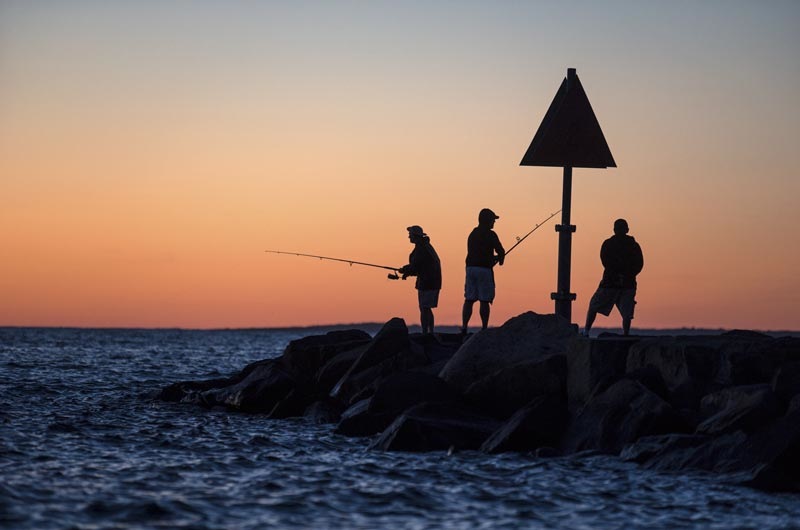
Anglers up and down the East Coast are pledging to keep only one striped bass a day.
The challenges facing striped bass are multifaceted and commercial fishing is in no way, shape or form solely at fault. The recreational regulations need to be completely revamped as well. The current limit for recreational anglers in our state is two fish per angler at 28 inches. This bag limit, much like the commercial quota, should be reduced by half. By reducing the bag limit from two to one fish you instantly reduce mortality by 50 per cent. That’s a big deal and this step is likely even more vital in the short term than the reduction of the commercial quota.
Furthermore, the recreational size limit should be increased to 32 inches. There’s a movement going on now in the recreational angling community called the 1@32 Pledge in which anglers all along the eastern seaboard are pledging to only keep one fish a day at 32 inches, regardless of their given state’s regulations. I’m participating in this initiative, as will be every client who steps on my boat this season. I’d encourage all to do the same. It is progressive action like this that just might bring about the realization amongst officials in this state and others that the time to act is now. More information on the pledge can be found on Facebook.
Alex Friedman, president of the Dukes County Fisherman’s Association, on multiple occasions during the forum referred to striped bass as a sustainable resource. With this statement, Mr. Friedman, I must adamantly disagree; under the current regulatory structure they most certainly are not. This was proven when the population crashed 30 years ago and is being played out now before our very eyes all over again. It’s not to say that the striped bass population can’t remain viable and sustain limited commercial and recreational harvest, but how the fishery is currently being managed is irresponsible, plain and simple, and has us on the fast track to another collapse. Instituting the aforementioned reductions to commercial and recreational harvest and closing access to the fishery are logical and practical first steps in finding out if our beloved stripers can rebound again and continue in their role as the great American game fish to be enjoyed by generations of anglers to come. I for one have faith that they can, but not unless quick and decisive action is taken.
Capt. W. Brice Contessa lives in Edgartown.
Comments
1@32
AAH Tashmoo1@32
I commend you Mr. Contessa.
Vincent Fiorillo Long Island, New YorkI commend you Mr. Contessa. I hope you lead the way with a simple truth. If the fish are not around the fishing industry that depends on them will be gone as well. Well done and spread the good word. After all our sport is "fishing" not "catching." I wish you a successful season that your charters bring home the memory of a great trip with you at the helm!
2@40!
Lou Wareham2@40!
Albert, WOW! what a great
richard toole Oak BluffsAlbert, WOW! what a great shot. I am glad to hear a fisherman seriously speaking about long term sustainability.
What about the livelihoods of
Dan ChilmarkWhat about the livelihoods of the fishermen in the industry? What about the other fishing fleets from other states and abroad that come into these waters and catch their fill? And what kind of math are you doing when you say that the species is in critical condition, but if we just kill 1/4 of the fish every year, instead of 1/2, they'll rebound? You’re already past the point of rebounding if the stocks are in critical condition.
Look folks, this is a painful reality. We need fish AND we need fishermen. One doesn't exist without the other. And to make this work, you need to put a paid moratorium on fishing for 3-5 years. Think of it like the Farm Bill's subsidies to farmers. They pay farmers ten of thousands of dollars apiece each year to NOT grow crops to keep the prices stable. In order for the fish to rebound, they need a sustained number of years to grow, reproduce, and grow again. Then, small increments of fishing can be re-started to get the fish onto plates while maintaining the inventory. But you need to preserve the fleet as well. Yes, this means paying licensed fleets to stay in harbor for 3-5 years. At taxpayer expense. Yes, it's crazy. Yes, I fume at the thought of having to pay people to do nothing (I hate welfare too), but the only solution to preserving the fish is to protect them from fishing until they are able to rebuild their numbers. Then, when the stocks are back to a growing norm, you can start to re-introduce commercial fishing to the area. This will be costly, folks. It will hurt. It will give some people the ability to stay home and do nothing while taking a paycheck (much like welfare does), but unless you take an approach of artificially growing billions of these fish, from each species, growing them in oceanic fish farms, and releasing them, each year, the fish WILL BE GONE.
It's a matter of what you NEED to do, not what you WANT to do. We need fish and fishermen, but to have them, it will cost us.
Brice you are on target every
mike edgartownBrice you are on target every year there are bass at the oak bluffs dock until commercial seasons comes and with in two days after the boats tie up to the piers and snag the fish there are none left and for the rest of the summer into the fall there are no fish around. The last two years the commercial fishery has gone over its quota and they show no sign of letting up. I recognize some people make a living catching fish. But for every one of them there are ten others who make a living off the recreational fisherman. Keeping the fish around helps this economy a lot more then the fish sold on the fish market.
The little noticed line in
Albie Scott NewburyportThe little noticed line in the article "lack of forage fish". Coastal herring have become more or less non existent North of the Cape, and I imagine waters to the South are also suffering from the same problem. When the NMFS opened inshore waters to large scale herring fishing, the bluefin tuna disappeared within several years from their historical haunts along the coast. No herring, no tuna. And since the stripers also like a good dish of herring...............
1@32. I am in, and could not
Pauli Edgartown1@32. I am in, and could not agree more with the captain.
I'm very happy to learn that
Ned B. E'villeI'm very happy to learn that Capt. Brice is taking the 1@32 pledge and holding his clients to it. I agree that a prudent strategy is to implement immediate strict limits and/or a moratorium on striper catches as to provide a satisfactory tme for the populations to recover. Over fishing in striper prey fish populations, i.e., menhaden, and herring and the negative impact of climate change on the reproductive cycles of stripers and their prey fish are added variables that make any long term sustainability model for stripers more complex. One thing for sure, I have to work a LOT harder to catch a keeper now than I did in the 70's, 80's, or even five years ago. I'm taking the 1@32 pledge. Let's keep each other honest and educate folks who take shorts or more fish than they can possibly eat. Around Boston there are serious problems with locals taking shorts. I wish there was more presence of fish & game to monitor catches and enforce deterrents that would diminish or eliminate poaching and excessive catches. I crush all my barbs and release everything I catch unless...it's the keeper of a lifetime. I'm still hoping for a +50.
1@32. Circle hooks or no
Frothandbubble1@32. Circle hooks or no barb. Catch and release any 'cows' unless it's a trophy.
Add new comment