


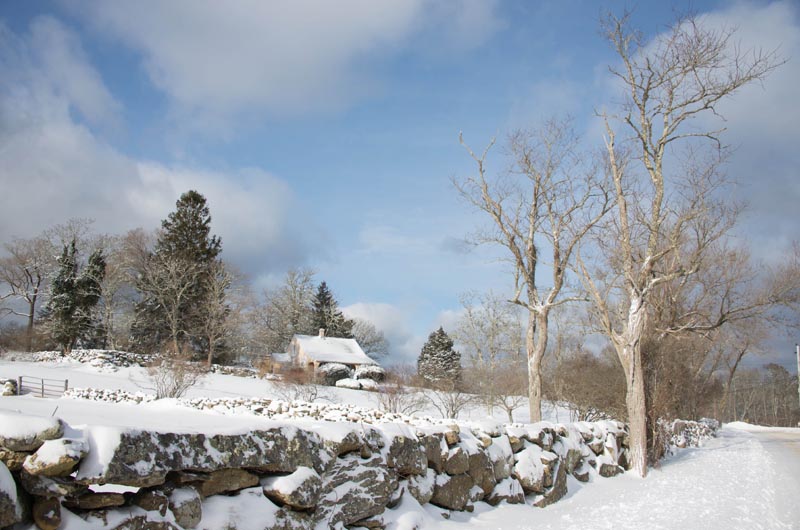
With the much-discussed big-house bylaw now a fact of life in Chilmark, discussion at the town planning board this week turned to preservation of historic houses.
Pamela Goff, who owns a pre-Revolutionary house off Tea Lane, asked the board to consider an amendment to the bylaw approved by voters last year to regulate very large houses. The first-of-its-kind bylaw could have the unintended consequence of actually encouraging people to demolish old houses instead of preserving them, Mrs. Goff said.
“I’ve been going over the pre-Revolutionary and pre-Civil War houses listed in the master plan and it made me realize how many of them are essential to the look of Chilmark,” she said. “These old houses are very important to the town and important historically.”
Mrs. Goff said there are five or six properties with pre-Revolutionary houses “in transition,” either on the market or recently sold, and she was concerned what would become of them.
“In the last 15 years we’ve lost five houses,” she said. “For 250 years they lasted and in five years of extreme wealth they were gone.”
The so-called big-house bylaw requires a special permit process for houses that exceed 3,500 square feet on a three-acre lot. Home size is capped at 6,000 square feet per three-acre lot. Existing homes that exceed the threshold are allowed a one-time exception to increase the living area size by five per cent.
Mrs. Goff wondered whether some sort of exemption should be contemplated on the square footage limits to help preserve historic structures.
“How do we give the owners some little incentive not to tear them down, something that might give them the incentive to keep the houses up?” she asked. “I’m afraid with the stripped-down square footage allowed under the new bylaw that people have the incentive to tear them down and have additional square footage in a new structure.”
Planning board chairman Rich Osnoss agreed.
“It would at least show some intent on our part,” he said. “I certainly value it and I think other people in town do too. There’s so much character there.”
Kate Warner, a West Tisbury architect who attended the meeting, questioned whether a square footage exemption was the best approach since it would create a loophole that could possibly be abused.
“I’m worried if you give an exception on volume,” she said.
There was also discussion about creating a fund to help Chilmarkers maintain and restore historic homes, perhaps using Community Preservation Act funds.
The board agreed to ask the subcommittee currently working on the Squibnocket beach project to expand its responsibilities and explore amending the bylaw — with discussion to be continued.
In other business, a public hearing was held on amending the Squibnocket district of critical planning concern to clear the way for the upcoming public-private project at the town beach. The hearing was continued.
Comments
Pamela's concerns are valid
Jim Powell West TisburyPamela's concerns are valid and need to be addressed. Certainly, if the powers that be (town planning boards, MVC and realtors) want to preserve "the rural character of the Island", and I am sure that they do and have done a wonderful job in the past, they will make sure that provisions in their town and DRI checklists encourage preservation and restoration of essential elements of Island architecture, it's cultural history and lifestyle.These provisions should also include incentives to present and future homeowners so as to ensure the irreplaceable value on these Island treasures.
I can only see regulations
paul adler west tisburyI can only see regulations relative to preserving old homes within visual distance of a major road. But was is equally important is energy savings, especially of larger homes. The least disruptive is solar power, and maybe geothermal. If a mandate is needed, it should be for energy savings and production.
I live in a town with a very
Caroline New YorkI live in a town with a very strong preservation group. One of my neighbors has a barn that has fallen into disrepair; the structure is quite old, old enough for the town to call her and tell her she has to restore it, that it is "historic". The homeowner is old, lives alone, has a limited income but was forced to hire a lawyer and fight the town. The town expects her to completely restore the barn, telling her its a blight, and further, that the age of the barn merits complete restoration.
In a perfect world, when everyone has money to restore old barns, sure, it would be nice to see this from imploding. But the homeowner is now being forced to comply, even though she filed for financial hardship in the case and was turned down. It's a crime.
I tell this story as a warning for all of those who feel historic preservation is really all fun and games. Be careful what you wish for.
I agree that these historical
Dan OBI agree that these historical buildings should be protected and restored to help preserve our history. These houses add to the charm and aesthetics of our island and remind us of simpler times.
However, on the flip side I find it makes no sense to keep these old, poorly insulated, energy wasting structures standing when a new, solar powered, nitrogen reducing, super efficient structure can be built.
New buyers will approach these properties from two angles- either buying them because they want to preserve the structures, or because they want to demolish them and create new efficient homes. Either way, I don't feel it's the place of the government to decide how one develops their land. The King of England tried that once, and we all remember how that turned out for him.
Instead of more regulations, perhaps our committees can work with the new homeowners to ensure that regardless of whichever path is taken, the structure will continue to benefit our community.
These replies use this
Nancy Salzman Chilmark and Cambridge, MAThese replies use this current Historic Preservation crisis as a handle to hype their current energy crisis solution...bypassing the Irreplaceable Structure Issue. Historic Island homes are too unique and valuable (for our Nation) to be thrown away because they do not fit the latest Fad heating technology. Under that argument, coal, gas and woodstoves pollute as well....and what will come next? Would this thinking justify destroying antique ivory scrimshaw because TODAY such harvesting of ivory is now known to endanger that species?
Protection of the Story and Landscape Beauty of these objects should be the prime concern: This is Chilmark's identity!!
The MVC DRI Checklist that
Fred Hancock Oak BluffsThe MVC DRI Checklist that went into effect May 1, 2013 includes the following:
8.2 Demolition or Exterior Alteration of Historic Structures:
The demolition or exterior
alteration of any structure that:
i)
has been identified as having historic significance by a local historic commission or
architectural commission, by a general plan of
the Town, by the Massachusetts Historical
Commission, or is listed with the National or Ma
ssachusetts Registers of Historic Places; or
ii)
is more than a hundred years old – with MVC concurrence.
This goes back to my original
Caroline New YorkThis goes back to my original comment. Let's say you own a historic building on property that you inherited (a very likely scenario on the Vineyard). Your grandparents may have had the money, maybe so too your parents, but you don't and the structure has fallen into such disrepair that it is about to fall down.
1. Does the MVC have the authority to force the homeowner to repair?
2. Is there a clause for claiming financial hardship?
3. Does there exist a map at MVC or elsewhere of buildings already deemed historic on private property?
4. Are homeowners notified by certified letter that they own one of these buildings and are told they are now required to keep it intact?
There are a lot of serious questions here. I repeat, in a perfect world, we'd have lollipops and rainbows, and historic buildings that are never torn down or falling in. But what right does the homeowner have?
Add new comment