

They are the Island's most vulnerable but invisible population. And with an inadequate safety net for the homeless, members of the clergy and county administration are calling for an Islandwide response.
They sleep in vehicles, garages and on other people’s couches. They squat in summer homes and pitch tents in their friends’ backyards. They are the Island’s homeless, the community’s most vulnerable but invisible population.
And the safety net to protect them is inadequate, say members of the clergy and county administration, who are calling for an Islandwide response to the increasing number of people facing the crisis of housing instability.
When she first started as associate commissioner for the homeless on behalf of Dukes County in 2008, Connie Teixeira knew of only a handful of individuals experiencing homelessness.
Since then, the number rose to 117 in January of 2013, and this year it is estimated at 160. And she’s certain there are others she has yet to identify.
The group includes about 20 people waiting for elder housing, and 80 unemployed men in the construction trades. There are two families living in cars and a man living in a bus. About 30 are young people between the ages of 18 and 30 who sleep on other people’s couches and in their unheated garages.

Connie Teixeira, associate county commissioner for the homeless.
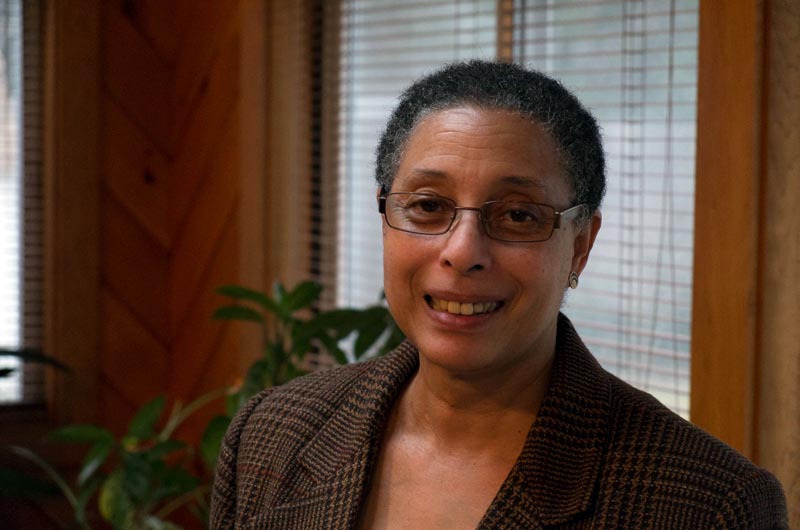
Connie Teixeira, associate county commissioner for the homeless.
Some commit petty crimes just to spend a night in the warm county jail, she said.
Though many do not sleep outside every night, even when they do, they can be difficult to locate, Ms. Teixeira said.
“We are now just getting an element of trust,” she said, describing the trust as tenuous.
She’s been working to develop relationships and penetrate the underground community of the homeless, but she said the Island poses unique challenges.
David Vigneault, executive director of the Dukes County Regional Housing Authority, agreed. “The smallness of the community, which can very much be a benefit, can also be a deterrent,” he said.
When the weather turned bitterly cold at the start of the year, Ms. Teixeira faced an even graver challenge in catering to the needs of the homeless population.
Since the jail purchased new blankets, she has been able to acquire its old blankets, fit for Antarctica, she said, to pass out to those in need.
But her other resources are insufficient.
A county fund allots her $1,000 per year for hotel vouchers, to put people up at a local hotel for a temporary stay.
The program has met some success addressing some temporary housing emergencies, but often only one hotel room is available at a time, she said.
Sometimes she negotiates a lower rate with the hotels so that the person can afford the room on their own, which helps to preserve some pride, she said.
She’s found other funding sources in the Island faith community, with which she maintains a discretionary fund, available to help people in their homes pay rental assistance and heating bills. Others she sends to Hyannis, arranging a taxi to pick them up in Woods Hole and deposit them at a shelter by noon, when guests are advised to line up for admission.
In Hyannis people can get connected to the services and government programs that help them find long-term solutions.
Last year about $20,000 was donated to Ms. Teixeira’s cause, mostly by churches and private donors.
Members of the clergy stress that the plight of the homeless on the Island is compounded by the lack of emergency housing and advocacy.
“There are not a lot of places to go that are safe, and money is tight all over,” said Richard Rego, pastor at the United Methodist Church of Martha’s Vineyard.
He and another 17 members of the Island clergy group met Tuesday to discuss their plan of action for tackling homelessness, creating shelter on the Vineyard, and hiring and training a professional caseworker.
They also would like to work toward establishing transitional housing to function as a temporary shelter for those caught in an emergency housing situation.
At the county Ms. Teixeira has a title but no office, and no pay. Her volunteer role is daunting and she often feels unequipped to meet the needs of the population she serves.
She and members of the Island clergy will take the issue up with the county commission next Wednesday, and hope to approach the selectmen of each town in the coming months. Ideally they would like the towns to absorb some of the increasing public cost associated with people who are homeless.
In 2010 the last of the state funding dried up for transitional assistance and casework.
Starting in the 1990s, a limited number of transitional units were available.
But funding sources are long gone due to state and federal cuts, Mr. Vingeault said.
He and other Island groups are working to better accommodate the need in the lowest income brackets, to increase the housing available and to dole out more subsidies.
“The need for housing on Martha’s Vineyard is critical,” said Jessica Burgoyne, executive director of Habitat for Humanity, an organization that offers zero per cent interest mortgages to people on the lower end of the area median income scale.
“Habitat is doing everything and anything it can to grow its capacity to be more of an affordable housing developer on the Island.”
The annual homeless count will be conducted on Jan. 30.
Comments
We have had homeless people
Carol Lashnits VHWe have had homeless people on the Vineyard at least since the 70's. Living in substandard or condemned housing, paying a much too large % of one's income for rent, etc. were at one time priorities for the HUD subsidized IEH apts. for years. We made a major mistake by eliminating those federal preferences and should re-instate them. We are not Boston which has a least a few shelters for the homeless but try telling the HUD folks that. Re-instating Federal Preferences would automatically move the homeless folks up the list above others not in such dire need. IEH over the years has accepted at least 30 people who would now be homeless....or dead. Sometimes I bent the rules a little but the hospital did that, as well....as did the jail. A lot of the homeless don't have credit. Any criminal records are often so that they can get arrested and get to spend a cold night in a warm jail.Don't look to the Cape for answers. We have to find our own solutions. Churches and non-profits could help if they weren't afraid of liability issues. We've been talking about that as a possibiliy since the 80's. These agencies which have large community rooms, for ex., can hire a "babysitter" if they're nervous. Build more RENTAL housing, use the available 2+/- acres still unbuilt on at Woodside to develop more elderly housing. Do you know for sure that there is no federal money. I don't believe it. Really, this is just another example of a lot of talk, talk, talk and not much action. We're good at that but it doesn't help people. It will get worse until we DO something and stop bemoaning the fact that suddenly a few people are becoming aware of a long time problem. We are very good at preserving land, but not very good at preserving our Islanders. I know I sound like a broken record....I just wish that someone would look into creative solutions!!
This is a national problem
Caroline New YorkThis is a national problem Carol. Homelessness happens from Hawaii to Maine and everywhere in-between. In rich cities, in poor cities, in cities with churches and non-profits that do lend a huge helping hand, but the only thing that will solve the underlying problem is Jobs.
I might suggest each Vineyard business owner look to hire one homeless person, give him/her a job that gets them out every day, even a small job will get them a reward at the end of the week of a paycheck. I know, I lived there for twenty+ years, small paychecks don't pay the rent, but feeling useful goes a long way in the mental component of overcoming being homeless. I've been gone for a while so help me out here. Is there a community center where homeless can shower, be fed? Or a food pantry?
Carol, I'm more apt to agree with your opinion that the help comes from on-island, not federal dollars.
Yes, Caroline I totally agree
Carol Lashnits vhYes, Caroline I totally agree with you that jobs are important! With rentally assisted housing, what income you have is irrelevant, however. A lot of our homeless are elderly and/or disabled - not that that makes them ineligible for a job but yes it would help with self esteem. And there are several community centers, the YMCA, etc. with shower facilities as well as several food pantries and soup suppers throughout the winter practically daily. All that is good. Again, lots of talk, not a lot of offering to solve the problem. The housing trust people are wondering what to do with that house that was given to them near Stop and Shop in VH. Turn it into a single room occupancy house - that would be a start, at least. Let's stop building houses for moderate income folks and do more for those who are jobless, homeless, poor, etc.
You are not a broken record.
jack schimmelman vineyard havenYou are not a broken record. the first step is to ensure that poverty on this island, which includes poverty and homelessness is acknowledged by the majority of our community. With acknowledgement we may be able to create dynamic solutions.
SIPS buildings /(Structural
Frank BrunelleSIPS buildings /(Structural Integrated Panel System) buildings offer a lot for the money. You can build a 650 sq ft. building with very high insulation values - completely done with wiring and plumbing for around 100,000 if you do it bare bones. It would fill the need, adding a pellet stove and some solar panels and maybe a heliostat for daylighting and the island could have excellent quality housing for seniors and indigent people.
Frank - We already have good
Carol Lashnits vhFrank - We already have good quality housing for seniors and some disabled at IEH - If it's true that there are only 20 people on the waiting list, with 165 apts. that's nothing. Sometimes you have to go down 5 people on the list before one says yes. That's why I think we need to go back to the federal preferences which puts the neediest at the top of the lists. But people who don't meet the criteria for IEH are the ones primarily who are homeless. The late Freddie Ferro thought we needed trailers for folks without housing - maybe on county land at the airport? - I laughed at him but maybe he was onto something. I like your idea of pre-fab bldgs. What did the county do with their unexpected surplus of funds l
ast year? This would have been a good use.
Carol, thanks for the info.
Frank BrunelleCarol, thanks for the info. SIPS are not pre-fab buildings, but instead are engineered according to your specific drawings by the company, and the components are manufactured at a plant, shipped flat and then assembled on site using a crane. This makes for a far superior product to a pre-fab design. The building I have for a studio is made this way and is extremely tight and well insulated. I heat it with a P-38 pellet stove and can get by with a third of a bag of pellets per day in this kind of weather. When very cold, it takes a bit more. The company put the building up including all the doors and windows in three days. The costs for this type of construction can be far less than traditional stick frame buildings and are in my view very suitable for affordable housing. I use the building without having added wood, or tile, or carpeted floors but only the oriented strand board under-layment it was shipped with. It can of course be modified at any time, but a this is perfectly acceptable. The walls are not sheet rocked, but plastered and the electrical is not in the walls but on top of the OSB board in approved conduit. It is a bit industrial looking, but the cost ends up being about $135 a sq. ft. as opposed to the Vineyard average of about $350 per sq. ft. that the insurance company told us was the average value they go by. In addition, there are some easily installed electrical changes that can make it more economical. The circuits that control stereo, and television for example are all connected to the same master switch that turns the lights on and off. So when you leave the room, everything that was on goes off. Very simple and this is common in Europe. I use LED lighting and ended up purchasing all of the lighting for this and and some other buildings and businesses from China and had them all shipped in at once. Now, you can get the same prices on Amazon for LED and this cuts the costs down radically for lighting. And, we are using heliostats for daylighting and warmth on sunny days using a new method that does not require as much equipment but can be operated simply and manually with very minimal up-front costs. There are lots of ways to save money and improve the quality of life using solar, not just PV. And finally, we have an automatic transfer switch that can transfer the electrical power to operate on battery power if power goes out. With 20 lights going the draw is still only 100 watts and so we can go quite long in the event of a power outage and the pellet stove can stay on for a while, though we have never had to test it yet. But using LED gives another measure of security and comfort. Any complaints about the warmth of LED lighting can be corrected using common photographic gels that come in all degrees of color correction and are available in sheets inexpensively for those who wish to. We use them in our home, but in my studio I am quite satisfied with spot lighting. This housing is not cheap housing, it is inexpensive, extremely comfortable, quick to put up - and engineered to much higher standards than stick frame buildings. My studio is rated for 140 mph winds. Walls are at least R-40 and the roof R-60 approximately. I boost the insulation by adding polyisocyanurate (iso) in the backs of some of my paintings adding another R-10 to the R values in the walls, and some paintings are done on the iso itself which can then be used on the outside walls provided they are foil backed both sides for weather and fire protection and protected with marine varnish. This last step is not particularly effective on a large scale but on the other hand every bit helps. And why not? The other advantages are that the buildings get assembled as fast as pre-fab. Mine took three days. Any person who wants to have one of these can either draw what they want in rough fashion, send the drawing to the company, they will engineer it and the owner can then get it approved by building and zoning. A stock design from any book can be chosen and modified if wanted. All of this cuts costs enormously and the SIPS is rated for 140 mph winds. Stronger, better insulated, less cost to build, less cost to maintain, goes up flawlessly, no worries about contractors as whatever company is chosen supplies trained bonded workers. The electrical, plumbing, sheathing, and trim are all done by local contractors and any cabinets, flooring, drapes, blinds etc. as needed. It is also possible to save on lumber by using sawmill grade lumber shipped directly to the site and milled on site using simple tools. Finishes can all be non VOC (volatile organic compounds) and should be using SIPS and an air filter is needed because the buildings are so tight.
As a long standing visitor to
Val Bates Edinburgh, ScotlandAs a long standing visitor to the Vineyard, I cannot tell you how much this upsets me...or how little it surprises me. Until society does more to help the vulnerable and those in dire straits, there will always be homeless people amongst us. It is just that the contrast between rich and poor is nowhere more obvious than the Vineyard.Let's hope more can be done to assist people, particularly in the winter months.
Homelessness does not always
flyboy42 edgartownHomelessness does not always equate with under employment or unemployment especially on Marthas Vineyard. The true solution is community stabilization through home ownership. Are transitional sevices needed? To some degree, yes. As a long term solution, no. Home ownership brings a multitude of long term benefits to the entire community. For the cost of a rental unit a family would most certainly qualify for a Habitat for Humanity home.
To what Val said above, it's
Caroline New YorkTo what Val said above, it's sadly ironic that today Michelle Obama treats herself to a huge birthday party at the expense of us taxpaying have-nots. Wouldn't it have been a gigantic statement of her spoken disdain for income inequality to fund a homeless center on the Vineyard, her second home? Oh well.
Like Barney Frank, I believe
Carol Lashnits vhLike Barney Frank, I believe in rental housing. We are not talking about "community stabilization". We are talking about individuals in desperate and immediate need. Home ownership is a very expensive solution. Taxes, maintenance, not to mention a mortgage or home equity line of credit can kill you. That IS their solution but it doesn't help the very low income folks. Was that last comment written by a member of the affordable housing trust or the housing authority? Why won't people sign their names?
Alot of us are one property
Ken EdgartownAlot of us are one property tax payment from being homeless. Please dont expect those barely eeking out a living to support the homeless. We dont have a free market economy anymore and alot of people are hurting. Let the charities help these people and leave property taxes alone.
Tax the weekly rental.
Donald Muckerheide Oak BluffsTax the weekly rental. Realtors get 15% of the take. The residents deserve 5% or 10% to mitigate the effects of the inflated home values the illegal commercial use of residential property creates.
The reality is that MV is
MoredogsonMVthankidsThe reality is that MV is very liberal and many residents want to tell others how they should live, but those same people have failed to look after their own communities. I have found, across the country, that some of the most liberal communities have the worst problem with homelessness, such as Ann Arbor, MI.
Liberals don't realize what it takes to actually HELP people.
So, @moredogsonmvthankids,
Jack Schimmelman Oak Bluffs, MVSo, @moredogsonmvthankids, what does it take to actually help people.
Add new comment