


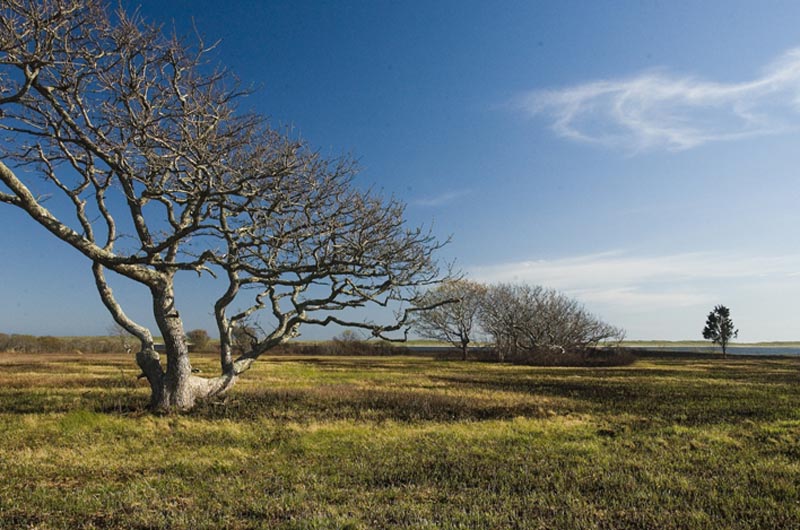
In Massachusetts, land used by a charitable organization qualifies for a tax exemption under state law. But a recent case in the town of Hawley, now going before the Massachusetts Supreme Judicial Court, could have wide implications.
A case before the Massachusetts Supreme Judicial Court over whether a piece of forestland in the Berkshires can be taxed is being closely watched by conservation groups on the Vineyard, who say it could have wide implications here.
The case between the New England Forestry Foundation and the small western Massachusetts town of Hawley dates to 2010 when the Hawley board of assessors refused to grant the forestry foundation a tax exemption on about 120 acres of land it owns. The town sent the forestry foundation a $172 tax bill.
The foundation appealed the decision with the state appellate tax board, which found in favor of the town. The case was later taken on appeal by the state’s highest court, which heard arguments on Monday this week. A decision is pending.
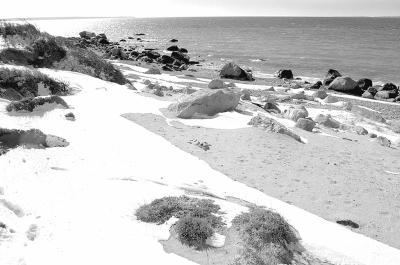
Whether conservation land is considered "occupied" is one issue.
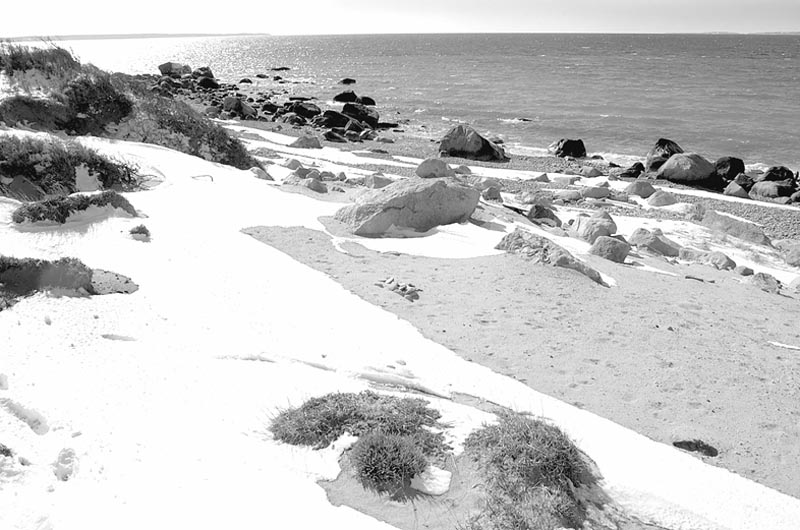
Whether conservation land is considered "occupied" is one issue.
In Massachusetts, land used by a charitable organization qualifies for a tax exemption under state law. But the town of Hawley argued that lack of access and use of the forest made it ineligible for the exemption.
“The property owner’s failure to demonstrate active use of the property destroys its eligibility for exemption,” town attorneys wrote in their brief. They further quoted the appellate board, which said in part: “Simply keeping the land open and allowing its natural habitat to flourish is not sufficiently charitable.”
According to the town, the appellate tax board ruled that the forestry foundation did not appropriately qualify as a tax-exempt charitable organization and the property had insufficient public access to qualify for a tax exemption.
In their brief with the court, attorneys for the New England Forestry Foundation disagreed, saying the foundation exists “for the purpose of protecting the natural beauty, biological integrity, recreational availability, and long-term viability of the land. This purpose — forestland conservation — has long been recognized as a charitable activity in the commonwealth.”
The foundation further argued that it qualifies as a charitable organization and occupies the forest by protecting it from development and actively managing it through an ecologically sustainable forest management plan.
Friend of the court briefs have been filed on both sides of the case. Conservation groups have sided with the forestry foundation, while the Massachusetts Association of Assessing Officers has sided with the town in the case, which also involves questions about the value of open space.
Vineyard conservation groups are taking special note. According to the Martha’s Vineyard Commission’s 2009 Island Plan, 36 per cent of land on the Island, or 20,720 acres, is protected open space.
“It’d be very serious,” said Adam Moore, executive director of the Sheriff’s Meadow Foundation, which owns or has conservation restrictions on more than 2,800 acres on the Island. “If all these lands that are held in conservation by conservation organizations were found to be subject to property taxes it would be terribly expensive. It’d be financially ruinous. Not just for Sheriff’s Meadow, for all the different groups. Not just on Martha’s Vineyard but throughout the commonwealth.”
On the subject of public access, Mr. Moore said Sheriff’s Meadow works hard to provide access to most of its properties. “I think there are so many different values to conservation land — the provision of public access is a very important one,” he said.
The Island has more than 20,000 acres of protected open space.
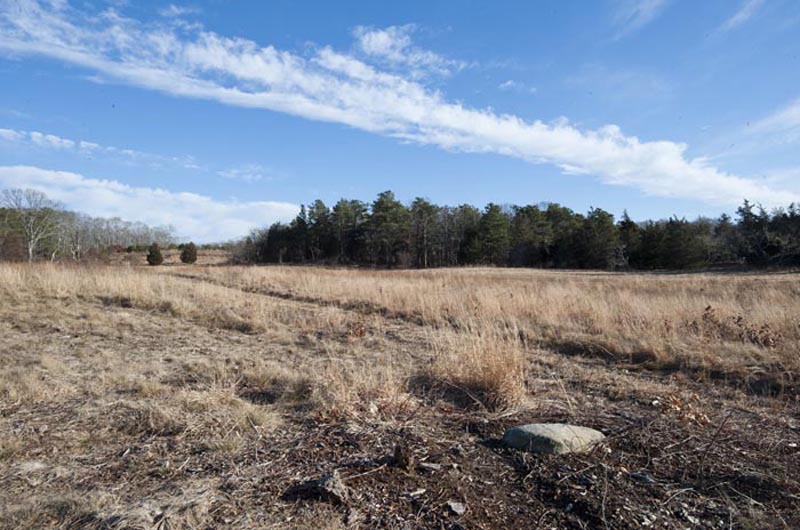
The Island has more than 20,000 acres of protected open space.
But he said there are other benefits too. “They provide wildlife habitat, they offer scenic views, they protect natural resources, they protect trees and rare plants and offer places for rare birds and wildlife and common birds and wildlife that we enjoy every day . . . there are so many benefits to conservation that all of these lands provide,” Mr. Moore said.
He said that Sheriff’s Meadow has been questioned about but never denied a tax exemption. He said he was concerned other towns might follow Hawley’s precedent.
Vineyard Conservation Society executive director Brendan O’Neill expressed a similar view. “It’s really a test case,”said Mr. O’Neill, who called recent decisions by appellate tax boards in favor of taxing conservation groups “very concerning.” And he said the value of open space goes beyond the tax rolls.
“It’s a great opportunity to really educate people and leadership about the importance of open space in the commonwealth and the role that is played by these nonprofit organizations in protecting open space,” Mr. O’Neill said.
“Thousands of acres have been conserved on the Vineyard through these nonprofits.”
Like Mr. Moore, he said to date, Island town assessors have routinely accepted tax exemptions for conservation groups.
Part of the court case debates whether preserving open space is using the land, Mr. O’Neill noted. “Conservation organizations statewide have taken the view that leaving land in its natural state is occupying it for the conservation purposes for which the group was created,” he said. “It’s easy for a church or a school to occupy its land for the purposes for which it was created . . . what about the case of protected open space? There is not a structure to occupy, that sort of thing. We’re saying that it’s our being good stewards that qualifies for such occupancy, we’re occupying [the property] to further our purposes . . . stewardship, scientific studies, as well as things like supervised public walks. So it’s an interesting case.”
As for the value of conservation lands, he said: “They create great benefits in the form of natural resources, clean water for shellfish resources, which is extremely valuable to towns, and farmland and habitat. All those things have significant tangible and intangible value.”
Chris Kennedy, Martha’s Vineyard superintendent for The Trustees of Reservations, also spoke to the question of value when it comes to conservation land.
“People that look at open space and say, ‘unless you’re doing something it serves no purpose.’ I think it’s kind of short-sighted,” Mr. Kennedy said.
He noted that undeveloped land does not need the services and infrastructure, like schools, roads, fire and police services required by developed land.
“In the long run conservation land is one of the best values for the town,” Mr. Kennedy said. “Clearly you have to have a balance.”
Comments
Simply keeping the land open
Ardley West tisburySimply keeping the land open and allowing its natural habitat to flourish is not sufficiently charitable.” I would argue that it can be a charitable gift to the former owner, who no longer pays taxes and very often still enjoys the abutting property. Imagine never paying taxes on land one never intends to build on and only owns to provide a buffer of privacy to screen out the commoners. Add in the tax write off and it is win-win for the wealthy.
You are spot on Ardley as
Bob EdgartownYou are spot on Ardley as that is what Sheriff's Meadow is all about. And Chris Kennedy is wrong about conservation lands not needing roads, police, fire etc... They absolutely need all of these services and do not pay a penny for them. Time to start taxing land bank property and the rest of them. A small tax rate set as a percentage of actual rate would be fair.
How myopic, Ardley. Surely,
Scott EdgartownHow myopic, Ardley. Surely, a guarantee of open space that is never subject to development benefits others beyond the person that donated the land. Don't be one of those people that cuts off your nose to spite your face. Not everything needs to be viewed through mutually exclusive lenses of "benefiting the wealthy" or "screwing the middle class". Just because something provides benefit to one person or group doesn't mean that it can't also benefit others. Don't be so intellectually lazy that you fall into the trap of anchoring to an ideology or emotive point of view.
You might want that buffer if
John EdgartownYou might want that buffer if someone is planning a casino next door! You can't have it both ways...it's either conserved or developable...
As long as there is some form
Mr. B. ChilmarkAs long as there is some form of public access (walking trails, open to school trips/educational offerings, and the like) I see the value, even if there are limitations to that access to preserve the nature of the property. I would also consider it worth a tax exemption if it could be shown that the "prevention of use" of a large property (or contiguous properties) helped preserve groundwater supplies for the larger community.
Sure the wealthy donate land
Caroline New YorkSure the wealthy donate land to protect themselves from hoi polloi - that's no secret. And of course the wealthy donate land for a tax credit. That's economics 101. But what's the alternative? Forcing them to grant access to everyone and requiring them to prove the land is what it is will cause fewer people to donate land in the first place. I'd ask the residents of Hawley if they'd rather see 100 houses on that land or complain that it's yet another win-win for the wealthy. I bet this resident has donated money to the fire department, the police, the arts, and the library to make up for the low taxes he pays for the forest land. It's important to see the whole picture.
Scott, I think a simple
Ardley WTScott, I think a simple viewing of the town maps and real estate transfers in Edgartown will illustrate the fact that many of these lands are designed to only benefit the wealthy. I don't believe it is intellectually lazy to expect a clear intention of public benefit when property is removed from the tax rolls. Sure, undeveloped land is important. It can be achieved through zoning restrictions.
I don't know who you are quoting when you speak of "benefitting the wealthy" and "screwing the middle class". I don't formulate my opinions based on ideology or emotions. It just seems fair to me that if I want to restrict development on my neighboring property, I had better own the title to that property and be willing to pay my taxes.
FYI, as a person in an upper tax bracket I willingly pay what is due and contribute additionally to several local organizations for the benefit of the community. I pay high income taxes. I don't use every loophole available to me because I can afford to pay more. I don't need to receive a direct benefit to donate to a charity. The act of donating is my gain.
To learn more about this
Thomas Hodgson wtTo learn more about this organization, including their tax return, go to : http://www.newenglandforestry.org
In England there is a general
Peter ChilmarkIn England there is a general presumption of foot access across most open lands which seems friendly and unobtrusive. Constructing parking lots and allowing vehicles is another matter, and not presumed to be allowed.
I'm not sure how you can
Josh WTI'm not sure how you can argue that our conservation lands only benefit the wealthy. I'm not at all wealthy and I benefit greatly from the preservation of land, whether it be through hunting, hiking, or just sitting and enjoying the scenery. I only wish we had preserved more of this island when we had the chance. If giving land to conservation groups benefits the wealthy landowner, either financially or otherwise, I'm fine with that, as long as it is open to the public (a certain property recently put into conservation comes to mind...).
But Josh, the problem is that
Bruce EdgartownBut Josh, the problem is that some of these lands don't allow you to hunt, hike, sit or enjoy the scenery. Some landowners get conservation restrictions on a part of their land and get the tax break and will have you arrested if you come anywhere near it.
I agree that this is a
Josh WTI agree that this is a problem, (hence my thinly veiled reference to the Woods property) I would not be opposed to lands that are not public access being taxed. However, groups such as the Land Bank and Sheriff's Meadow who allow public access on most, if not all of their properties, should not have to pick up the tab.
Conservation land most
Louis HereConservation land most certainly should be taxed. The creation of conservation land drives up property values and drives the have nots closer to the brink of extinction. If the haves want the property around them to be conservation land which minimizes the little people from having a piece of the local pie then it should always be taxed to cover the costs the local towns must bear to protect it. We are slowly moving to a more professional EMS service with fire services soon to follow. If the haves wish not to have so many have nots around they should be the ones paying for these services through taxation of their untouchable properties. I say… If you have the money to have it pay your damn way… I and so many others don't have it and pay every bit of the way!!!!
But if we divide up and sell
Mr. B. ChilmarkBut if we divide up and sell the conservation land, won't that cause an increase in the population and their demand for property-related services? I imagine that ten families, each on a three-acre lot, are going to require many more services/responses than one family on a ten-acre lot with twenty acres of conservation land. I would like, again, to return to the points surrounding ground water and its limited availability. Those ten families, with their ten wells, are going to suck down the water table more than the one family on the thirty acres. There has to be a middle ground in this conversation.
Seems like there is an
Tom ChilmarkSeems like there is an important distinction between a historic conservation organization like Sheriff's Meadow or in this court case, New England Forestry Foundation which is 70 years old and has over 60 properties in Massachusetts. NEFF has traditionally opened its land to public uses including the one in Hawley. They allow hiking, skiing, snowmobiling and manage it for timber which supports locals in the forestry sector. They just didn't advertise it enough to the satisfaction of Hawley. I think it is different when an individual owner does a one time deal for their property and maybe the courts and tax law should make a distinction. That is what has happened in other court cases, but is shouldn't apply to established conservation organizations.
I'm in shock by what I read
Tim Vineyard HavenI'm in shock by what I read written by some. I think it's a silly notion that conversation lands don't serve us all. Firstly, they are HABITAT, and actually house animals that we've driven off of other lands - that serves us all. Secondly, I'm not a wealthy person, and I hike my dog on conservation land constantly - mostly on spectacular parcels I never would have experienced unless I was wealthy enough to have purchased them - everyone has the opportunity to experience this pleasure. I'm very thankful that some of the best of the Vineyard is conserved for all of us to enjoy, and have no issue that the non-profit trusts holding and managing these parcels receive tax breaks. Let's remember that GE and other do not pay taxes, and our war machine is absurdly huge - worldwide. If you're looking to lower your tax obligation, concentrate on the real culprits, but please don't deny the public the opportunity to use lands we otherwise could not.
Add new comment