
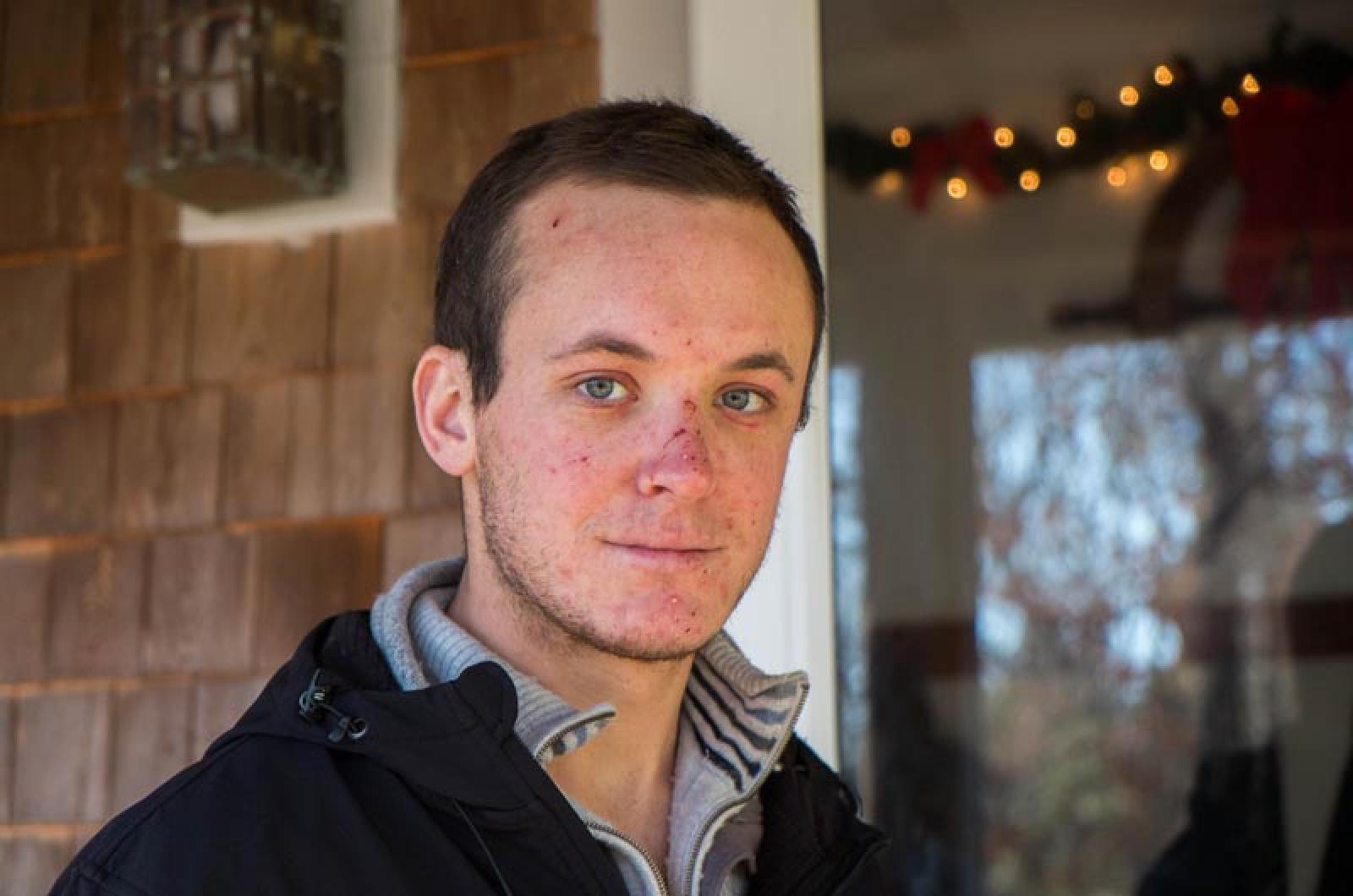
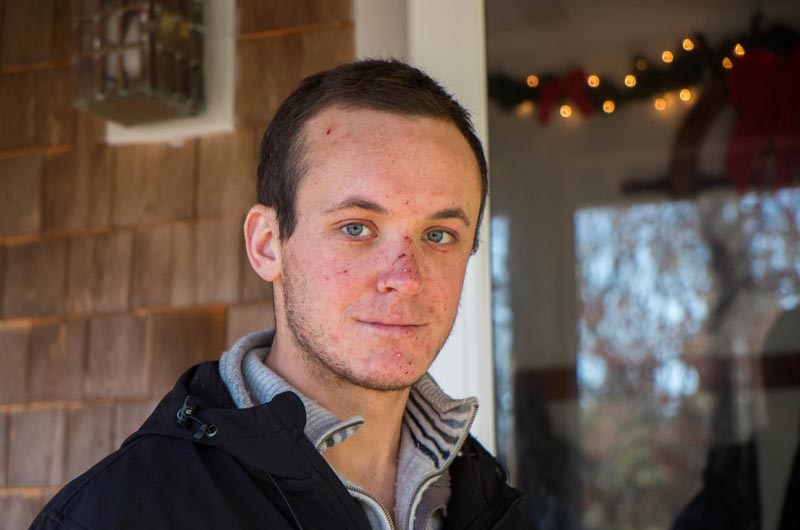
On Saturday four Vineyard men went hiking on Mount Washington in New Hampshire. On the descent Conor, 22, and Adam, 24, took a wrong turn onto Tuckerman Ravine, triggering an avalanche. They plunged 800 feet but miraculously survived.
On Saturday Conor and Tristan Lodge, Adam Herman and Richard (RK) Quebec, all Vineyarders, went hiking on Mount Washington in New Hampshire. On the descent however, due to whiteout conditions Conor, 22, and Adam, 24, took a wrong turn onto Tuckerman Ravine, triggering an avalanche.
The two men plunged 800 feet over rocks, cliffs and ice, and yet miraculously survived.
The foursome had started the hike together. Tristan and RK planned to spend a few days on the mountain but Adam and Conor would be leaving that night. As dusk approached, Conor and Adam worried they might not make it to the summit before night fell and decided to proceed ahead of the others. RK was nursing a knee injury from the summer before, and made slower progress uphill.
The mistake was splitting up, Tristan Lodge said by phone on Tuesday.
“This was not youthful confidence or recklessness,” he added. They had planned to hike together and stick to the Lion Head trail, which has a negligible risk of avalanche.
Conor Lodge and Adam Herman survived 800-foot drop into Tuckerman Ravine during avalanche.
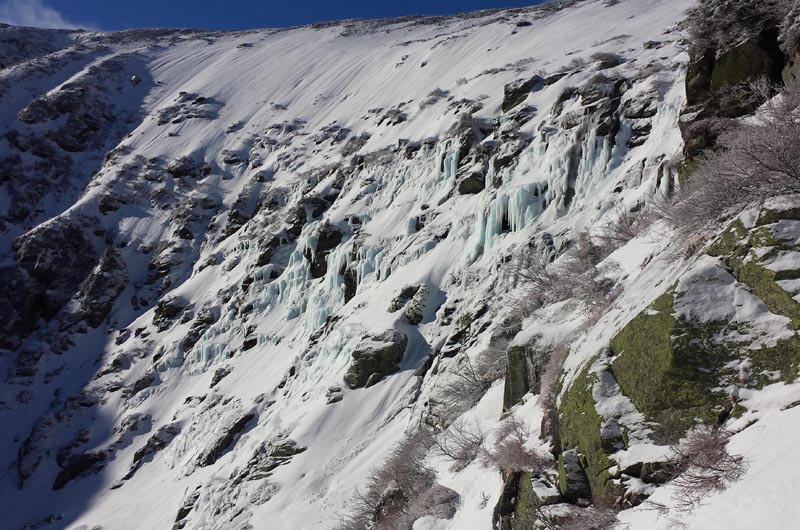
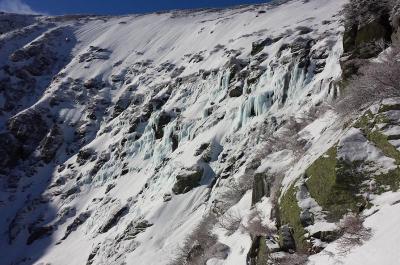
Conor Lodge and Adam Herman survived 800-foot drop into Tuckerman Ravine during avalanche.
After reaching the summit, Adam and Conor headed back down. Along the way they met Tristan and RK who asked them to wait while they, too, visited the summit.
Waiting proved difficult, though, in the 70 mile-an-hour winds, so Conor and Adam started downhill at a slow pace.
“We figured we needed to keep up our heat to survive,” Adam said. “We tried to move very slowly, and make sure they had time to catch up to us.”
Soon they came to a trail split, where Lion Head trail meets Tuckerman trail. Mistakenly, the men veered right onto Tuckerman, trying to follow a set of foot and ski pole prints.
“I didn’t know we were walking on a shelf, until mid-conversation the shelf started to give out under my feet,” Adam said.
Immediately, the men thought, “avalanche.”
“As soon as I saw myself swept up in it, I knew that this was going to be life or death for me and for him,” Conor said.
Adam said he felt something lift him into the air as if skiing off a jump.
They flailed their limbs and attempted to impale their ice picks in the side of the ravine but it was no use. The avalanche swept them down and across the ravine ripping away their ice picks and the micro-spikes on the bottoms of their boots.
Conor landed first. He had been able to stick his left leg out during the fall, catching it on rocks and vegetation to slow his descent.
“I knew if I stopped myself, I would be able to survive,” he said. But he hit his head in the fall, and woke up confused, the result of a concussion.
“I remembered this nagging sensation that someone else was with me,” he said, but he didn’t remember who it was, and couldn’t even recognize Adam who had landed some distance below him.
“I kept asking him, who are you, who are you?” Conor recalled.
He slid down to meet Adam. It was impossible to try and move further down the mountain, the angle of the drop was about 60 degrees, and the possibility of triggering another avalanche still remained, so the men decided to try and hike up the ravine. But it was slow going with Adam’s injuries and no climbing equipment. In the fall he had sustained a severely broken arm and a broken back.
The men stopped trying to climb up and huddled together, stabilizing themselves next to a bush. Then they heard Tristan’s voice, calling out from above.
“I can’t tell you how great it was to hear his voice,” Adam said.
Tristan and RK had taken the correct route, descending on Lion Head trail, but when they didn’t find their friends they became concerned. Applying logic and “some intuition,” Tristan began looking around and finally spotted two pairs of tracks heading off to the left. On a hunch he followed the tracks to an area where snow had been torn away from the side of the mountain by an apparent avalanche.
“It was a big chunk of snow missing, and we saw their footprints going into it,” he said. The temperature hovered around zero degrees and the wind blew the snow in all directions.
“Conor was down there and stuck and I couldn’t get to him,” Tristan said. He called out to his brother and Adam, “No matter what, we are coming for you, hang in there.”
Tristan and RK ran down the mountain, skirting the ravine, until they reached the caretaker’s house and called for help.
While waiting to be rescued, Adam's mind wandered to the stories he had heard of people left in the cold who lost body parts to frostbite.
“In the back of my head, I was like I will probably have to stay the night out here and lose a couple of limbs or fingers,” he said.
For the better part of five hours, Conor and Adam sat in the ravine, struggling to stay awake and keep their blood flowing. They distracted themselves with talk of girls and school.
“I had given up hope, and Adam told me not to,” Conor said. “He said we would be saved, we would be alright.”
At one point they thought they heard the sound of a snowmobile approaching. But the sound died out, replacing hope with deeper doubt. Finally, at 9 p.m, lights appeared below, and rangers Beth and Sam reached them carrying food and extra layers of clothes. More hours passed before the rescuers could secure them to a Bobcat and bring them down to the base of the mountain.
Jeff Lane, a snow ranger who participated in the rescue, said the hikers were lucky as the ravine had not filled up with much snow, and the avalanche was not large enough to bury them.
At around 2:30 a.m., Conor and Adam were driven by ambulance to Memorial Hospital in North Conway, N.H.
Later that day, the Lodge brothers travelled back to Massachusetts. Adam was transported to the Trauma Center at Maine Medical Center. He will undergo surgery on his arm on Friday, and afterwards will recuperate with his parents in Oak Bluffs.
“I want to thank Tristan and RK because if it weren’t for them, we may never have been found,” Adam said.
“I have to thank the rescuers,” added Conor, who is finishing his final year at Northeastern University. “I appreciate all the efforts in trying to keep me alive.”
Comments
I'm glad the boys are fine
Caroline New YorkI'm glad the boys are fine but in my opinion, thanking the rescuers doesn't go far enough. I would demand they pay the search team ALL the costs associated with their rescue and transportation to the hospital. Not an insurance check, money from their own savings. And if they have no savings, then work to earn it. I bet when they see how many thousands of dollars was expended to find and save them, they'll think twice next time they hike or ski. I grew up hiking Tuckerman's - its serious business up there. They are plain and simply lucky to be alive.
really....they made a wrong
Kayo west tisburyreally....they made a wrong turn in a white out with 70mph winds and fatigue & you,having grown up hiking there (add some arrogance,lucky you)gives you the right to pass absurd judgement on them.... they were trying to be responsible waiting for their friends
While it is easy to be the
Karen MVWhile it is easy to be the judge and juror from behind a keyboard, the anger your post encapsulates seems to be misplaced. The punishment you ask for is based on the notion that people should be held accountable for their actions. While this is true, the accompanying logic of your proposal begins to falter when looked further into. For one, Adam has been a lifeguard for over eight years, saving many summer people from undertows without asking recompense. Additionally, Conor is a certified captain for the past 3 years and a sailing instructor for the past 9 years, during which time he helped many people from running aground and other mishaps at sea. Your proposal is quick to judge the character of these young men as ignorant and irresponsible, because, obviously, that is the only people who have accidents. Now, lets look further into the avalanche. There were mistakes made, most primarily being separating from the other two members of the group, but for the most part there is a logical course of action guiding their behavior. They experienced a white-wash, which, accompanied with the sun lowering, reduced visibility to 15 feet. That was hardly enough to see the next trail marker. Instead, they chose to follow footprints that were in front of them. The footprints had obviously been going somewhere and that somewhere had to be fairly safe (to merit the footprints). While following these footprints, they sparked an avalanche and the rest is history. They had the equipment necessary for the hike and the clothing to last 7 hours in the cold. So what, I ask, in your opinion, makes these men punishable? Its not their character. Is it their mistakes? The mistake they made could be made by a multitude of others is the same scenario--following footprints. There are bound to be many mistakes made when man faces the powers of nature, yet it isn't our responsibility to punish these mistakes. Take, for instance, summer people with a lack of knowledge of riptide. They don't know how the sea functions and why should they be punished for this lack of knowledge? We do not send them a bill, whether they are rescued or not.
Ok Karen. So Adam is a
AJS Westfield NJOk Karen. So Adam is a lifeguard and Conor knows how to sail. It is very apparent that they have little experience hiking especially in winter conditions. They broke the first rule of hiking never split up. This makes them irresponsible. Thank You.
Shaddap!
Keep ur opinion VineyardShaddap!
I'm glad they are safe. Thats what the rescue folks are for.
Caroline,
MVCaroline,
That is a bit extreme if you ask me. They made a mistake, the weather turned, and an avalanche was triggered. If you spent so much time hiking Tukerman's, then you should know the weather can change in a heartbeat and even the most experienced climbers can run into trouble. If you get into a car accident because of bad weather should we expect you to pay (out of pocket) each and every dollar associated with emergency crews helping you? Let's leave the comments as such: We are glad you are ok, and hope you have learned a valuable lesson from this.
Your analogy of a car
Caroline New YorkYour analogy of a car accident is not remotely similar. I'm talking rescue teams that are on call for hikers and skiers, the ones that don't have much funding to begin with. Two of my children were on ski patrol at Canon Mountain in NH, near Tuckerman's. They could tell you a million stories of poor judgement on the part of the skiers that led to avalanche or near avalanche conditions. Kids who thought they were impervious to danger who took chances. These kids took a chance in splitting up. I'm only saying that while I am sure they are appreciative of the efforts of their rescuers, a thank you is hardly sufficient. In order for them to learn not to take such chances again, they need to understand the financial ramifications of their rescue and I say that ONLY comes from handing them (not their parents) the bill. Harsh? I don't think so. It's reality and not coddling the kids into thinking they just because they got rescued, all is fine.
When you go down a one way
John Gault Oak BluffsWhen you go down a one way street you don't have an ACCIDENT what you have are the results that occur when you follow or listen or proper directions. I agree with Caroline, when you dance you have to pay the fiddler. It seems ignoring signs or leaving the main group has consequences and it's time to pay the fiddler.
I've spent decades climbing
Geoff Parkhurst MVI've spent decades climbing and that has included Mt. Washington, summits (literally) miles higher, extreme vertical caves, severe winter conditions, accidents and injuries. My most recent trip up Mt. Washington was last April with my 16 year-old son to ski Tuckerman Ravine.
Probably due to its accessibility, I've seen more ill-prepared and occasionally idiotic climbers on Mt. Washington than anywhere I've been. On a mountain that is very exposed and is notorious for rapidly changing and often extreme weather, poor preparation can be fatal. And I am as frustrated as anyone when foolhardy behavior leads to expensive rescue efforts. (As I am when I see the Coast Guard risking their lives to rescue a boater who had no business being out on the water.)
But given that body of experience, I'm hesitant to finger-point in this case. Errors were inarguably made (walking out on a windblown cornice, for one) and inexperience may have played a role (a few pokes with an avalanche probe could have detected the cornice in a less spectacular manner than the way they found it), but this does not have the hallmarks of the just-plain-stupid that accounts for so much of the volume of rescue requests.
The fact that they had clothing which permitted them to survive until rescuers arrived is indicative, as is the fact that they were using ice axes and crampons. (Not "ice picks"!) And while it's tempting to criticize their splitting up, climbing in pairs is common, and their original plan was to split up since two of the men were prepared to spend several days on the mountain and the other two were planning a single day summit-and-back.
Even more telling is that fact that the second pair of climbers recognized the problem, tracked them without falling off the Headwall themselves in the low-visibility conditions, and were able to summon and give accurate directions to a rescue team.
I'll agree that a series of errors was made, but I can't put this group in the AIR (Another Idiot Rescued) category. And the down-side to threatening everyone who ventures into the mountains with potentially large rescue costs is that it could lead people to wait too long to call for help. And none of the snow rangers wants a rescue mission to turn into a retrieval mission. I'm glad these guys came out alive.
These were not foolish,
Geoff Parkhurst MVThese were not foolish, arrogant, or "risk impervious kids". They took on a very challenging environment and it nearly cost them their lives. This is a real risk that anyone who makes a winter ascent of Mt. Washington must accept. The fact that they are alive at all speaks to the fact they they were neither foolish nor unprepared. Having climbed and skied Mt. Washington and Tuckerman Ravine for 40 years, the folks who are criticizing this group baffles me. Grouping these climbers with the "million stories of stupid skiers" is baseless. And the idea that they are "being coddled into thinking that since they were rescued all is fine" leaves me speechless. They took an 80 story fall over cliffs, rocks, and ice, one suffered a concussion and the other a fracture that will require multiple surgeries and you think they think it's "all fine?" Based on what? I've not only climbed and skied my whole life but I've participated in some pretty grueling rescue work and while I've never been thrilled about the idea of chasing fools into danger, I would have been thoroughly satisfied to have participated in this one. I'd say that these guys are exactly who I'd like to go out for. The ones with a little more experience or a little better luck don't need rescuing. And for those who want to slap the big expenses on those being rescued, perhaps you could volunteer to found a bereavement group for people whose kids froze to death because they were afraid that picking up their cell phone or radio to call for help would be too costly. And for anyone talking about "failing to follow signs" you have clearly never been there. I'd rather hear from other members of the climbing community who know that 1000 get above a tree line on the mountain that held the world wind speed record for over 75 years there aren't any signs. (What's left of them would get pretty dangerous going over 200 mph.) There are low rock cairns. And when it's blowing like mad and the light is flat and visibility is 10 or 20 feet for high contrast objects (like your climbing partner) the cairns are easy to miss and it is incredibly challenging to NOT become disoriented. So if you don't know what you're talking about, don't be judging these climbers. If you want to try to put through legislation to ban dangerous activities like winter climbing, it's your right to try. Good luck with that. And if you're one of the experienced mountaineers who has spent a lot of time on Mt. Washington I would welcome your input.
What a stupid comment to pay
friennd oak bluffsWhat a stupid comment to pay for these men to be safe! We are so lucky it end so well! I know both of them! My kids went to school with them, they are smart good kids. But by chance they do get a bill! Im sure Gina with the PA and islanders, will band togeather and fund raise for it! That what mv does, love to help when they can.
Add new comment