

<p>Seas around the Vineyard are rising slightly faster than the global average and Island planners should prepare for significant sea level rise by the end of the century, a new climate change report has found.</p> <p>The Vineyard Conservation Society report examines the effects of climate change on the Martha’s Vineyard and its surroundings.
Seas around the Vineyard are rising slightly faster than the global average and Island planners should prepare for significant sea level rise by the end of the century, a new climate change report has found.
The Vineyard Conservation Society report examines the effects of climate change on the Martha’s Vineyard and its surroundings. Sea level rise, health, ecology, emissions, severe weather and ocean acidification are all topics covered in the report.
The report was written by Jeremy Houser, the communications coordinator at VCS, and paid for with a grant from the Edey Foundation. Mr. Houser spent nearly two years collecting data from the U.S. Climate Change Research Program, Union of Concerned Scientists and the National Academy of Sciences, as well as data from the National Oceanic and Atmospheric Administration. He has a PhD from the University of Massachusetts neuroscience and behavior program.
“The actual projections are, at this point, fairly grim, especially for an Island community,” Mr. Houser told the Gazette in an interview this week. “But there’s still a lot of variation within the projections, even the best case scenario is still a lot of trouble that we’re going to have to deal with. The worst-case scenario is that much worse.”
The report projects that seas will rise about one foot by 2050 in this area, with estimates for later in the century varying greatly from two to six and a half feet, depending on the rate of emissions from greenhouse gases. Without large reductions in fossil fuel usage, the report says, the Vineyard will experience sea level rise on the higher end of the projected spectrum.
In the past century, global sea levels have risen more than seven inches. In New England, seas have risen nearly one foot in that same time period. From 1932 to 2000, seas rose an additional 0.1 inches per year in Woods Hole beyond the global sea level rise. Nantucket saw similar increases.
Combining local sea level rise with global estimates, the area has seen an increase of one inch every five years, the VCS report found. Over the next few decades the Island, and the world, will face “faster than ever” rates of sea level rise, though the rates are similar to today’s increases.
Sea level rise can be attributed to warming waters, the melting of mountain glaciers and ice caps, melting of ice sheets in Greenland and Antarctica, subsidence and uplift in tectonic forces and changing ocean currents. Subsidence, or sinking of the land, is the greatest contributor to increased sea level rise. According to the VCS report, from 1958 to 2008, sea level in most of New England rose two to six inches beyond the global average increase.
Explaining climate change is largely forward thinking, Mr. Houser said, and he recognized that the numbers can seem insignificant. But he said the numbers can distract from the serious consequences of sea level rise.
“We need to use those numbers because it’s really the only hard unit of measurement we have,” he said. “It underestimates them. The real impact of sea level rise isn’t so much this overfilling the oceans like it’s a big bathtub; it’s the other effects where every inch matters so much more.”
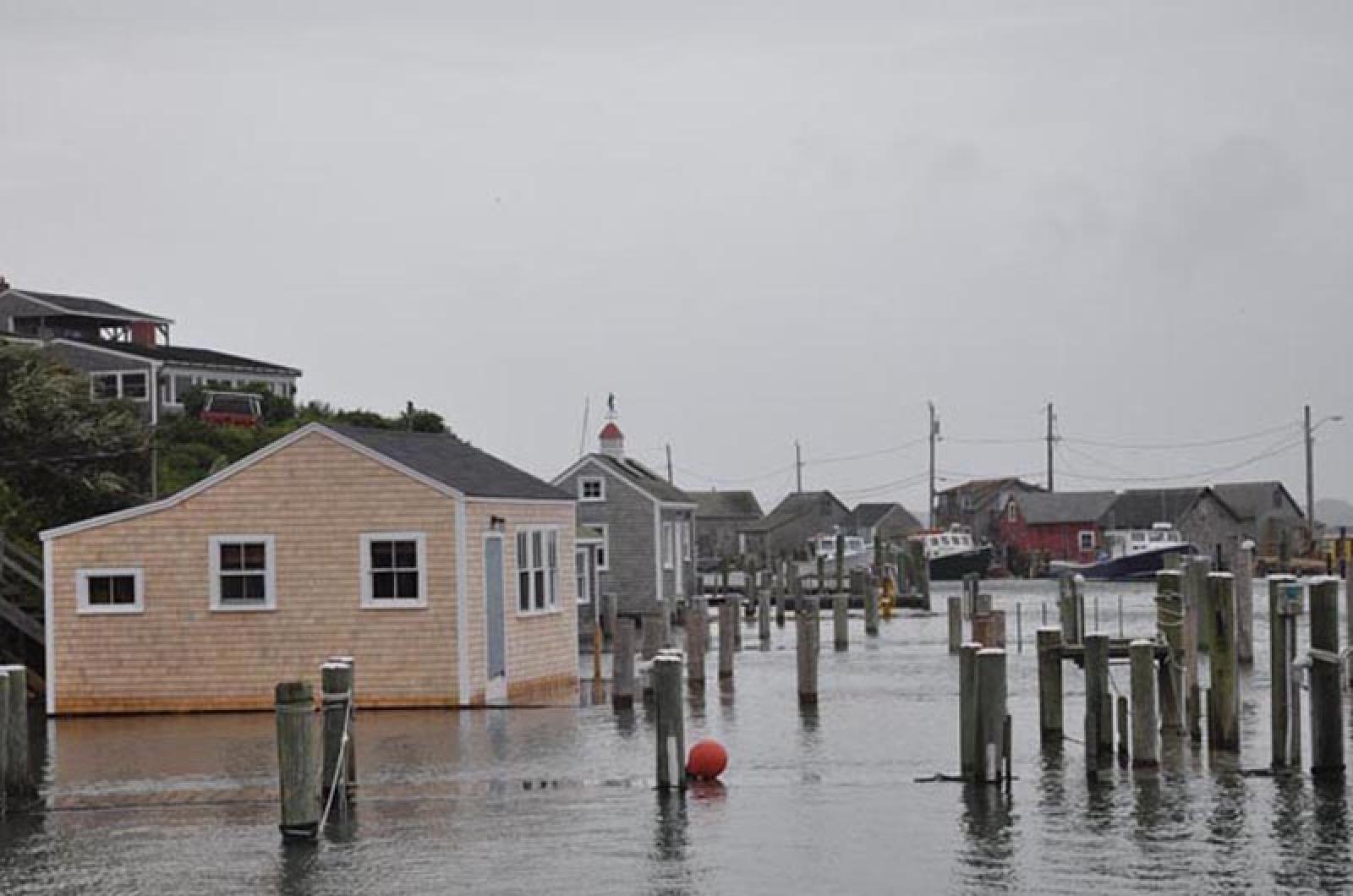
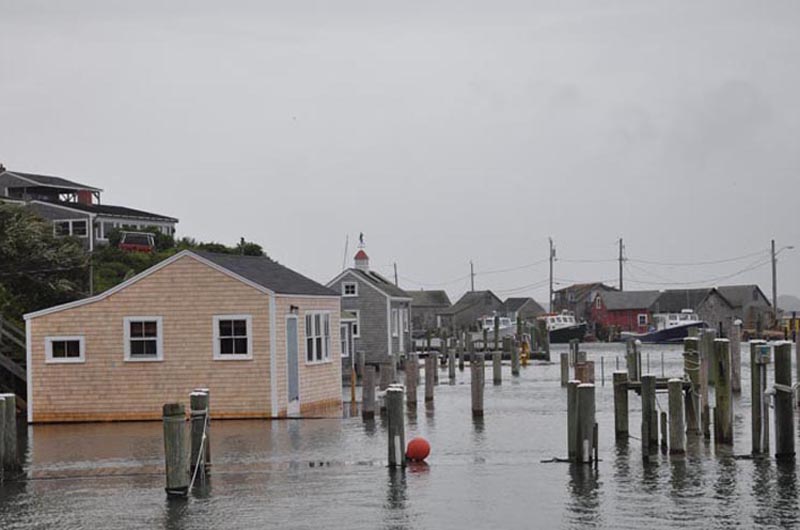
Every time there’s a tropical storm or hurricane, for example, Mr. Houser said, inland flooding will increase.
“That’s where these seemingly small differences matter,” he said. “The total impact of two feet versus four feet of sea level rise is much more than just double . . . the impacts are much greater.”
The direct impacts of sea level rise on the Vineyard can be seen through coastal erosion and the loss of wetlands. Climate change contributes to erosion “by fostering more powerful storms with bigger waves, storm surges and flooding, and wetland destruction,” the VCS report said.
“Beach is lost when waves batter the base of a cliff or overtop the dunes, not because the global bathtub overflows a fraction of an inch every year. But the fraction of an inch allows those big waves and storm surges to penetrate deeper inland, and stay here longer, where human structures and the natural environment are simply less prepared for water.”
While sea level rise does have an effect on shoreline change and coastal erosion, “the majority of this change is caused by factors other than sea level,” the report says, including natural and historic changes along the shoreline.
The loss of wetlands is a critical factor because of the role they play in protecting the coastline from storm damage.
“The loss of wetlands as they become consumed by the open ocean is extremely important in its own right,” the report says. “Unfortunately, wetlands are being lost at exactly the time they are needed most.”
Looking to the future, the report suggests monitoring areas similar to the Vineyard on an international scale, such as the low-lying Seychelles islands in the Pacific. The economy there is similarly driven by tourism, and “enormous amounts of the most valuable areas” are being lost, the report found.
“It would be wise to observe the adaptation efforts of the Seychelles and other islands over the coming decades to learn from their successes and avoid repeating their mistakes,” the report concludes.
Mr. Houser said the report points up most importantly the need for Islanders to prepare for a future where the coastline is changed by rising seas — in some places subtly, in others dramatically.
“We’re going to adapt,” he said. “We know the history of this place and our people are not just going to pick up and leave the Island.”
Comments
this is a very important
John Englander Floridathis is a very important issue for the Vineyard. It should be understood that the estimates for sea level rise this century are just that. It could very well be worse than the scientific consensus. As I explain in "High Tide On Main Street" my recent book, sea level forecasts have been consistently low. We simply can not accurately predict how the great polar ice sheets and glaciers will melt. The low lying land in many parts of the Vineyard makes it very vulnerable. It is time to start looking ahead to the inevitable future of higher sea levels. By the way, as a long time Vineyard summer resident, I end my book with a vignette from there. For anyone interested, it is available from Amazon, for e-books, and as an Audible book.
Nor can we ignore the massive
Dee Ouchman Isles of LangerhansNor can we ignore the massive rising of the sea floor in vast areas. Meanwhile the northern polar ice cap is larger than it's been this early in the season in several years. Maybe the Island is sinking due to many factors like depleting the aquifer and the Island is settling. Who knows for sure? The Island is getting smaller every day grain of sand by grain of sand. Nothing will ever stop that until the next glacial age. In the mean time there will be winners and losers in the real estate game. I could care more about your book but I don't.
Thanks for the comments, John
Jeremy Houser Vineyard Conservation SocietyThanks for the comments, John. It's safe to say that VCS would cosign to all of that.
Also, the sea level rise report described in this story is available for viewing and download at our website, www.vineyardconservation.org
Please provide labels on your
Your Momma PlymouthPlease provide labels on your chart and graph.
A good point! I can help: In
Jeremy Houser Vineyard Conservation SocietyA good point! I can help: In the first image, the areas shaded in yellow would be inundated with 1 meter of additional sea level rise beyond today's sea level; the red areas correspond to 2 meters of sea level rise. These maps were prepared by Chris Seidel of the Martha's Vineyard Commission, and popularized in a talk by Phil Henderson. For more on these inundation maps, see our website's climate change page.
Regarding the line graph, here is the original caption from the VCS report:
The effect of different levels of greenhouse gas emissions on sea level rise becomes especially pronounced later this century. The curves labeled A1FI and B1 (corresponding to the high and low emissions scenarios used in this report) represent a summary of results from studies conducted since the IPCC’s 2007 report (depicted in the AR4 bars). Figure from Vermeer and Rahmstorf, 2009.
I hope that clears things up, and thanks for reading.
Add new comment