

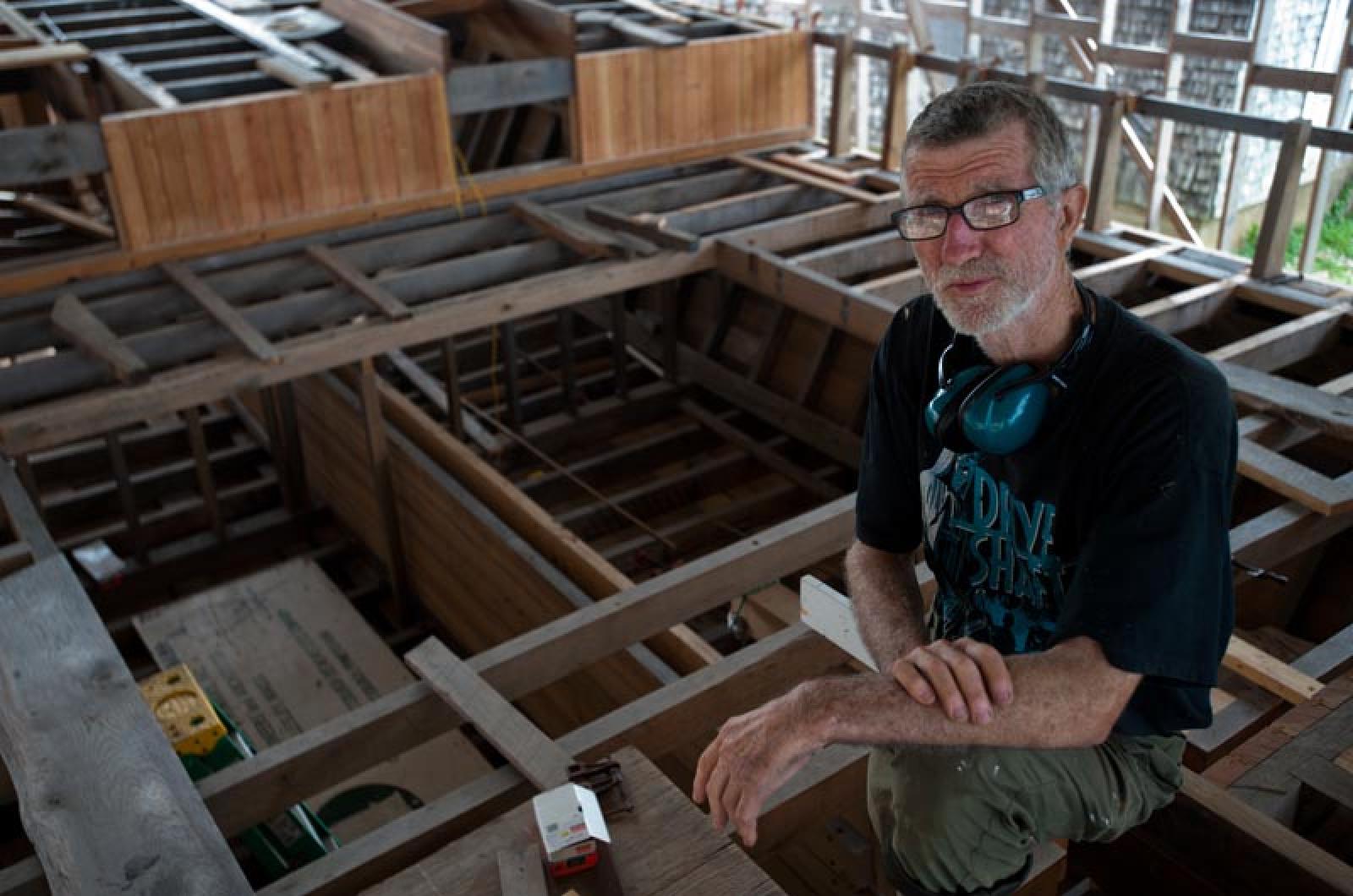
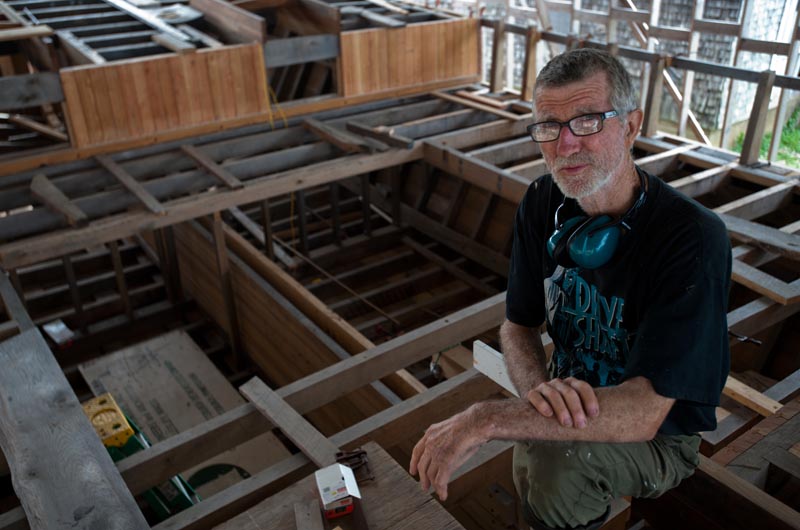
Each morning when boatbuilder Ted Box wakes up, drives to his makeshift warehouse on the Vineyard Haven harbor and climbs the scaffolding to gaze at his 70-foot scow schooner, he is confronted with all the problems of completing a big boat. Ted is 68, a master shipwright, has seen many a craft to the finish, but is looking toward daunting work ahead.
Each morning when boatbuilder Ted Box wakes up, drives to his makeshift warehouse on the Vineyard Haven harbor and climbs the scaffolding to gaze at his 70-foot scow schooner, he is confronted with all the problems of completing a big boat. Ted is 68, a master shipwright, has seen many a craft to the finish, but is looking toward daunting work ahead.
The Seeker, as the scow is dubbed, is based on late 1800s Gulf Coast blueprints obtained from the Smithsonian. It is flat amidships, yet has a graceful rocker at the keel, a sweeping sheer and a pronounced deadrise, the term used to describe the V shape at the ends. It’s cut from a combination of white oak, North Carolinian cypress and yellow pine, and has been in the works for more than two years.
Now the ship must be removed from the lot where it resides and put into the water by mid-September. In order to be seaworthy, the sides need to be fitted with guardrails, the hull caulked with cotton, seam compound applied and bottom painted, despite the projected launch date being in May of 2014.
As the project draws to a close, however, the thoughts of what it means, and not of when or how it is to be completed, has been occupying Ted’s mind. He has been pondering the meaning of mentorship; especially how even the ancient art of boat building can teach lifelong lessons to younger generations. Sitting on the bench of a local restaurant, Ted, a lean, pensive man wearing a gray tank top and a pair of khakis, and I, 16, try to discuss what we believe has never been given enough consideration. We want to determine the importance of mentorship from both the mentor and mentee’s perspective.
Ted started telling me about his memories of his teacher, a respected Provincetown boatbuilder by the name of Francis (Flyer) Santos. He remembers being impressed by Flyer, not because of the craftsman that he was, but because of the man that Ted saw him to be. “Anyone can become a great boatbuilder,” said Ted, blue eyes thoughtful through a pair of rectangular spectacles. “But what kind of man would you become?” According to him, Flyer exemplified a commitment to community that was pivotal to Ted’s development. During the 1960s, Ted’s hometown, Seaford, Long Island, experienced a population boom, drawing in businessmen and entrepreneurs, stimulating a get-rich-quick environment. The coastline was flooded with sewage from an unfinished plant, and common workers, content with their increasing pay, decided to turn a blind eye. Flyer’s mentorship taught Ted to appreciate an honest living, following an unscrupulous time.
“I also wanted to be a man that wouldn’t allow harm to come to his community,” he continues. “A man that could stand up and say that this isn’t going to happen.”
To teenagers who are in danger of taking the wrong path, Ted wants to impart similar values. His recently created nonprofit, Seaworthy Inc., manages the boat and its construction. Ted’s plans, as they are stated on his website, are to “blur the line between work and play,” essentially “build confidence, knowledge, and responsibility” by exposing youth to wise and experienced mentors.
Indeed, he has already scheduled many educational events to take place on the Seeker, including opera, ballet, and theatre performances, exhibitions of environmental art, and martial arts and fitness programs. They are all designed to benefit at-risk youth, emphasize the importance of a “moral code” and smooth the rocky transition from adolescence to adulthood.
When I first met Ted on a brisk winter’s morning, I did not expect that his project would entail all that.
Eager to nab a story for my high school paper, I saw the Seeker the night before heading en route from Oak Bluffs, and decided that I wanted to write about it. Coming from a family of journalists and documentarians, I have always been encouraged to strike up new acquaintances. Little did I know that this one would evolve into such a powerful relationship.
Personally, I think there are many gifts that mentorship can give, including that mentioned by Ted. But what makes one of the most profound impacts on people my age is an objective view. As someone who’s still in his development and trying to grasp his identity, I find self reflection difficult. Parents often inflate their kids with high images of themselves, and teenagers grow up unable to distinguish reality from fiction meant to bolster self confidence.
That is why a mentor is special, because he can lend an unbiased perspective on who you are. He can parcel out both what flaws need to be fixed and what skills should be honed. By coming into your life with a clean slate, he can transform an unsure, shy adolescent into a confident, capable adult. Despite what parents might think, telling their children that they are good at something at which they aren’t is not only confusing; it serves to muddy the waters of their self awareness. A mentor can offer honesty and, in doing so, provide something we are in desperate need of: a sense of introspective clarity.
Upon sharing my thoughts with Ted, he laughed and nodded in agreement. “When I was with Flyer,” he recalled, “I cut myself. My hand was bleeding pretty badly. Everyone was making a fuss about it. But Flyer came over and said ‘What am I? Your mother? Patch it up and get back to work.’ ” This immediately resonated.
Drawing on recollections of his childhood, Ted believes there may be another advantage to mentorship. He describes how a school system is oriented toward only a handful of gifted youngsters. To succeed academically, students need to be inclined and motivated, and the reality is that important information is conveyed not through application, but between the black and white lines of a textbook. What is missing is the element of imagination put into practice.
“[I love boat-building because it’s about] being a part of something enormously creative. It didn’t exist until it came to fruition in my imagination,” Ted said, cracking a smile. “An idea floating in the ocean.”
Even back in the earliest stages of construction, the sheer magnitude of Ted’s dream was readily becoming apparent. The Seeker was a boat of pure wood backbone, a mere archetype of what was to come. But for me and for others who cared to take the time, it stood as an admirable effort to revive interest in a long forgotten trade. Building boats is tough. You come away with blisters, splatters of paint and shaky confidence in your coordination, but it is exciting to think that you are shaping dreams into reality with your own bare hands.
Today, this theme attracts passersby every day, some of which are inspired enough to become volunteers. Excited children climb up the rickety steps and gape at the scow from the top, which, to their amazement, looks “bigger on the inside.” A judge came in with her husband to discuss its political meaning. A pharmaceuticals entrepreneur expressed a desire to hold meetings on the craft. Countless tourists take a moment to peek at the modern Noah’s Ark, while familiar locals shake hands with Ted and check up on progress.
“Everyone lends a new perspective,” Ted remarked.” If you stop learning, you become an anachronism.”
It is part of life; we come into this world with a lot to learn and depart from it in much the same way. One moment you are a child innocent of reality. In the blink of an eye you are wiser with age, wondering where it all went. But our lives never stop testing us. They push forward ideas to soak in and problems to confront. Mentorship works in much of the same mysterious vein. As Flyer once did for Ted, Ted is now doing for many other children. As those kids become adults, they may also take on the next generation. Every day, we head out into the world, and people in it change and teach us. That we will always remain mentees is without question.
Benjamin Guggenheim is a high school junior who lives in Los Angeles, Calif., and Vineyard Haven.
Comments
I have a dream that one day
Dreaming TisburyI have a dream that one day I will wake up and on my way to get gas that hunk of junk that was suppose to be there for ONLY a year (yea right) will really be GONE!!
There are those that are
Dick Iacovello Vineyard HavenThere are those that are obviously living in their own nightmare.
Their lack of vision allows them only to see a "hunk of junk",
while many others realize the value of mentorship & genuine
dedication to make a better life, and environment for those that
are curious enough to look past their nose.
Sorry that that 'hunk of junk
Farmer5 chilmarkSorry that that 'hunk of junk' is spoiling your view of the gas station. I hope it will be gone too....so I can marvel at it floating, fully rigged in the harbor.
"He describes how a school
Mr. B. Chilmark"He describes how a school system is oriented toward only a handful of gifted youngsters." I am not sure what school/school system the gentleman is acquainted with, but I think I speak for other teachers when I say that our schools are in the business of being "oriented" in so many ways and directions for so many little sub-groups that they have no opportunity to create a meaningful focus outside an individual classroom. Some charter and magnet schools try, but the idea that schools (especially public schools) are designed around the "very best students" is simply wrong.
Mr.B,
TED BOX Martha's vineyardMr.B,
When the young person who is gifted mechanically, is respected by the school system in the identical way that the young person who is academically gifted, I will withdraw my statement, but, that is not the case in most schools in the United States. There are many reasons for this, almost none the fault of dedicated teachers. The schools in Europe treat their students disparate gifts differently than here in the USA. Then again, a master mechanic in Germany is held in the same regard as a doctor of medicine. Please don't tell me that that is the case here. It isn't, and it's degrading to a gifted individual to be held as something less than another with a different gift. Very few scholarships go to those gifted students that are not academic, artistic or musically inclined.
When someone who can't do
J.P. Uranker Oak BluffsWhen someone who can't do something better than what is being done makes a statement about a creation that is a " Hunk of Junk" then they should at least have the testicular fortitude to use their Sir name. Ted has labored long and hard on this project and its not being done is a simple matter of cash flow. We unfortunately live now in a society that takes enjoyment out of such comments. Having had the same comments made to my "Welcome to Edgartown" sign and my work. No one realizes the time or SKILL it has taken Ted to do what he has accomplished. I would hope Mr. Boch would reconsider his plans for the property until Ted can raise the money needed for the engines to be properly installed with any navigational that will be need. Everything in its proper time,you really can't rush a piece of art work.
My second year staying on
Jan Walsh VhMy second year staying on island as an illustrator and daughter of a wise and creative and encouraging father I can TRUELY appreciate mr box's DREAM! He is wise, and a brilliant boat wright ! I hope in the year 2014 mr box will get his due praise , when the seeker slips into the harbor , quietly, but with the strength and will of her massive beams kind of like Ted box .
Add new comment