


<p>While each of the spectators made it home in one piece after the annual Monster Shark Tournament had officially ended, the same isn’t true for the 12 sharks weighed in over the two days. Each fish was cut up and pieces transported to different places. Muscle was brought home to serve — shark steak for dinner. Teeth found homes in the keepsake boxes of little boys. Photographs were uploaded to Facebook and Instagram.</p>
While each of the spectators made it home in one piece after the annual Monster Shark Tournament had officially ended, the same isn’t true for the 12 sharks weighed in over the two days. Each fish was cut up and pieces transported to different places. Muscle was brought home to serve — shark steak for dinner. Teeth found homes in the keepsake boxes of little boys. Photographs were uploaded to Facebook and Instagram.
But by some measures, the most valuable loot was the information gleaned, and the tissue samples collected. Both were brought into laboratories along the coast this work week to inform scientific studies of a group of fish still poorly understood.
Three biologists attended the shark tournament this weekend, each studying sharks from a different angle. Lisa Natanson, a scientist based at the Northeast Fisheries Science Center (NEFSC) lab in Naragansett, R.I., studies aging, growth and reproduction of sharks. She has been attending the tournament for more than a decade with Gregory Skomal, a fisheries biologist with the Massachusetts Division of Marine Fisheries, who is working on a statistical study. The third, Joanna Borucinska, of the University of Hartford, studies shark pathology.
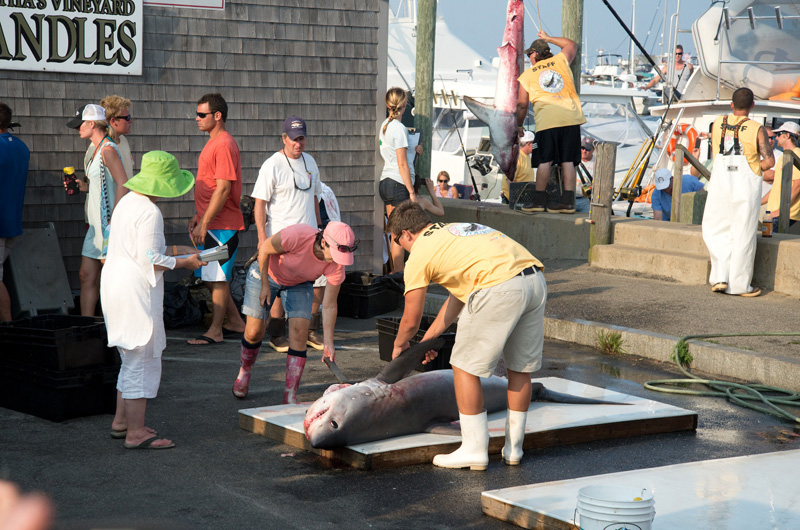
After each fish was weighed and measured, the scientists were granted the first cuts of the fish, a speedy dissection process completed with gusto and precision. Ms. Natanson carried a six-inch boning knife, which rests in the holster strapped to her abdomen. It’s small, but kept continuously sharp by a whetstone she holds in the other hand while cutting into the sharks. Her other equipment included a portable black case for storing tissues, a sieve, measuring tape, rope, a scale and a rusted, dust-covered caliper.
Ms. Borucinska had a bucket, a ladder and a large cooler, as well as a handful of students standing by to assist.
In its 27th year, the shark tournament took place on Friday and Saturday last weekend. The crew of Magellan out of Harwich, captained by Jason Pillsbury, took home the $20,000 prize. Magellan landed a 429-porbeagle shark on Friday and another 313-pound porbeagle on Saturday, winning the tournament with 742 points.
Sponsored by the Boston Big Game Fishing Club, the tournament attracted a large crowd of spectators as it always does, along with marine scientists who use the caught sharks for their research.
A total of 12 sharks were weighed in over two days. Spectators gathered four deep late Friday afternoon when Magellan brought her catch to the docks rimming the Oak Bluffs harbor. The tail of the porbeagle was passed around for people to touch and marine scientists on hand who use the tournament for study were bloody to their elbows as they took tissue samples.
Although the tournament has been controversial in the past, there was no sign of protest this year. Oak Bluffs police added extra officers for crowd control as well.
Sharks can be studied alive. Tag and capture methods allow scientists to
measure, count and estimate age. But most of Ms. Natanson’s work requires a deceased fish, she said. “Basically we are here opportunistically; they don’t need us here,“ she said of the scientists’ presence at the tournament. To get the samples she needs, she attends all the accessible tournaments and collects tissues from pups to adult sharks. The Monster Shark tournament provides her with some samples of bigger sharks, she said. The tournament boasts the highest minimum weights of any tournament in the United States. For other samples, she will attend research cruises or go on commercial fishing boats.
“Going on a variety of these tournaments helps us,” Ms. Natanson said.
Some of the samples collected at past tournaments contributed to two studies forthcoming about thresher sharks, the first two papers written on that species.
Aside from the 12 sharks caught and brought to harbor, many more were caught and released, but that data will not be known for awhile, said Steven James, president of the Boston Big
Game Fishing Club, which sponsors the tournament.
The Monster Shark Tournament, now in its 27th year, has been a lightning rod of controversy of late, drawing both local and national animal rights protestors to the scene. Earlier this year, Oak Bluffs voters passed a nonbinding resolution to make future shark tournaments catch and release. The town also levied an increased service fee on participants this year to pay for additional police presence around the harbor. In response, Mr. James said he will consider relocating the tournament to private harbors in Newport, R.I., leaving the Oak Bluffs tournament a diminished version of its past self or ending it altogether in the future.
The elimination or downsizing of this tournament would yield fewer samples for her and her colleagues to study, Ms. Natanson said, but it won’t define her research.
“Since we started doing this, there have been a lot of changes in tournament rules that have changed our samples,” so it’s not something they can’t adapt to, she said. “We are sampling these sharks because they are dead, and they are available, and why not? But we are certainly not encouraging them to go out.”
Mr. Skomal has been coming since the first shark tournament, held in 1987, the year he moved to the Island. He moved away in 2010 and now makes his home in Marion, also on the coast of Massachusetts.
At his talk last Thursday night at the Tabernacle, Mr. Skomal discussed the research he has completed over the last few years. His team continues to tag white sharks, using simple acoustic tags as well as advanced satellite tags. In the last four years, Mr. Skomal has tagged over 34 white sharks, demonstrating that the sharks migrate all over the Atlantic ocean. These truly monstrous fish have come closer to shore as the gray seal population has increased in the last decade.
A new technology, funded in part by Discovery Channel, is the AUV, or antonymous underwater vehicle. It’s a robot shaped like a six-foot long torpedo that follows sharks in the water and records information about them.
He studies all sharks, from “some of the smallest critters that live out here, like dogfish, to the biggest, like basking sharks and white sharks,” Mr. Skomal said. His research on white sharks attracts the most attention, he admits.
White sharks have been caught and released in the tournament, but their capture was prohibited over a decade ago, around the time they started showing up closer to shore. There used to be as many as four or five shark tournaments in the state, Mr. Skomal said, but this is the only one that remains.
“I think that is largely related to the economy,” he said. “Shark fishing is expensive. Big boats, fishing offshore, fuel prices . . . I think that results in a dip in fishing effort offshore.” The prize for the tournament is $20,000, but the costs are almost as high.
Even in the case of the Oak Bluffs tournament, the biggest one around, the enrollment numbers have declined in recent years. This year only 85 boats registered for the event, down 17 from last year.
If the tournament moves to Newport, R.I., where participants would not be charged a service fee, the scientists will follow suit. “We are going to continue to opportunistically sample,” Mr. Skomal said.
Ms. Natanson wears pink floral boots with blue socks pulled straight up underneath them; later, she switched to pink Crocs. The skin of a shark is like sandpaper, she explained, and when touched to human skin, can leave a rash. Unsurprisingly, the teeth are also sharp, she said.
Blood can spurt in all directions as the fish are cut open, but the scientists don’t seem to mind. Ms. Borucinska also wears Crocs, hers orange. From tissue samples she collects and stores in a cooler, she studies shark diseases, with a particular focus on anthropogentic causes, like pollution and fishing.
Blue sharks were once caught by the hundreds in the tournament, she recalled, but after the publication of a 2002 paper describing fish hook trauma in blues, co-authored by Ms. Natanson and Mr. Skomal, they were banned. She is not sure if the paper had a direct influence on this decision, but she thinks it was a factor.
Today, she’s looking at bioindicators, or changes in tissues that suggest that sharks have been affected by their cells’ digestion of toxins in their environment. Sharks’ immune cells, charged with eliminating pollutants, are evolutionary precursors of human lymph nodes, she said. Evidence of the destruction of red blood cells and an increase in those melanomacrophage cells may signal an increase in pollutants in the environment.
At tournaments she might also collect samples of gonads and thyroids to analyze the effects of synthetic hormone on endocrine function in sharks. Plastics release estrogen-like compounds into the water, which may prove to have an effect on the reproductive capacity of male sharks. There is evidence that the fertility rate of male sharks suffers when they are exposed to plastics in the environment. On Friday she pulled an ovary from the winning shark, a 429-pound female porbeagle. Ms. Natanson estimated that the shark was 20 years old.
Ms. Borucinska has been collecting bioindicators for the last five years but the study has another 10 years before she will be able to identify pollutant trends over time.
Some changes may be apparent over a shorter period of time, however, especially in the case of severe weather events.
“I am very curious about if there is any effect of the last hurricane,” she said. She suggests that the water warming, coupled with the pollution heaved into the water during a hurricane storm surge, may threaten shark survival. Though she attends three tournaments in Montauk, N.Y., two in June and one in August, she said Martha’s Vineyard usually has the biggest fish, because of its access to offshore waters.
Comments
Very interesting article. I,
Gina Hayes Cape Cod MaVery interesting article. I, like many of us, would not have remembered all the valuable information the scientists are able to gather from the shark tournaments. I always remember the meat being donated, but forget the need for scientific information. Thanks for writing a great article!
Sorry, but am I alone in
johnny westport, maSorry, but am I alone in believing that the value of doing everything we possibly can to keep these magnificent and misunderstood creatures alive outweighs the value of taking tissue samples from those needlessly killed?
Excellent photos by Ray Ewing
Loulou Fremont, CaliforniaExcellent photos by Ray Ewing. Love being up close to those magnificent beasts!
How about this next time?
john burton vermontHow about this next time? Instead of killing the shark in some public spectacle, the "scientist" accompanies the boat and examines the shark for "bioindicators" by performing blood tests and electronic scans, etc. and then the fish is released. Do doctors kill their patients first before they measure their health? (Don't answer that.) Further, since when do we need the input of sharks to tell us that the oceans are filled with plastic? This planet is choking on the stuff. You want to strike a blow against petrochemicals? Stop using them.
This is not responsible
Michael West Vineyard HavenThis is not responsible journalism, this is swallowing whole what a few people with obvious biases tell you. Shame on you and your professionalism. In the first place shark meat is contaminated with methyl mercury and is highly toxic, not edible as food. In the second place, ask yourself why, after killing and cutting up sharks for ten years and "studying them," why - pray tell - are they STILL poorly understood? Could it be that's not the way to learn much about sharks?
Ray Ewing's photos tells it
Albert Fischer AquinnahRay Ewing's photos tells it all without words,especially the photo of a mako shark's head with a beer can in it's mouth,how horribly disrespectful and ignorant, sickening.
I am appalled at a scientist
Beverley Bailey United KingdomI am appalled at a scientist who recalls that "after publication of a 2002 paper describing fish hook trauma in Blue sharks, they were banned". Sorry, but why would fish hooks not traumatise any other species of shark?
This 'shark science' is a joke. I totally agree with the posts above that we already know the ocean is full of pollutants - studying dead sharks isn't necessary to tell us that.
As to pulling an ovary out of the winning shark (a female), Ms Natanson explains she is studying male sharks so again, what was the point? This shark, an endangered Porbeagle, weighed 429 pounds and was estimated to be 20 years old. Shame, shame, shame.
There is plenty of research - good, robust research - that is being done using non-lethal methods. Yet, according to Ms Natanson, another ten years of work (dissecting sharks killed purely for people's amusement and profit) lie ahead for her before she'll be able to identify 'pollutant trends'...nice little earner...for her at least.
"nice little earner" as well
john burton vermont"nice little earner" as well for the t-shirt and hotdog vendors at the circus in downtown oak bluffs. how can a place like the vineyard, with such beauty and abundant wealth, be so lacking in class?
Add new comment