

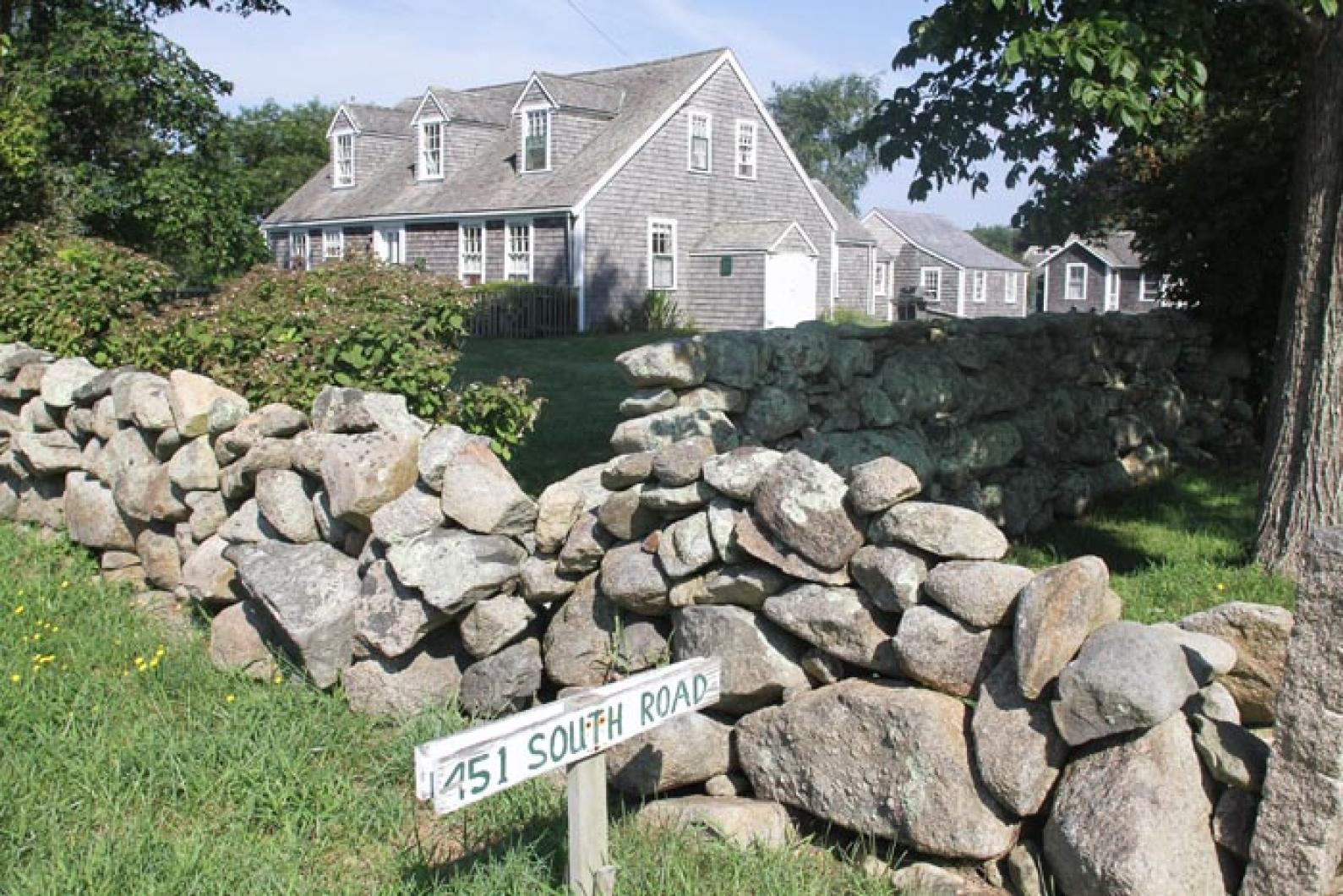
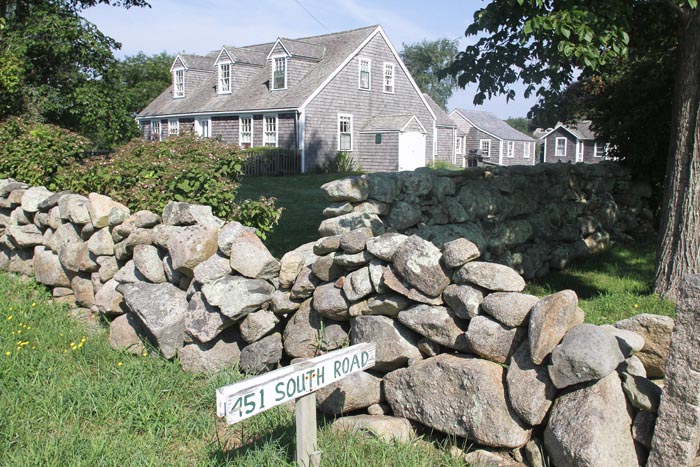
<p> The historic 17th century Barn House in Chilmark, famously home to an avant-garde communal colony of Vineyard artists, writers and intellectuals, is being considered by the Massachusetts Historical Commission for nomination to the National Register of Historic Places.</p>
The historic 17th century Barn House in Chilmark, famously home to an avant-garde communal colony of Vineyard artists, writers and intellectuals, is being considered by the Massachusetts Historical Commission for nomination to the National Register of Historic Places.
If the nomination is approved, the South Road compound would be the first place in Chilmark to be named to the national historic register. Vineyard landmarks on the national register include the Gay Head Cliffs, the village of Edgartown, the Flying Horses Carousel in Oak Bluffs and the five Island lighthouses.
The application will be reviewed at a Sept. 14 meeting of the state historical commission in Boston. If the application is approved, the recommendation then goes on to the National Park Service, the federal agency that oversees the registry.
Barn House residents John Herzan and his wife, Lauren Brown, have been at the forefront of the move to place the house on the national register. Ms. Brown has been a visitor to Barn House since she was a child. Journalist and political commentator Walter Lippmann, poet Sylvia Plath, painter Thomas Hart Benton, and American Civil Liberties Union founder Roger Baldwin were all summer visitors there.
“We’re very excited about the prospect of designation,” Mr. Herzan said in an interview at the property last week. “This is of great significance to the Island and the state.”
He said the designation is important for several reasons, including to recognize the historical significance of the original structures and to protect the property from environmental impacts, in the event of any changes to South Road or the area surrounding Barn House.
Much of the research done for the application was based on a dissertation done by Jonathan F. Scott in the 1980s on early colonial houses of the Vineyard. Ms. Brown said the research was critical in applying for the designation.
The 43-acre rolling property overlooks Lucy Vincent Beach, nestled in the heart of agrarian Chilmark. Structures on the property include a small, shingled former farmhouse dating to 1690 and one of the oldest buildings on the Vineyard, a barn built in 1786 and several small cabins from the first part of the 20th century, each named after the families who built them.
Formerly known as the Skiff-Mayhew-Vincent house, the farmhouse was home to a number of patron Vineyard families. Nathan Skiff, the first recorded owner of the property, purchased the land in 1686. The farm was one of seven on South Road that appear on a map sketched by fellow farmer Simon Athearn in 1694.
The main part of the barn was built with materials from the old Chilmark meetinghouse; some of the original fieldstone walls surrounding the property remain in place.
The property was sold to Simon Mayhew in 1731 after Mr. Skiff’s death, and it remained in the Mayhew family until Herman Vincent bought the farm in 1833. He ran the farm for 50 years, and at the time of his death had a flock of 74 sheep, one cow and one horse, the application says.
In 1900 the barn was converted to a milk room. Another building that dates back to the property’s days as a farm is a small, gable-roofed shed, originally used as a chicken coop in the mid-19th century. There is also a bath house with shower stalls and lavatories.
In the early 1900s Barn House became a retreat for writers, artists and social activists. In 1919 a group of friends calling themselves the Chilmark Associates bought the property and formed a communal colony, where meals and chores were shared among guests, stimulated by enlightened conversations. The owners included Stanley King, then president of Amherst College, and his friends Boardman Robinson, Clifford Wartnes, Wolcott H. Pitki and Dorothy Kenyon. The name Barn House was decided on at an annual meeting in 1927.
As the number of guests grew, more outbuildings were constructed; today there are eight cabins on the compound named for the families who built them.
Writer and Barn House resident Max Eastman described the people who lived at the Chilmark compound as “that tiny tribe or colony of writing and painting and thinking folk.”
The late Anne Hopkins, a longtime Vineyard resident who grew up summering at the Barn House, recalled those summers in an interview with oral historian Linsey Lee published in the Gazette in 2003.
“It was fun as a cooperative and the food was purchased by whoever was the housekeeper. For years it was my mother who did that and planned the meals, and we had a cook and what we called a chore boy. Now we have a chore boy or girls and a cook, because we can put up 33 people,” she said. “It’s as good as any summer camp.”
“The evening entertainment . . . the kids almost always did one production,” she continued. “And everyone was expected to work, especially during the war we had a rather large vegetable garden. Even now people are expected to work.”
Mr. Herzan said the environment at Barn House today is “very low key” and relaxed.
“Barn House is an ongoing institution,” the application says. “In its totality, Barn House, though altered over time, retains sufficient integrity to support its architectural significance as a rare survivor of the type of house erected during Chilmark’s earliest years of English settlement.”
Comments
I was 'chore girl' there
Doreen Ouellette Bolnick Harare, ZimbabweI was 'chore girl' there around summer of 1968 and '69 and just loved the place!!! I had afternoons off plus another full day. I had a map of the island with a goal of walking every road and as much of the shoreline as possible in two years. I had such a pleasant room by the cherry tree. I remember many members, including Lauren Brown who is about my age. I believe she must be the Lauren who wrote a book on weeds in winter. Turns out we had a shared interest in illustrating botanical field guides. I wrote and illustrated the first wild flower guides for Zambia and for Southern Mozambique. Continuing this thread, I taught at the Brookside Gardens School of Botanical Art in MD for five years before moving back overseas to Zimbabwe. My husband is a development economist and this is our 6th posting. My son, Dan, is a professor of evolutionary biology. His wife specializes in ancient DNA and they have two young daughters. Bruce and I plan to move back to MA. I hope to be able to stop by Barn House sometime in the future and hope it hasn't changed much.
My best regards to all I once knew.
Doreen Ouellette Bolnick
Harare
I was a chore boy at Barn
Peter Coughlan Palo Alto, CAI was a chore boy at Barn House from 1979 - 1982 and got to stay on post-season of my last year to paint the farm house. Around that time I met Jon Scott, who apprenticed me in his carpentry business. I woke up this morning with a flood of fond memories of the place and found this link. Delighted to see the place is still going!
I remember when I was younger
My name is Johnathan Arthur Loeser I reside in two places Rego park Ny and Armenia Qundio Colombia SAI remember when I was younger my family stay at Barn House it was one of the best times of my life ! I remember making Ice cream on Sundays for dessert! And the tennis courts and visiting my aunt Besey and in the in the early evening the Canadian geese would fly in and we use to watch all the rabbits run around the fields, I loved the cabin mice they would run around like crazy folk !
Add new comment