

<p>Wasque Point is a remote place; this is the far southeastern corner of Chappaquiddick, an island off an island. The name comes from the Algonquin word Wannasque, which means “the ending.” Where the land ends, there is nothing but Atlantic Ocean, dotted with flocks of scoters bobbing where the waves break, and then it’s ocean as far as the eye can see.</p>
Wasque Point is a remote place; this is the far southeastern corner of Chappaquiddick, an island off an island. The name comes from the Algonquin word Wannasque, which means “the ending.” Where the land ends, there is nothing but Atlantic Ocean, dotted with flocks of scoters bobbing where the waves break, and then it’s ocean as far as the eye can see.
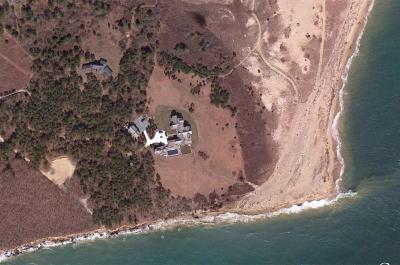
Schifter compound shortly after it was built, as seen via Google Earth imagery.
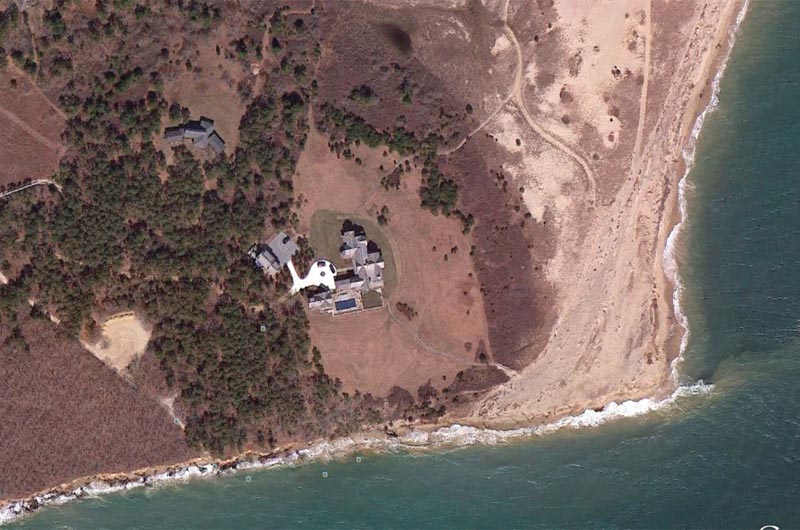
Schifter compound shortly after it was built, as seen via Google Earth imagery.
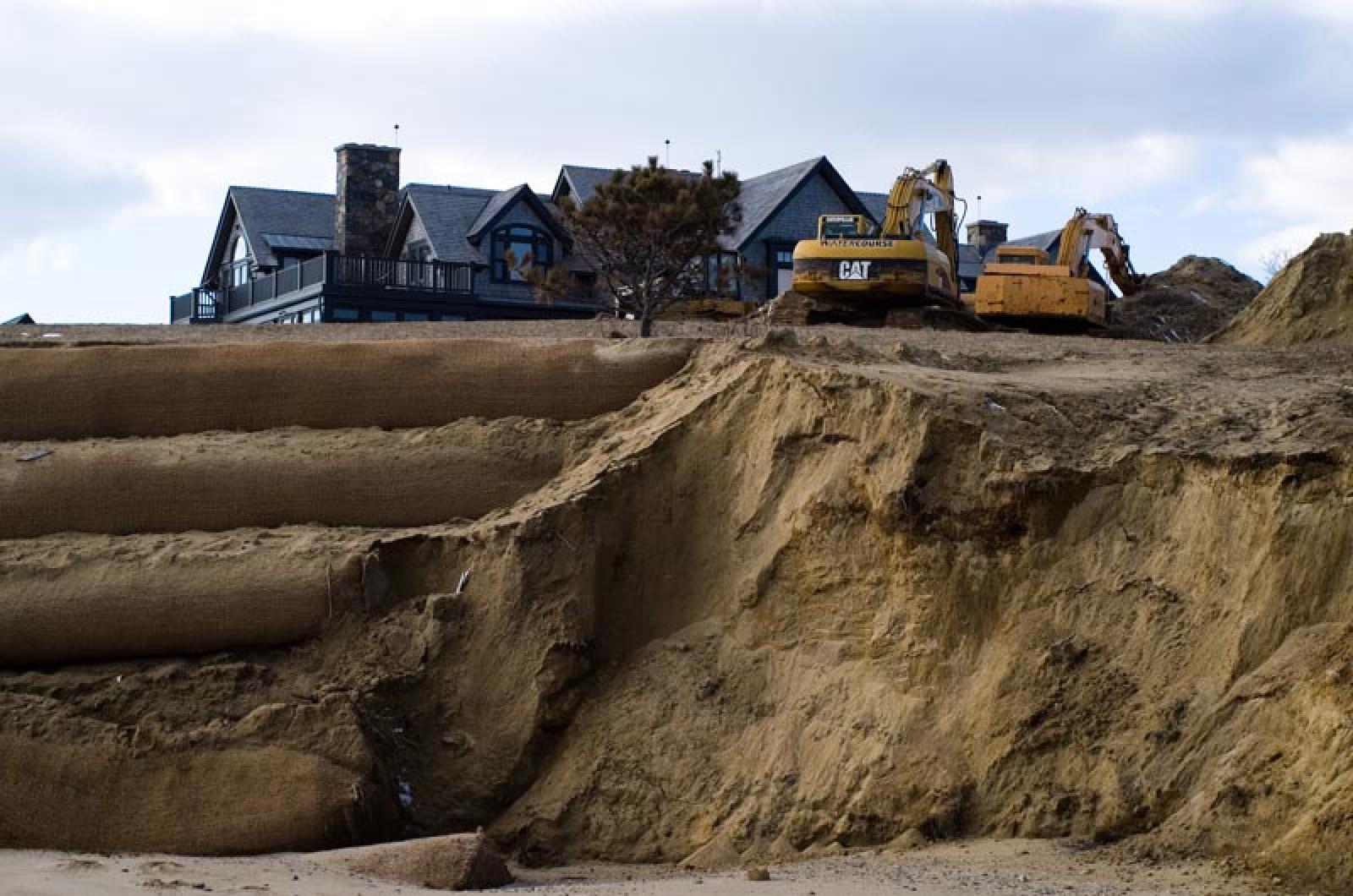
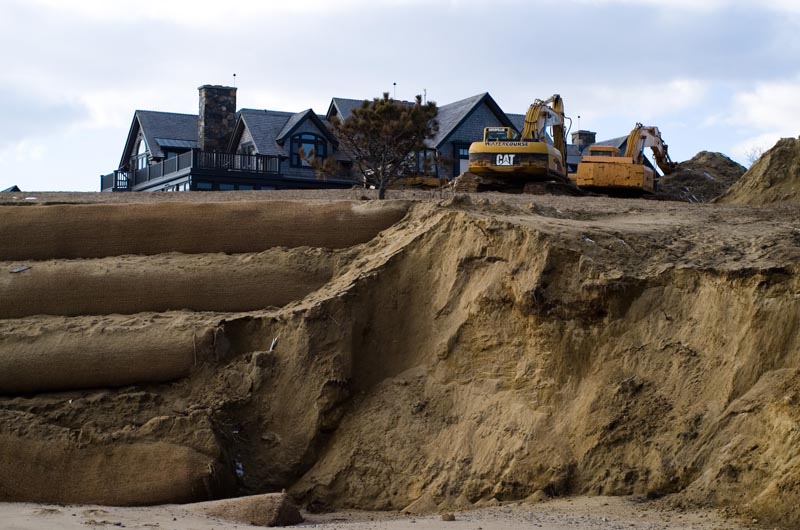
But at this point where sea meets land, nature has staged a dramatic event over the last year: severe erosion, said to be unprecedented, has drastically altered the landscape, eating away at the bluff and bringing the ocean ever closer to Richard and Jennifer Schifter’s summer home. Looking out at the ocean from the property, the lawn stops abruptly, 50 feet past a stone swimming pool enclosure, ending in a coastal bluff lapped by waves. Plans are now underway to move four structures on the Schifter property: the 8,803-square-foot house currently valued by the town at $7.6 million, a guest house, garage and another home farther inland, in an effort to save the property from the encroaching sea.
When construction on the home was completed in 2007, it was 220 feet away from the coastal bank. Mr. Schifter, a partner with a private equity firm in Washington, D.C., and Mrs. Schifter, who has a background in social work, came to Chappaquiddick because they were looking for a gathering spot for their four daughters and future grandchildren. Mrs. Schifter stumbled on the property online, and after coming out to see it, they put an offer in that day, on their first trip to the Vineyard. The family spends large parts of the summer there now and frequently visits in the off-season and over holidays.
The Schifter property is bordered by conservation land owned by The Trustees of Reservations. Poucha Pond lies to the east.
In 2007, an April northeaster caused a breach in the barrier beach that ordinarily runs between Katama and Wasque. The long ribbon of beach that once connected Chappaquiddick to Edgartown and divided Katama Bay from the ocean was broken. And the natural forces that resulted from the breach, which over time has narrowed and migrated eastward, led to the situation surrounding the Schifter house today. First there was severe erosion in early 2012 at Wasque Reservation, owned by the Trustees. A sandy beach has since disappeared and trees are tumbling off the cliffs into the surf.

George Sourati of the Sourati Engineering Group.
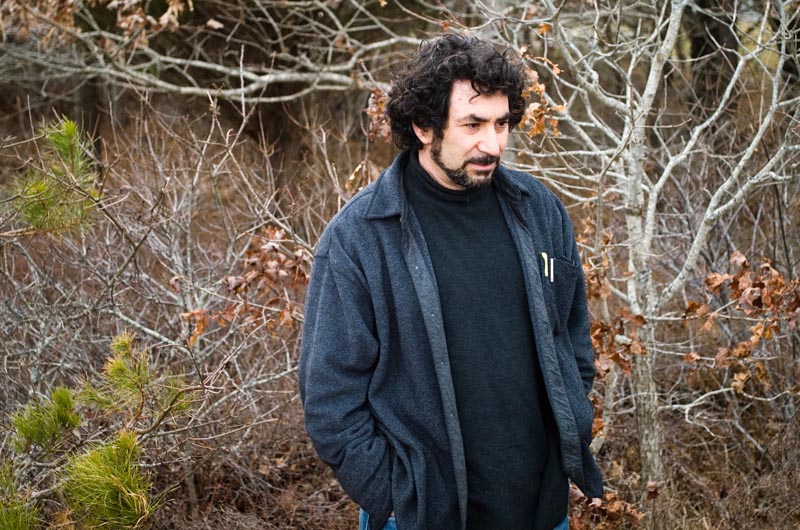
George Sourati of the Sourati Engineering Group.
Speaking to the Gazette by telephone this week, Mr. Schifter described his close-up view of the changes he has witnessed at his property. “Although the beach was gradually eroding, the water didn’t reach the bluff until August 2011,” he said. That was one week after one of his daughters was married on the beach. Hurricane Irene hit and brought waves up to the bluff for the first time, he said, but things stabilized after that.
But then the erosion began to accelerate in April 2012, he said. By August 2012, “it started to accelerate at a rate that clearly was posing a threat to us.”
He said his family was “confronted with a realization that inaction was not an option, sort of the reality that sunk in that our house was in fact threatened.”
W. Sterling Wall, a Chilmark coastal geologist who has been working with the Schifters, told the Gazette yesterday that the west side of the bank has lost about 70 feet from August 28 through Feb. 4. The east side, which is not protected, has seen even more pronounced erosion, about 125 feet. And now plans are under way to move the houses.
While Mr. Schifter said at first the idea “struck [him] as a daunting task,” in fact there was a method. George Sourati, an engineer who owns Sourati Engineering Group, found a group that could do the job: the International Chimney Corporation based in Buffalo, N.Y. The company specializes in moving historic structures and unusual buildings, and will work with a subcontractor, Expert House Movers.
The project has been fraught with complications.

In November 2012, after Hurricane Sandy and the northeaster.
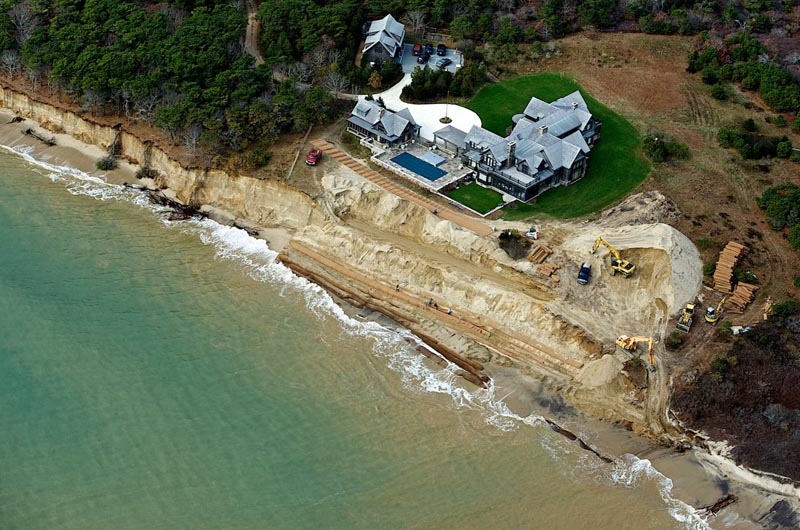
In November 2012, after Hurricane Sandy and the northeaster.
The first problem was finding a place where the house could be moved to; the Schifter property is nine acres, but more land was needed. So in December the Schifters bought neighboring property, including a house, from the Leland family for $4.5 million.
The Leland home will be moved first, making room for the rest of the project. Land behind the Schifter house will be cleared of scrub oak and pitch pine, and then everything — the main house, a guest house, a garage, a pool, a basketball court, the driveway, even the flag pole — will be either relocated or rebuilt.
In the end the house will be situated 325 feet away from the coastal bank, Mr. Sourati said.
Permits must still be obtained from the Edgartown conservation commission and the planning board; once they are approved, work will begin immediately. Richard Lohr, president of International Chimney, said a crew of about a dozen will be involved, and the company is ready to go.
The first phase of the project, expected to take about a month, involves excavation beneath the main house, which will be moved completely intact, including the basement.
Everything will be supported with a system including jacks and beams, Mr. Lohr said, and then jacked up and loaded onto about 20 small dollies, each the size of a small Volkswagen. The house will be raised up on a unified system, and a route will be prepared to the new location, where new foundations will be built. The actual move, getting from the old location to the new one on wheels, will take about a week, he said. The guest house and the garage will also be moved, though those are smaller projects, and the pool will be removed and then rebuilt at a new location. Mr. Sourati said the plan calls for careful recycling of materials whenever possible.
Richard Knight Jr. is the contractor for the move. He also built Schifter home.
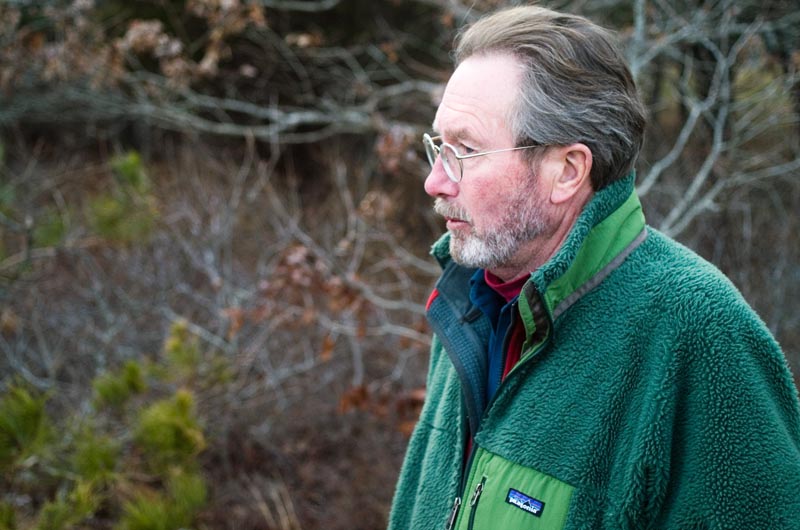
Richard Knight Jr. is the contractor for the move. He also built Schifter home.
Work by International Chimney will take about four to four and a half months. Remarkably, the Schifters will not be required to pack up any of their household goods. “Leave the furniture in the house, leave the pictures on the walls,” Mr. Lohr said. “It’s an unusual job, but it’s pretty routine for us,” he said. “We’ve certainly done a lot messier projects.”
One major logistical challenge will involve getting the equipment to Chappaquiddick, where most goods and building materials must travel on a small three-car ferry. Mr. Lohr said International Chimney will barge equipment to the Island from Maryland; the equipment will then be unloaded with a crane at the Chappy ferry point.
After the move, it will take about six months more to relocate and re-connect systems such as septic, electric and water.
The contractor for the project is Richard Knight Jr., whose building company Knight and Zadeh built the Schifter home originally. Now Mr. Knight and his partner Michael Zadeh will have the unique experience of taking the house apart — and building it again.
“It’s astonishing, really,” Mr. Knight said during a visit to the site this week, referring to the erosion. “And part of it is how quickly it’s happened as well. When the house was built . . . there was a bluff and then there was a beach, the beach was almost a quarter of a mile, probably, of sand out in front there. So the house when we built it and when we sited it, it felt safe and comfortable, and not at all vulnerable. But hindsight being what it is . . . looking at it now you can say, ‘well, this is process, this is mother nature.’ It was not expected, obviously.”

Coir bags used as last defense against erosion.
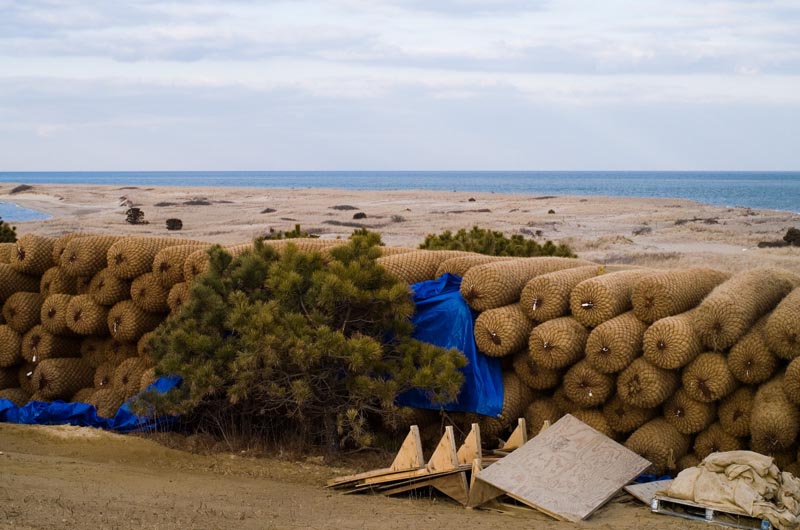
Coir bags used as last defense against erosion.
As for the future, when the breach closes, the erosion is expected to stabilize, but no one can say for sure when that might be.
“It’s a very difficult situation,” said Mr. Sourati, who as engineer will work alongside Mr. Knight on the project.
Both men said the job is unlike any they have ever done. “We’ve moved little buildings and houses, but nothing of this scale,” Mr. Knight said.
“No one’s worked on a site like this one,” Mr. Sourati said. “It’s so dynamic.”
Meanwhile, temporary emergency measures have been taken to stem the erosion. Late last year the conservation commission approved the installation of a coir envelope system, essentially huge, long envelopes of sand placed at the foot of the eroding bank. The question of whether the envelopes will be allowed to stay is a future issue for the town to address. The Trustees have already said that while they support the project to move the Schifter buildings, they will oppose any permanent beachfront protection system.
The issue was discussed at a conservation commission meeting last week. “We’re dealing with a really tough problem,” coastal geologist Leslie Fields told the commission last week. “This is so extraordinary at this site; the erosion rates are unprecedented and the applicant, the homeowner, is going to extraordinary measures . . . I’ve been in this business a long time and you see it rarely.”
Others raised the question of to what extent people should be allowed to protect their property.
“The bottom line is, the real decision is, are we going to allow in the future that man is going to be able to protect these investments . . . or are we going to say at a certain point, when the sea taketh, the sea taketh and that is it,” Chappy resident Woody Filley said.
With the Schifter house now perched at the very edge of Wasque, the questions come into sharp relief.
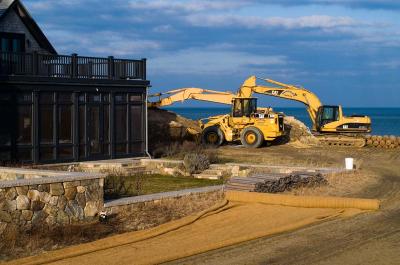
Work has been steady in trying to protect the home.
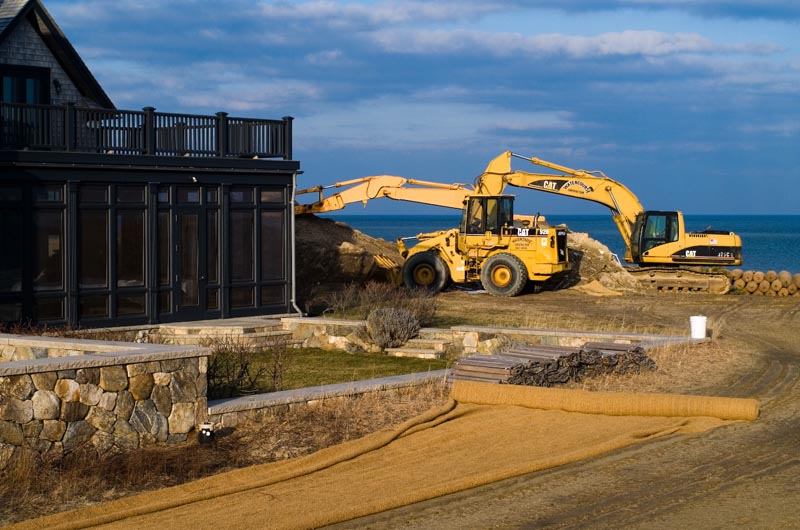
Work has been steady in trying to protect the home.
“When you’re there, it’s hard not to notice what is happening,” Mr. Schifter said.
While others deal with the logistics of the move and issues of coastal erosion, for the Schifters this also has been an intensely personal experience. “At the time we purchased the property and built the house, Jenni and I had four unmarried daughters, but we felt we were investing in a project that we could leave to our grandchildren,” Mr. Schifter said. “And we now have five grandkids and [a sixth] on the way, and they’ve certainly been getting everything out of the house that we hoped they would.”
He continued: “They love going there, and I’d say the toughest thing we’ve had to deal with is the realization that we may not in fact be able to leave something to our grandkids, and so from that standpoint it is gut-wrenching and stressful. But at the same time we try to keep things in perspective. It’s not a tragedy. Life gives everyone challenges, and this happens to be the one we’re dealing with now.
“You can fret about it or you can try to figure out if there’s something you can do to respond and to either mitigate the harm or to deal with it. And so what we’ve been trying to do is figure out the steps that we can take to increase the likelihood that there’ll be something at the end of the day that we’ll continue to enjoy, and that’s what we’re trying to do.”
Comments
Really? I am trying to
Tom Chakas Berkeley, CAReally? I am trying to understand why I find this story so galling.
Wealthy family builds dream house on a vulnerable corner of a sandpile of an island. Big surprise, the bluff erodes. Unprecedented, but not unpredictable. Had they lived on the island for any time before buying land, they might have understood the impact of water and weather here. No worries, buy the property next door, move the house. $4.5 million? No problem. Barge equipment from Maryland!
Couldn't someone warn this guy, or prevent him from building such a big house in a fragile place? At least he is considering his grandkids. When Mr. McNamara was building on the eroding bluff at Lucy Vincent beach, he was warned. His response: "I'll be gone, let my kids worry about it."
The only thing "unprecedented
Mark Robinson Cape CodThe only thing "unprecedented" about this situation is our failure to know our history and so we are forced to relive it. No, wait, that too is precedented. Beaches on MV, and especially at Wasque Pt., have been eroding and accreting for 10,000 years, when the glaciers last receded, leaving a pile of sand and gravel for the rising seas to shape, wear away and redeposit. The problem is that each generation thinks the sand movement is new because it's new to them! There are old-timers with almost 60 years of experience on Chappy, watermen like Dana Gaines, who, as an act of charity, could have provided specific knowledge of the erosion potential of Wasque, if anyone had asked. Instead, the homeowners undoubtedly relied upon the "expert" advice of off-island engineers who are over-educated and under-historied!
Hard to work up any sympathy
Joe Buti Lowell, MaInteresting engineering problem here. But what a waste of money.
simple engineering problem.
rob mclane casimple engineering problem.
I was astonished when they
Chris ChappaquiddickI was astonished when they built that house. The size of it and the proximity to the Wasque rip was surreal. They've learned the same harsh lesson as those that lived along the Jersey shore in homes that were at sea level. The Shifters can afford to fix their mistake and in the process put some private money into our economy. My only question is how can they justify moving the house to a spot which will still be within striking distance of the rip. Perhaps the Shifter grandchildren should have a special fund put aside for the next move.
It is not exactly a feel good
Jean NJIt is not exactly a feel good story. They built too close, bought the neighbor's property and now they are moving two houses. I wish that I had their problems..
You should do some research
Mike ChappyYou should do some research on this mans life. You may want to take that wish back.
Jean - google this man and
Mike ChappyJean - google this man and read about his life story. I bet you don't wish you had his problems. I'm guessing you wouldn't want to have your home invaded by soldiers, and your family rounded up like cattle. You'd probably have a tough time knowing that due to your birth place, you were the only person in your family allowed to leave and come to the USA - while the rest of your family was put into camps, and never came out alive. And thats just the beginning, he accomplished more in his life than most people ever will. This mans life is an amazing story, and this house just adds to it.
Cheers to them for choosing
Big fan MarylandCheers to them for choosing international chimney and expert house movers of Maryland. The are the best.
When I was a five year old,
Jim Todd N Water StWhen I was a five year old, the Edgartown Lighthouse was surrounded completely by water and the extensive shoals it marked. A boardwalk and a new wooden jetty stopped the sand flow in the September 1944 Hurricane and the first tiny Lighthouse beach began with sand migrating from Cow Bay. The Lighthouse Beach buildup accelerated when the stone causeway was built in 1945. Normal high tide reached the southwest corner of the lighthouse base until about 1975. All the beach accretion to the southwest has happened in 35 years.The forces at Wasque are many times greater. Ocean levels have risen about 6" since 1935 and that along with more frequent big storms has removed hundreds of yards of South Beach in the last century. This trend will accelerate with global warming. The Schifter grandchildren will see Wasque point erode at least 200 yards more in their lifetimes.
Wake up! Donate the land,
Frank Misa EdgartownWake up! Donate the land, salvage what can be salvaged from the house. Take the writeoff, gather up the insurance money, fire your builders, movers and engineers and buy another house on Chappy in a more stable area. Consider the monstrosity you have created on Wasque --- that area while eroded is now a tremendous eyesore. Start over. Factor in your learned lessons but leave Wasque alone.
can the house be moved to D.C
john burton vermontcan the house be moved to D.C.?
The only eyesore I see is the
Barry Roy ChilmarkThe only eyesore I see is the lack of compassion and kindness in your tone. Since the homes are not destroyed there is no basis for an insurance claim. Of course if they waited until the structures toppled into the water there would be both a claim and a true eyesore. In my opinion the owners are enduring a very costly remedy in a highly responsible manner. I have seen abandoned homes and portions thereof perched on cliffs in the San Juan islands. That is an eyesore.
I totally agree. I lived on
Agnieszka Meyro Albuquerque, NMI totally agree. I lived on Chappy for four years, and since I relocated I've been coming back every September. I watched all the changes. Chappy is an absolutely unique and precious environment, like no other place on Earth and we have the responsibility to protect it. I know most residents on Chappy feel this way and they've been active and vocal about it. The amount of time and energy and cost spent on building and then moving this house is appalling. Not to mention, it is an eyesore for anyone walking on the beach around the Point. I know, it's private property but I just wish people were more sensitive to nature and others around them.
DITTO!
sally johnsonDITTO!
Clearly Lots of new money
obporch obClearly Lots of new money doesn't make you smarter than any island old-timer.
Why would anyone whose house
cindy ChappyWhy would anyone whose house is 200 yards from one of the world's best beaches need a swimming pool? Doesn't the act of excavating a 8800 sq ft building, assorted out buildings and pool further aggravate the fragile balance, hastening the erosion?
Why would anyone build a pool
cindy ChappyWhy would anyone build a pool when they were living 200 yards from one of the best beaches in the world?
Doesn't excavating a 8800 sq. ft house, various out buildings and a pool further aggravate the delicate balance of an area already under assault by nature?
Does anybody know how it
Ian WTDoes anybody know how it survived the blizzard?
Best of luck to them. Do
Stephen J. O'Rourke Somerset, MABest of luck to them. Do what you have to do to save the house and enjoy with your family. My wife and I were married on the beach there when it was hundreds of feet wide! Now the exact spot where we were married is hundreds of feet under water! (Fortunately, the marriage is not under water!!!!).
So surprised to read some of the comments. I'm sure it's envy that the Shifter's have the means to have such a property. Like Mother Nature, human nature can be cruel as well.
Best of luck to the Shifter family.
I hope someone films a documentary about the move.
Amazing change in the Wasque
Billy D CtAmazing change in the Wasque point over the last 6 years. I remember the house be built in 05. We do a yearly surf fishing trip to Chappy. The expanse of the beach at that time was unmeasurable. When we have returned each subsequant year after the breech, Wasque has dramatically changed and after Irene one couldn't believe their eyes. Mother Nature is uncontrollable and unforgiving but the lost of that much beach front couldn't been imagined. Once a beautiful spot to drive the beach on a splendid evening to fish a great rip now just a distant view from the bluff. We will return again this June and view the regress of more shoreline and see the progress of the engineering challenge. Good Luck.
I cannot fathom why the
Christine Waltham, MAI cannot fathom why the Schifters felt the need to built such a humongous house that does not blend in with its natural surroundings. Problems often occur with house moves. I remember when the much smaller Vincent house was relocated to its present location behind the Whaling Church. It partially slid off the trailer on Main Street!
"Schifter compound shortly
Dave Boston"Schifter compound shortly after it was built, as seen via Google Earth imagery" is dated March 11, 2012 on Google Earth, but newer versions of the program will let you go back to 2007 shot before the beach was gone - check it out
Does anyone know or have an
Debbie EdgartownDoes anyone know or have an estimate of the total cost of this process? Not including the 4.5 mil for the house next door?
Does anyone know or have an
Debbie EdgartownDoes anyone know or have an estimate of the total cost of this process? Not including the 4.5 mil for the house next door?
Add new comment