

The Martha’s Vineyard Commission will open a new public hearing next week on revised plans for the Katama Meadows subdivision, after commissioners voted Thursday to accept the withdrawal of a previous application.
The Martha’s Vineyard Commission will open a new public hearing next week on revised plans for the Katama Meadows subdivision, after commissioners voted Thursday to accept the withdrawal of a previous application.
“This has a long and twisted procedural history,” commissioner Doug Sederholm said, outlining the project’s past.
In 2020, the commission denied a market-rate subdivision plan from Utah-based developers Douglas Anderson and Richard Matthews, who own the 54-acre Edgartown property and called their proposal Meeting House Way.
The applicants then took the MVC to court, charging that the regional planning agency had overstepped its statutory powers.

The new plan has new income restrictions.
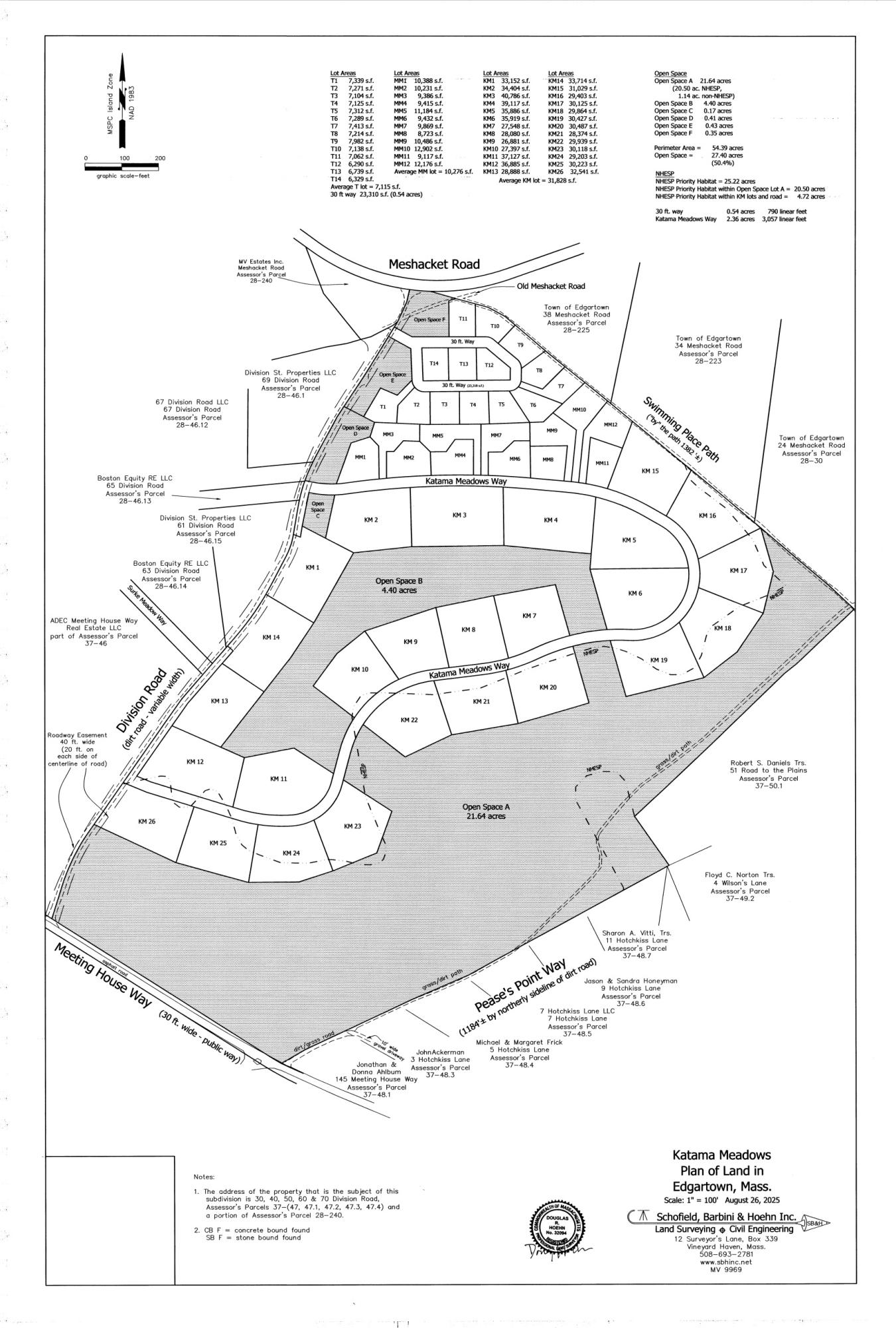
The new plan has new income restrictions.
After a judge in 2023 ruled that the commission did act within its authority in denying the project, Mr. Matthews and Mr. Anderson appealed his decision, both to the court of appeals and directly to the Supreme Judicial Court.
Both cases remain on pending status and the two sides have engaged in negotiations, Mr. Sederholm said.
“Those negotiations resulted in the application number 773,” he said, referring to the plan submitted in February of last year, which called for 26 single-family building lots, 12 duplex dwelling units, 36 affordable units for residents earning up to 80 per cent of the area median income (AMI) and 25.6 acres of protected open space.
Following a public hearing in March, the developers — now doing business as Katama Meadows, LLC — withdrew their application to both the MVC and the Edgartown planning board in mid-April, after the board’s chair was unseated in the town election earlier that month.
Edgartown’s planning board doesn’t allow new members to vote on projects that have already gone before the board.
The Martha’s Vineyard Commission’s policy for withdrawn applications is to impose a two-year waiting period before plans can be resubmitted, unless significant changes have been made.
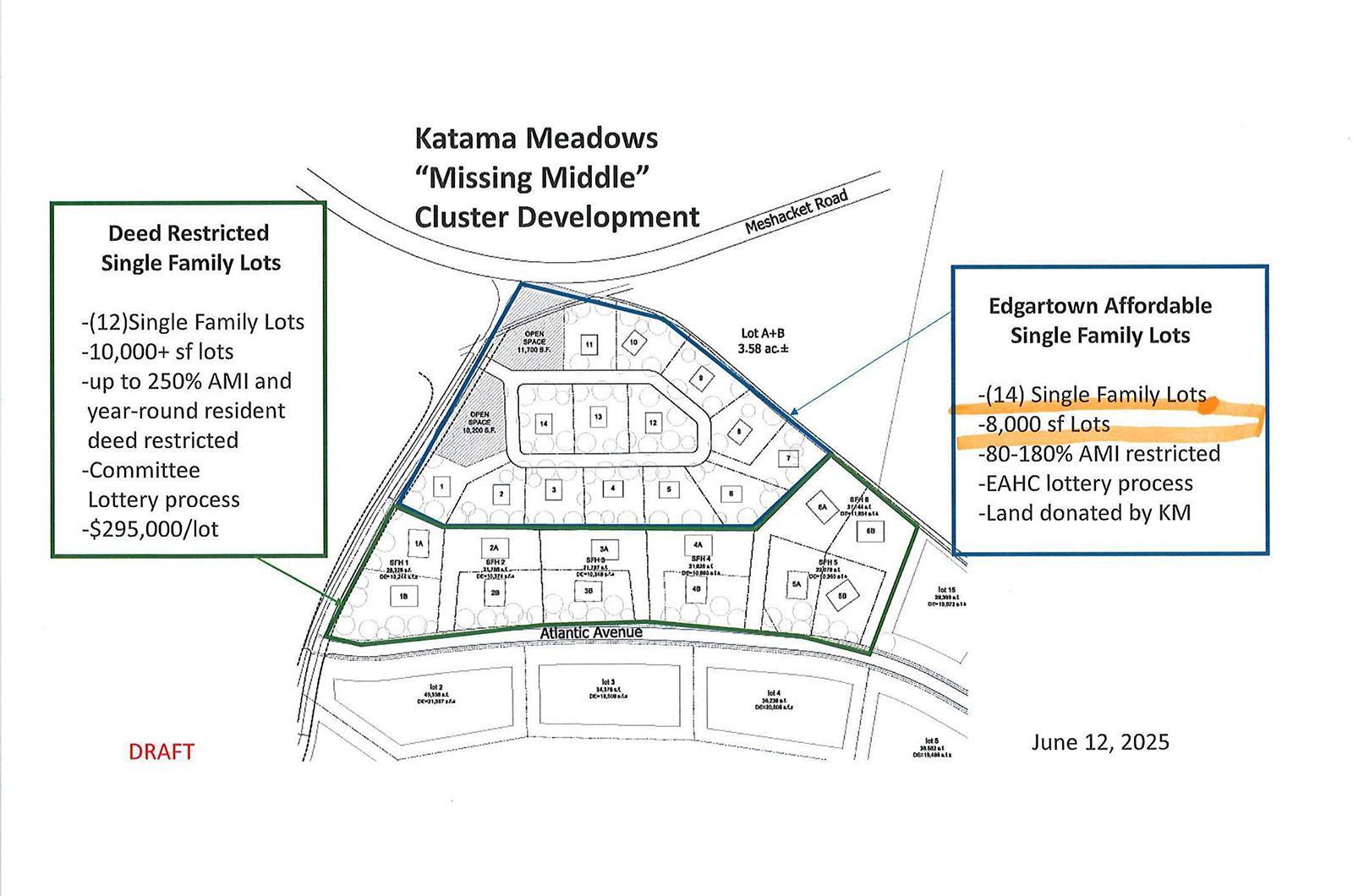
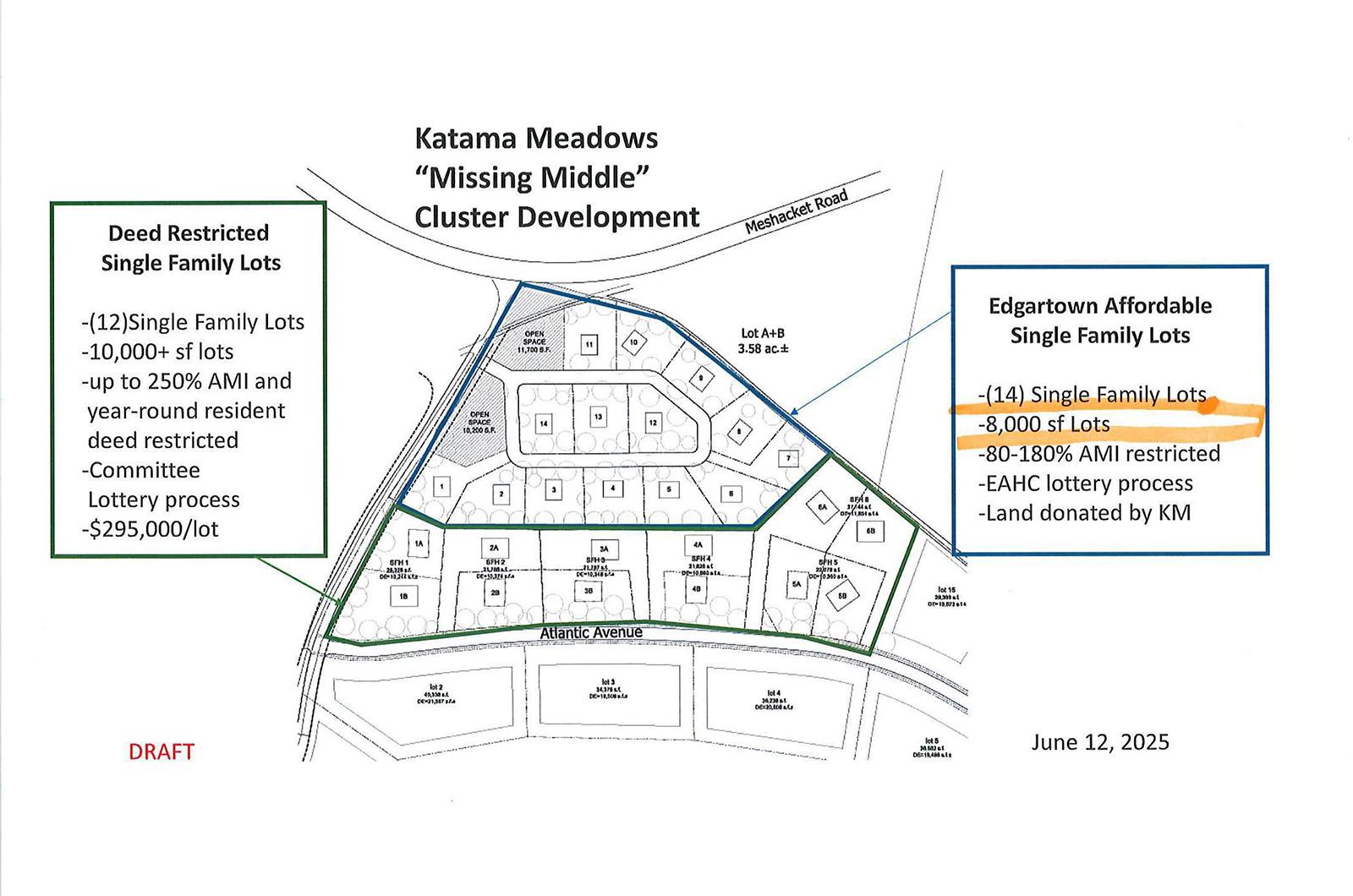
The new Katama Meadows proposal — the fourth since 2018, counting the two versions of the Meeting House Way subdivision — retains the open space and market-rate lots but raises income levels for the lower-priced parcels.
The developers now are pledging 14 lots to the town of Edgartown, with deed restrictions keeping them affordable to residents earning up to 180 per cent of the AMI.
Another 12 lots would be perpetually deed-restricted to year-round residents earning no more than 250 per cent of the AMI, according to the application.
In addition, deeds for the market-rate will include a 1 per cent transfer fee, to be paid by the owner when selling the property, to benefit the Edgartown Affordable Housing Trust, Katama Meadows attorney Robert Moriarty said.
On Thursday, Edgartown commissioner Jeff Agnoli argued that the new plan is not significantly different from the last one and should be delayed until the applicants make more changes.
Commissioner Ben Robinson, however, said the magnitude of difference between the plans was beside the point.
“The question really is, do we want to delay this two years or not?” said Mr. Robinson, who nonetheless abstained from the final vote, as did Ernie Thomas.
The remaining commissioners voted 9-3 to proceed, with Mr. Agnoli, Bernadette Cormie and Michael MacKenty dissenting.
The subdivision has drawn concerns from environmental organizations, as well as residents who felt the development was too big.
The public hearing is scheduled for the Jan. 22 commission meeting. Written testimony from last spring’s hearing on DRI 773 will not be carried over to the new case, Mr. Sederholm said.
Commissioners also voted to open a public hearing next month on plans to demolish the former Phillips Hardware building in Oak Bluffs and replace it with a three-story, mixed-use development.
The property’s previous owners, who had run the hardware store since 1928, received commission approval in 2016 for a similar project that never came to pass.
Current owner Jennifer Pacheco and her family, who bought the building in 2022 and also own Reliable Market next door, have revived the earlier plan to redevelop it with retail on the ground floor and apartments upstairs.
They are calling the project Oakwood, after a hotel that occupied the building during the Victorian era.
Although the MVC has already vetted the traffic, wastewater and other potential impacts of redeveloping the property, the building design has changed in the Oakwood proposal.
Where the previous plans showed gambrel roofs that echoed the existing roofline of the original Oakwood Cottage, which was connected to an adjoining cottage to form the Oakwood Hotel, the new design has a mostly flat roof with mansard towers at either end of the building facing Circuit avenue.
“The architecture is potentially something of regional impact,” said commissioner Willa Kuh, who called for a public hearing.
The vote was 9-4-1, with William Lake abstaining and nay votes from Mark Gauthier, Brian Smith, Mr. MacKenty and Mr. Thomas.
The public hearing is scheduled for Feb. 5.
Also Thursday, the commission voted unanimously to approve Ocean Club owner Reid (Sam) Dunn’s request to install a seasonal, heated vestibule inside the building’s stone porch by adding removable panels made from aluminum, clear plastic and canvas.
Intended to stop wintry air from entering the restaurant through its main door, the enclosure would be in place for four or five months a year, Mr. Dunn said.
“We would like it to be there only when necessary,” he said.
The vestibule — colored red to match the historic building’s Spanish-style tile roof — was installed temporarily and then removed while Mr. Dunn sought permission from the MVC.
Mr. Dunn also needs a building permit from the town in order to reinstall the vestibule.
Add new comment