

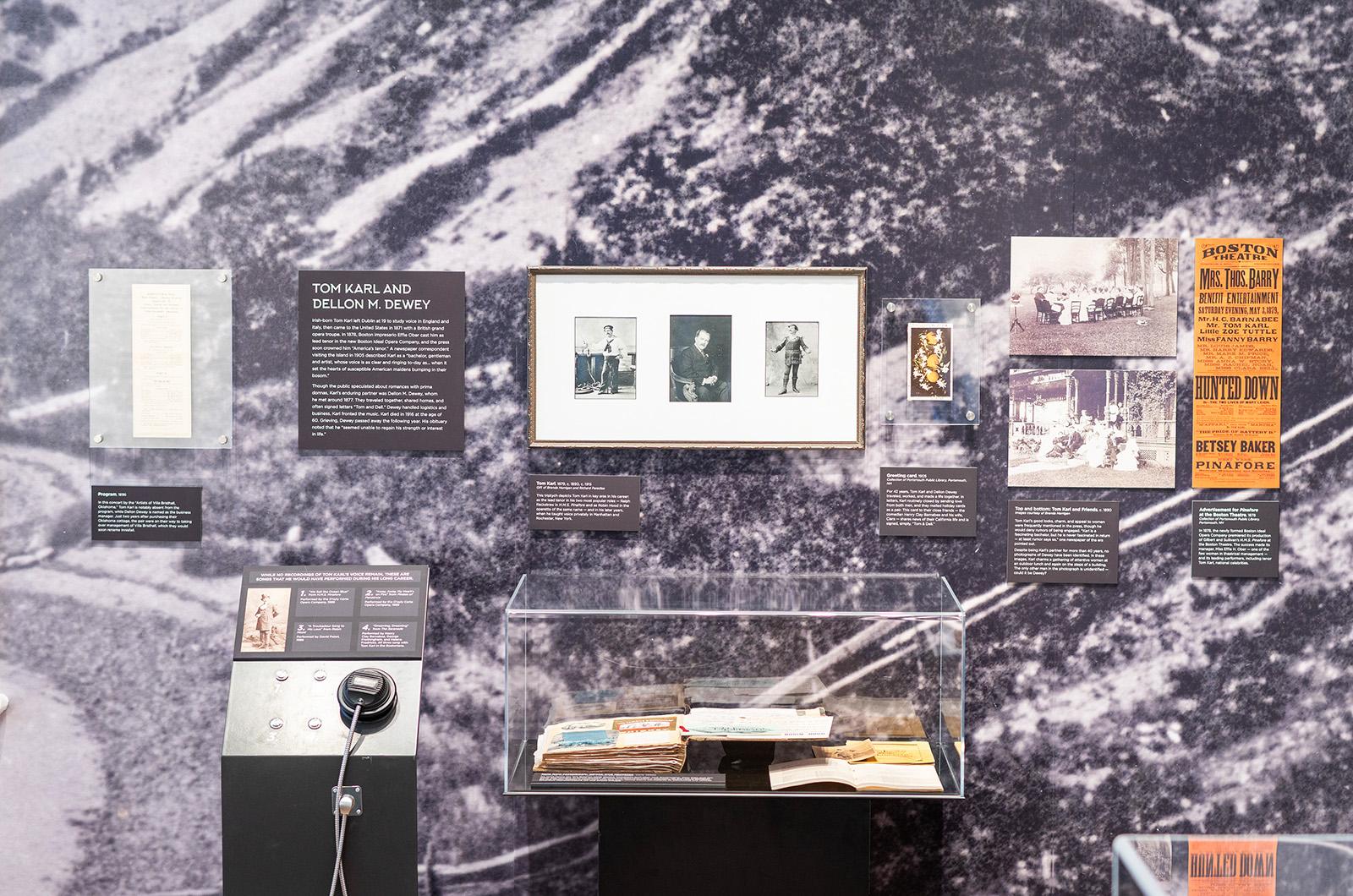
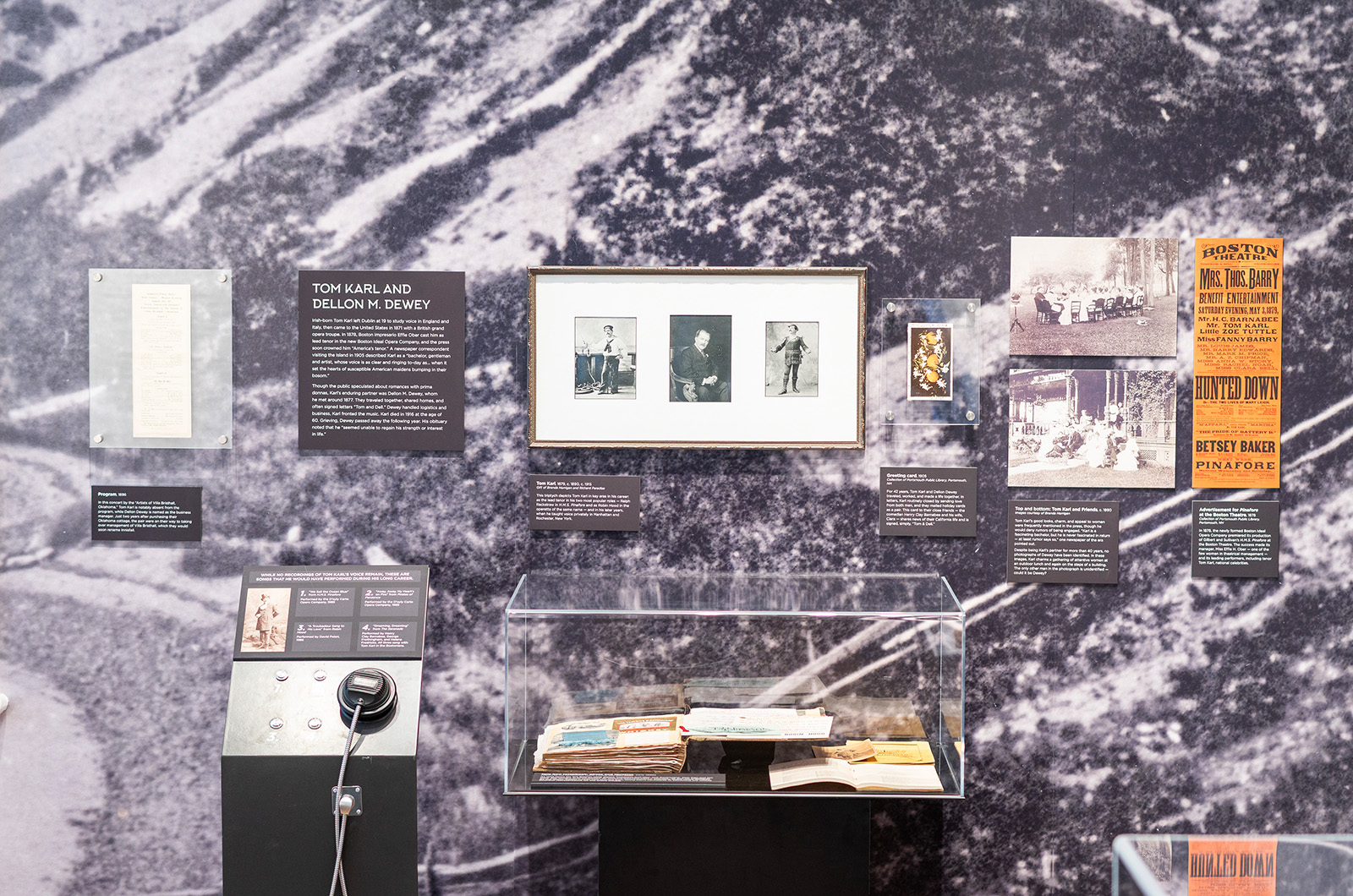
The Lost History of Innisfail exhibit is filled with artifacts and images telling the story of how an unsuccessful 1870s subdivision in Vineyard Haven became a summer enclave for touring opera stars, before it burned to the ground in 1906.
Oklahoma. Innisfail. Ghost Town. A swath of land between Lagoon Pond and the Edgartown-Vineyard Haven Road has worn all three names over the past 150 years, in a series of all-but-forgotten episodes the Martha’s Vineyard Museum is highlighting with a deeply-researched exhibition.
The Lost History of Innisfail, in the museum’s Waggaman Community Gallery through Jan. 11, is filled with artifacts and images telling the story of how an unsuccessful 1870s subdivision in Vineyard Haven became a summer enclave for touring opera stars, before it burned to the ground in 1906.
“The Vineyard is full of failed resorts, and this is one of them,” said writer Brenda Horrigan, who curated the exhibition with help from Island historian Chris Baer.
On Wednesday, Dec. 3, at 5 p.m., Ms. Horrigan and Mr. Baer will join the museum’s curator of exhibitions, Anna Barber, for a talk about Innisfail and its turn-of-the-century heyday as a summer music colony, headed by opera singer Tom Karl and his life partner, Dellon Dewey.
Ms. Horrigan also has a personal connection to Innisfail. When she and her husband, Richard Paradise, moved to the Vineyard in 1997, their first home was one of just three of the 19th-century cottages that survived the 1906 fire.
“It was 90 years’ worth of cobwebs,” Ms. Horrigan told the Gazette, recalling the boarded-up structure that she and Mr. Paradise bought as a fixer-upper from the son of Edward Dossert, one of the musicians who had summered at Innisfail when the cottage was new.
The building also contained a deceptively drab-looking paper sack that proved to be a treasure trove, she said.

Guest curator Brenda Horrigan will lead a talk on Dec. 3.

Guest curator Brenda Horrigan will lead a talk on Dec. 3.
“It was glass-plate negatives from 100 years ago, just stacked in there, and a letter and a map,” Ms. Horrigan said.
Intrigued by her discovery, she set out to learn more about the “life of freedom at dear old Innisfail,” referred to in the letter. By luck, Ms. Horrigan said, the couple’s architect was related to Eulalie Regan, the Gazette’s former longtime librarian and head of research.
Ms. Regan helped Ms. Horrigan unearth more information about Innisfail, its people and its origins in post-Civil War land speculation on Martha’s Vineyard. In 1872, big dreams were unfolding on the southwest side of Lagoon Pond, where a pair of investors gave the name Oklahoma to their planned 664-lot subdivision of summer cottages, complete with a hotel in the grandest Victorian style.
The partners — a Connecticut clockmaker’s son and the Dukes County sheriff — managed to sell some of their lots and got the waterfront hotel built by 1876, but the town of Tisbury declined to extend its roads to the neighborhood and Oklahoma never thrived.
Only a handful of cottages went up on the nearly nine-acre site, and the hotel struggled to stay afloat as the subdivision went through a series of owners over the next two decades.
In 1895, Mr. Dewey and Mr. Karl, an Irish-born American with a lilting tenor that took him from the grand opera stage to the head of his own operetta troupe, bought a cottage and a half-interest in the hotel and presented their first concert on Island the following summer, with Mr. Dewey credited as manager.
In 1897, the couple bought the rest of the hotel and 13 of the 50-foot-wide Oklahoma lots, renaming the hotel Innisfail and declaring their intention to establish a summer home for professional singers, complete with concerts in both Vineyard Haven and Cottage City (later Oak Bluffs).
For musicians like Mr. Karl, who toured constantly during the performance season from fall to spring, Innisfail was more than a vacation spot.
Show continues into January.
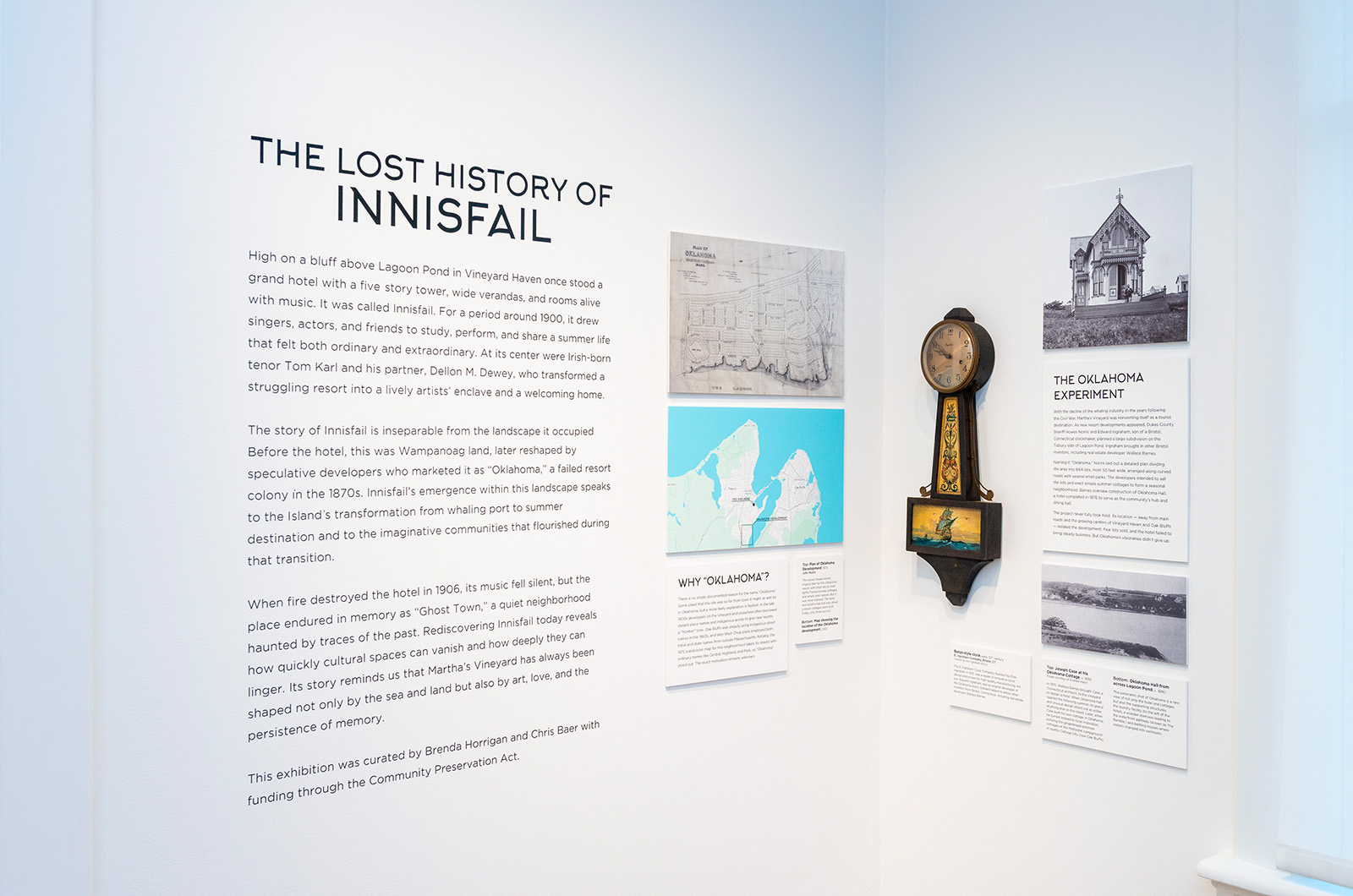
Show continues into January.
“These were working people. This was their home,” Ms. Horrigan said. “They taught, they did concerts around the Island, and Tom Karl would sing at Our Lady Star of the Sea Church in Oak Bluffs.”
Ms. Horrigan first shared her research in a 2001 article, Innisfail: When Irish Eyes Were Smiling on the Lagoon, in the Dukes County Intelligencer, which she has expanded into her first museum exhibition. A grant from Tisbury’s community preservation committee helped her extend her studies off-Island, to the New York public library, Harvard’s theatre archive and musical history collections in New Hampshire and Maine, to learn more about Mr. Karl and Mr. Dewey and the theatrical world they inhabited.
“If it hadn’t been for the CPC, it would be a much smaller exhibit,” Ms. Horrigan said.
Mr. Baer, a generational Islander who teaches at Martha’s Vineyard Regional High School, also helped expand the show, she said.
“He is a dream to work with,” said Ms. Horrigan, who drew on Mr. Baer’s historical expertise to represent the 19th-century era when Oklahoma, and then Innisfail, began.
Mr. Baer loaned some of the show’s most striking elements, including a carved and painted wood sailor figurine togged out in a near-copy of Mr. Karl’s costume in Gilbert and Sullivan’s The Pirates of Penzance, as shown in a nearby photo.
He also loaned his late mother Jacqueline Baer’s Memory Map, a large hand drawing from 2013 that recreates the artist’s childhood neighborhood — including the three “haunted houses” of Innisfail, with ghosts flying around them.
Writing in the Gazette decades after the 1906 fire, editor Henry Beetle Hough looked back on the musical community that he knew only through old-timers’ stories.
“There was no care at Innisfail... Innisfail could not last in this real, harsh world,” he wrote, correctly.
Mr. Karl and Mr. Dewey always had trouble keeping Innisfail afloat financially, and sold their Island holdings after the fire, never to return.
The Lost History of Innisfail is open during museum hours, Tuesday through Sunday from 10 a.m. to 4 p.m.
Add new comment