
Don’t squash my enthusiasm.
Don’t squash my enthusiasm.
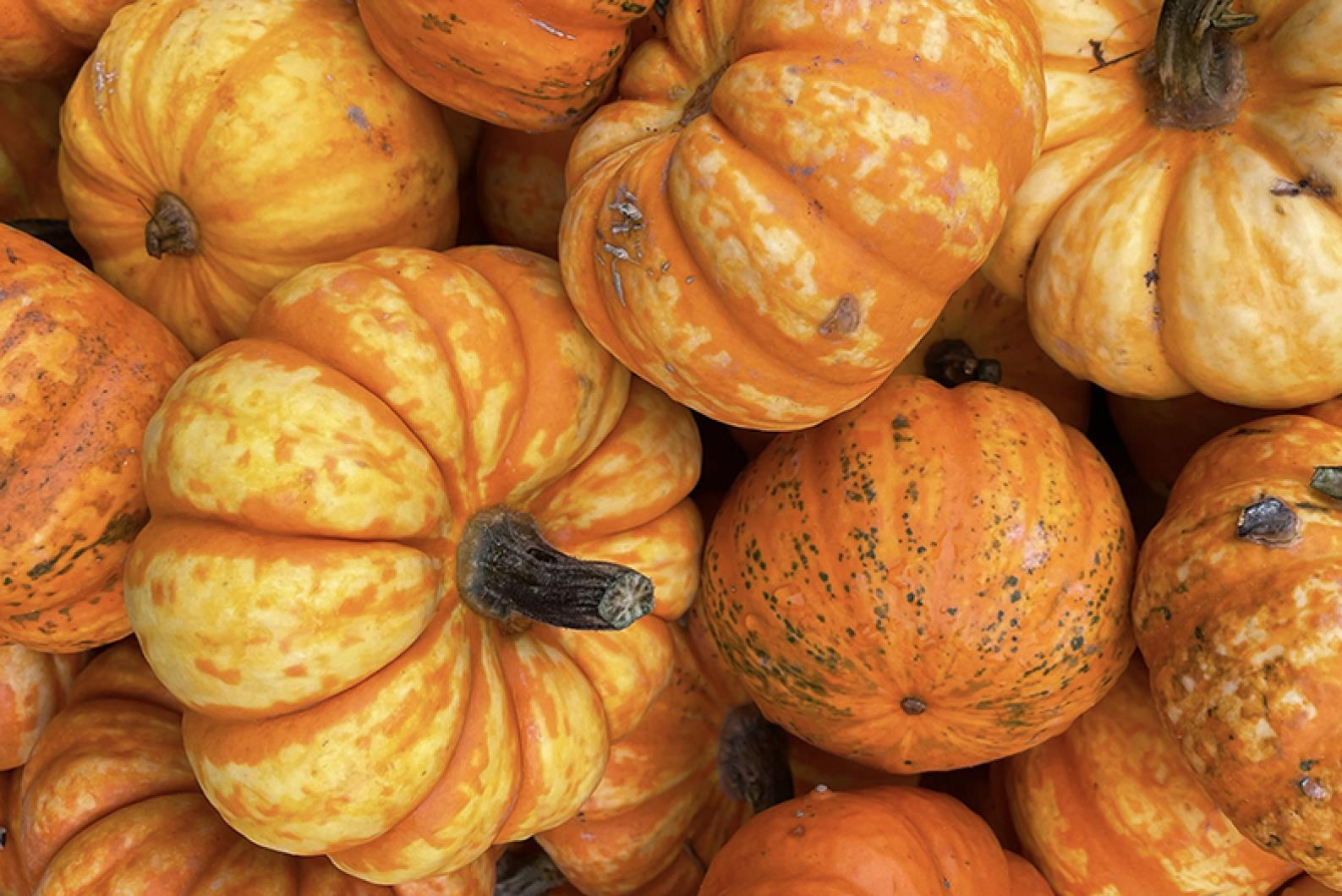
I am cultivating autumnal excitement for the season’s profusion of pumpkins. American farmers produce more than two billion pounds of the gorgeous gourds annually, and of that massive mass, eighty per cent are sold during October.
Halloween drives the decorative uses of so many of those orange orbs. This was not always so, as pumpkins have been more than just a pretty (or not so pretty) face for centuries.
Where did they originate? It’s not so easy to determine. Pumpkins can grow almost anywhere on the planet, except Antarctica, and have likely been on this continent as long as there were humans living here. Indigenous people cultivated pumpkins for food and medicine. It has been reported that Wampanoags called this plant pôhpukun, meaning “grows forth round.”
Other names for this ubiquitous vegetable (actually botanically a fruit) come from worldwide sources. The Greek root of the word describing this special squash was pépon, meaning “ripe or mellow.” The Latin pepo and French pompon could have led to the English pumpion, and eventually colonists used the term pompkin or pumpkin.
American colonists adopted this food source, raising pumpkins, and ate so many of them that a 1630s poem described their reliance:
For pottage and pudding and custard and pies,
Our pumpkins and parsnips are common supplies:
We have pumpkins at morning and pumpkins at noon,
If it were not for pumpkins, we should be undoon.
According to the New England Historical Society, at one time New Englanders were called pomkins, and the Boston area was referred to as Pomkinshire. Francis Grose, a British lexicographer, described New England as “pumpkin dominion,” and a biographer of 19th-century American journalist Horace Greeley declared that he belonged “to the nasal, angular, psalm-singing, pumpkin-growing generation.”
Pumpkins were used for almost exclusively as food until Irish immigrants brought a tradition of carving root vegetable lanterns to America. By the late 1800s and early 1900s, pumpkins became the carving orb of choice. With the popularity of decorative pumpkins, the Connecticut Field pumpkin emerged as the Halloween staple and gained traction in fields and on farms nationwide.
John Howden, a farmer from Sheffield, Massachusetts, took pumpkin agronomy to the next level and perfected a variety that provided the right size, shape and holdable stem so desired by knife-wielding holiday celebrants. His cultivar, the Howden pumpkin, became the ideal specimen and was patented in 1971 and commercialized by the end of that decade, well after Charles Schulz popularized The Great Pumpkin in 1959. In addition to the Howden pumpkin, John produced the Howden Biggie for those that wanted to live (and carve) large.
It is only after Halloween, when there just might be too much of a good thing, that our beloved holiday tradition begins to melt and rot. This doesn’t have to become a disposal dilemma.
Pumpkins can be composted, used for livestock feed or eaten by humans or wildlife, though care should be taken if you plan on simply throwing pumpkins into the woods. Don’t pitch ones with decorations such as paint, plastic, glitter, etc. that could contaminate soil or harm animals. Also, be wary of where you dispose of them. Too close to a road could put animals at risk for vehicle strikes and too big of a pile could bring rats or concentrate wildlife, sharing diseases among them.
Nor is it recommended to put pumpkins in traditional garbage or waste streams, as they take up valuable space and add to the large amount of food waste that could be diverted or better managed. Use your noggin, lest one be accused of being daft as a Headless Horseman.
Whatever you do, don’t let those end-of-life decisions drive you out of your gourd.
Suzan Bellincampi is director of the Felix Neck Wildlife Sanctuary in Edgartown, and author of Martha’s Vineyard: A Field Guide to Island Nature and The Nature of Martha’s Vineyard.
Add new comment