
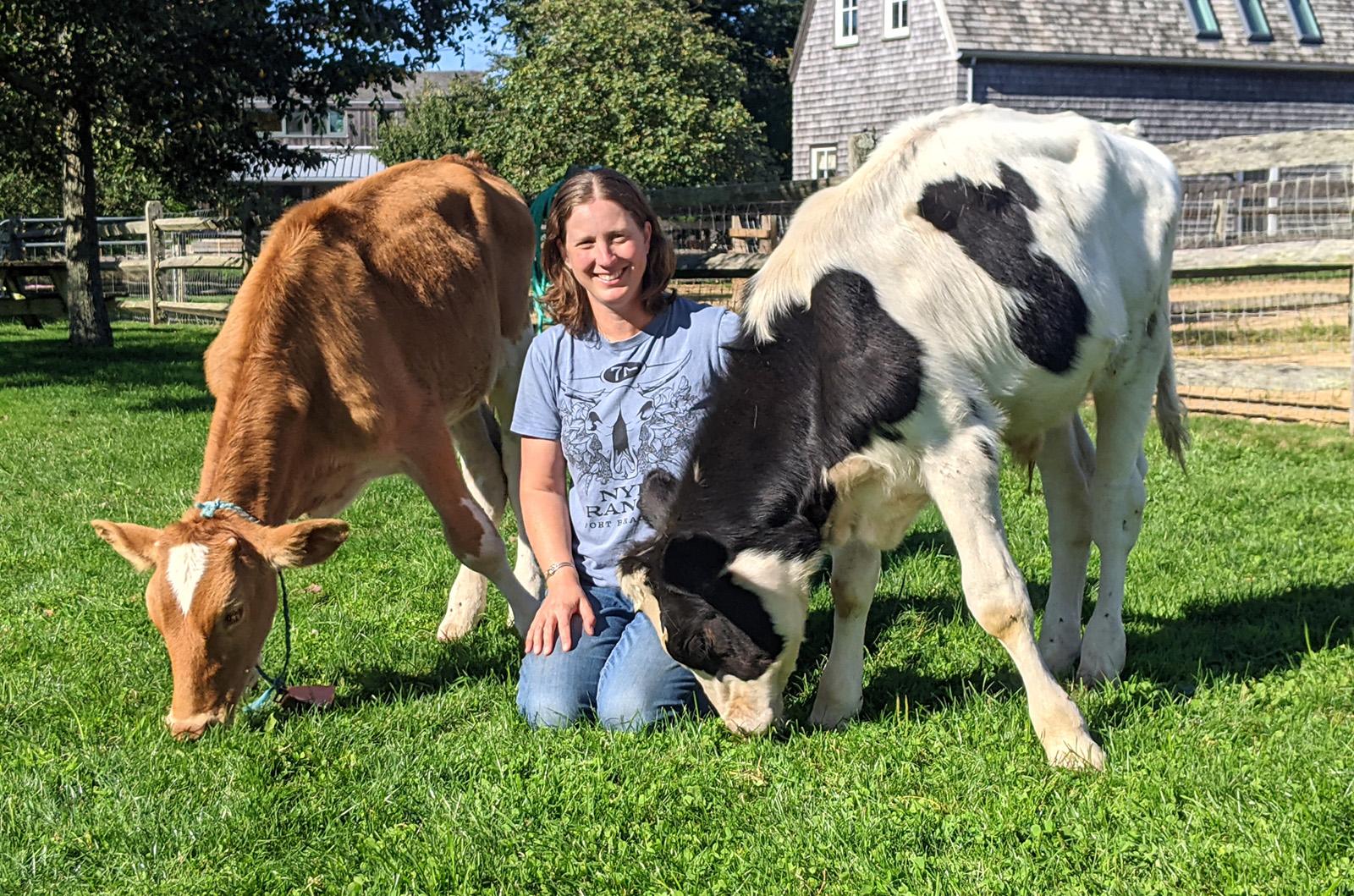
Blind Brian and Calamity Carl are two hard-luck bull calves.
Blind Brian and Calamity Carl are two hard-luck bull calves. Brian was one of the last calves born at Grey Barn before it shifted its focus from milk production, and Carl was born on a dairy farm in New Hampshire.
Bull calves born on dairy farms generally have a grim future. After all, the main product of a dairy farm isn’t calves — it’s milk. So breeds like Normande, Holstein, Jersey and Guernsey are bred to produce as much milk as possible.
Blind Brian is a Holstein, and Calamity Carl is a Guernsey. These cattle have lean bodies and the cows’ udders are heavy.
Here’s a hard truth. Dairy calves are routinely separated from their mothers at birth and are bottle-fed formula because the cow’s role is to make milk for humans, not for her calf. A female calf might have a future in milk production, and a few bulls are kept for breeding, while the vast majority of bulls are castrated and become beef.
But sometimes there’s another path, a path so narrow as to be statistically negligible, and that is learning to be oxen. Tractors have almost entirely replaced teams of oxen in the United States, but they still have a sporty function — competing at fairs. Some of them have a practical use, such as helping loggers by dragging logs to where they are needed. Oxen are not as efficient as diesel-powered equipment, but they don’t damage the ecosystem like a tractor does.
As an aging teamster, I’m excited that the 4-H Cowpokes are honing their teamster skills. They are so motivated that in October, four of them: Charlotte Goeckel, Wren Robertson, Penny Athearn and Emme Carroll, attended a weekend workshop on working steers, oxen and horses, hosted by the Draft Animal Power Network at Sanborn Mills Farm in Loudon, N.H., the town where I reside when I’m not on the Vineyard.
Steers are neutered bulls, and “working steers” are in training to be oxen.
Oxen have been part of Vineyard history. Side by side in a yoke, they hauled logs and rocks. It was oxen, not glaciers, that cleared the rocks out of farm fields. If you love the Vineyard’s picturesque stone walls, you have oxen to thank.
Currently, the Vineyard is home to four teams: a pair of oxen affiliated with Brookside Farm, a pair of working steers at Morning Glory Farm, Cicilio Neto’s team of Chilmark and Titanic, and the unlikely duo of Carl and Brian, currently living at Slough Farm on Butler’s Cove Road.
Brian is blind, which on most farms would be a death sentence, but Julie Scott, Slough Farm executive director, bought him. When I asked her why, she told me, “I just turned 40 and as part of my almost midlife crisis, I decided to buy Brian and give him a chance. I’d like my 10-year-old son, Henry, to have a working steer pair.”
This meant Brian needed a partner.
Carl, born on a farm near mine in New Hampshire, was a huge calf that had a difficult delivery. His farmer had to pull him into the world, saving both him and his mother. Because he was so big, his legs were weak and splayed. Not exactly the picture of promise. Yet Julie welcomed him, too.
Carl’s troubles didn’t end there. Not long after arriving on the Vineyard, he developed a dangerous abscess near his belly. For most farmers, already working with slim margins, the cost of surgery would have been unthinkable. But Julie loaded Calamity Carl into the back of her SUV and drove him to Tufts Medical Center. The surgery was successful and Carl survived.
The two steers currently live at Slough Farm, where they are cared for, trained and, most importantly, loved. Which brings us to another benefit bestowed by these steers: they build character. Children can develop a great deal of confidence while learning to control a 300-pound steer team, confidence that will serve them for the rest of her life.
Training them is a team effort and each week, the Cowpokes teach them voice commands: “walk on,” “come gee” (turn right), “come haw” (turn left), and “whoa.” Carl wears a bell so Brian can always locate him. The two sleep side by side and groom one another with long, patient licks, just as their mothers would have.
Last week, I watched Skylar, a 13-year-old Cowpoke, call out to Brian. Without tugging his lead rope, he followed her voice and stepped forward to follow her, his nose brushing her back. Beside him, Carl followed another Cowpoke, Charlotte, age 11, his bell chiming as he followed her command.
I felt tears rise as I watched them, two calves who should not have survived, now thriving, working and loved. For me, the Vineyard is a garden of wonders, and the unlikely success of Brian and Carl is another 300 pounds of Vineyard magic.
Carole Soule and her husband Bruce Dawson own Miles Smith Farm in Loudon, N.H. and spend winters on the Vineyard.
Comments
What a great article. You
Laura Prichard West TisburyWhat a great article. You capture many of the important life lessons I was lucky to have learned growing up on a cattle farm in Illinois, before marrying into a Vineyard family. Working with animals is a fantastic way to learn patience, resilience, and the importance of slow, iterative progress and practice in our busy world. Keep up your great work!
I love this article, it’s so
Kat CambridgeI love this article, it’s so timely as I am rereading the James Herriot books. Throwback to another time where humans worked with the animals together. Thank you!
Julie is the best! And thank
Susie Middleton West TisburyJulie is the best! And thank you for this story. Love that the 4-Hers are getting to continue this tradition.
Add new comment