


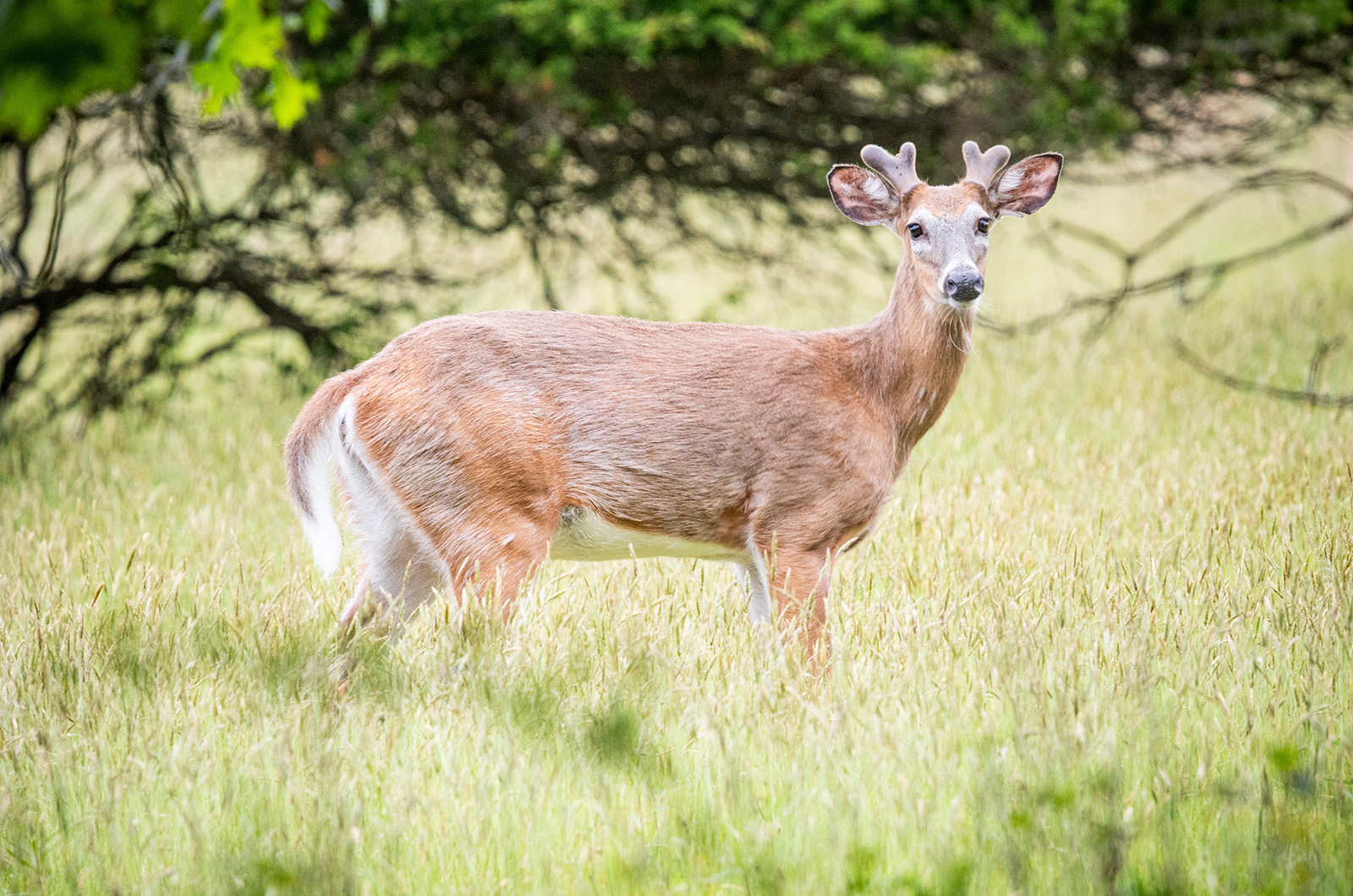
The Massachusetts Division of Fisheries & Wildlife (DFW) relies on hunters to reduce the growing Martha’s Vineyard deer herd. Islanders broadly have a stake in the hunters’ success.
The Massachusetts Division of Fisheries & Wildlife (DFW) relies on hunters to reduce the growing Martha’s Vineyard deer herd. Islanders broadly have a stake in the hunters’ success.
Deer help to fuel the Island’s worrisome increase in ticks. And the menu of illnesses that ticks transmit is a threat to public health on Martha’s Vineyard. Unchecked, the increasing risk of contracting Alpha-gal syndrome , Lyme disease, Anaplasmosis, Ehrlichiosis, Babesiosis, Powassan Fever, Rocky Mountain Spotted Fever and Tularemia may affect the Island’s seasonal economy.
Finding a tick crawling on your leg or arm or clothing is alarming. It can discourage folks from visiting the woods, the beaches or the many favored walking trails. Public health officials are worried.
I am a deer hunter, and I’ve relied on permethrin-treated clothing, insect repellent and a doxycycline backup to fend off deer ticks and give me a sense of personal security. But the lone star tick’s well-documented, relentless advance across the Vineyard landscape scares me. Just a bite from this newcomer may result in a recently identified and not fully understood mild to severe allergic reaction to mammalian-derived products. I’m not ready to become a vegan.
What to do? Island social media naturalists think that flocks of noisy guinea hens could eat enough of the suckers to make a difference, but studies show they prefer a juicy grub or worm to a scrawny tick.
The more excitable among us suggest spraying insecticide (goodbye butterflies and bees). That’s an idea rooted in desperation.
A single female deer tick lays a mass of approximately 2,000 to 3,000 eggs after becoming fully engorged on a blood meal. The more fecund lone star lays a cluster of 3,000 to 8,000 eggs, which gives rise to the notorious tick bomb, when hundreds of tiny nymphs cluster together in search of a blood meal (for instance, an ankle).
Small rodents and mammals help ticks to survive. But deer provide the primary breeding opportunity for a blood meal with which they thrive. More deer equal more ticks.
Martin Feehan, the deer and moose project leader for the DFW, says that the Island deer population is “north of 50 deer per square mile in areas that are open to hunting,” and in areas that are closed to hunting, “it is very likely that they exceed even 200 deer per square mile.”
Mr. Feehan would like to see more Island properties open to hunting. DFW’s ideal number is 12 to 18 per square mile.
DFW is working to give hunters the tools to achieve that goal. Years ago, the archery, shotgun and muzzleloader seasons combined lasted 27 days in Wildlife Management Zone 13, which comprises the Vineyard and Elizabeth Islands. The upcoming season begins on Oct. 6 and includes a special January winter season that ends on Jan. 31. With all the proper tags, hunters will be able to harvest three bucks and an unlimited number of does.
In addition, land trusts, farms and individual land owners can apply for a deer damage permit to take deer out of hunting season. Those deer must be donated to DFW’s “Hunters Share the Harvest Program.” DFW has also asked state lawmakers to reduce the 500-foot hunting setback, and remove the medical restriction needed to hunt with a crossbow and allow hunting on Sunday, all measures that would increase hunting efforts but have failed to win popular approval.
Mr. Feehan says that calls for alternatives to public hunting, such as sterilization and professional “lethal removal,” fail to take into account their limited effectiveness, except in small, closed communities, and the enormous costs of those programs. DFW says hunting is the most cost-effective means of reducing deer numbers and provides valuable outdoor recreational opportunities and a source of high-protein meat for the community.
But seeing lots of deer in backyards and fields belies the fact that these remarkable animals are very good at sensing danger. When pressured, they move to a safer habitat or become nocturnal. Hunting success is built on considerable time and effort. It requires weeks of preparation and specialized equipment. Days often go by before a deer comes into range. Hard work follows a successful shot: recover the deer in prime tick habitat; field-dress the animal as soon as possible; store it below 40 degrees to preserve the quality of the meat.
However, even as the deer population is increasing, hunting is decreasing. One gauge is the number of doe tags hunters purchased in Zone 13, in addition to the two buck tags they received with an annual hunting license. In 2019, DFW estimated there were 52 deer per square mile in areas open to hunting. That year, hunters purchased 2,307 doe permits and harvested a record 1,119 deer of both sexes.
In 2023, DFW put the per square mile estimate at 55 deer. Hunters purchased 1,565 tags and harvested 846 deer.
DFW’s harvest figure for 2024 is 798 deer. That’s not a good trend. What can be done to reverse it? Low-cost processing. A hunter drops off a deer and picks it up later as packaged venison.
On average, it takes about five hours to skin, butcher, vacuum-pack the meat, and dispose of the deer carcass. It’s a laborious process. The few people on Martha’s Vineyard willing to process deer charge a minimum of $200. After two or three deer and meat in the freezer, many hunters are done for the season.
The Martha’s Vineyard Agricultural Society, in collaboration with the Dukes County Tick Program and the Island Grown Initiative (IGI), operates a community deer cooler and charges participating hunters a small seasonal fee. IGI also accepts donations of whole deer to the DFW-sponsored and subsidized “Hunters Share the Harvest” program. In return, the seasonal cooler fee is waived.
This season, the Martha’s Vineyard Hunt Club will also be a participating processor in the share the harvest program. However, unlike the IGI program, hunters will have the option to pay a discounted processing fee and retain some of their venison so they can share it with their family and friends.
For more information, go to mass.gov/orgs/division-of-fisheries-and-wildlife.
Nelson Sigelman is the author of Martha’s Vineyard Outdoors, Fishing, Hunting and Avoiding Divorce on a Small Island. He lives in Vineyard Haven.
Add new comment