
Do snakes really have lips?
Do snakes really have lips?
That question was on my mind last week as I learned about the red-bellied snake’s peculiar practice of what is called lip curling. These small serpents curl their lips upward, exposing their teeth when ingesting prey or when faced with a predator. A silly snake smile is my mammalian impression of this behavior, when in fact the grin could be seen as scary and threating to something smaller than myself.
The scales of snakes that border their mouth are called labial scales. Labium is Latin for lips, so yes, it appears that snakes do have lips.
And this behavior is only one of the ways that this petite provocateur protects itself. A red-bellied snake can also release musk from glands at the base of its tail to dissuade predators. A less aggressive act is to play dead. The red-bellied snake feigns a dramatic demise by rolling over and exposing its belly to confuse or surprise its enemy, and can also flatten its body to seem bigger or perhaps appear injured.
These actions and reactions are not the only things that make red-bellied snakes successful masters (or mistresses) of their domain. It seems that every part of them and their habits helps red-bellies thrive and adapt.
Consider their skulls. Snakes have kinetic craniums that have movable parts. Unlike mammals, which have akinetic or non-shiftable skulls, snakes are able to manipulate their crania through jointed parts. Some snakes, such as boas, have up to eight hinged skull parts that can move independently of each other.
The red-belly’s skull is smaller than other snakes and movement of the different parts allows for cranial adjustment. A benefit of this ability is apparent when the snake is able to adjust its jointed skull and insert its head into a snail’s shell and consume the meaty morsel inside.
Snails are a food of the red-bellied snake, but not its favorite. That designation belongs to slugs, which are a primary prey. The red-belly’s slender, incurved teeth allow for consumption of such a slimy snack. Also on the menu are earthworms, insect larvae, pill bugs, young salamanders and small frogs.
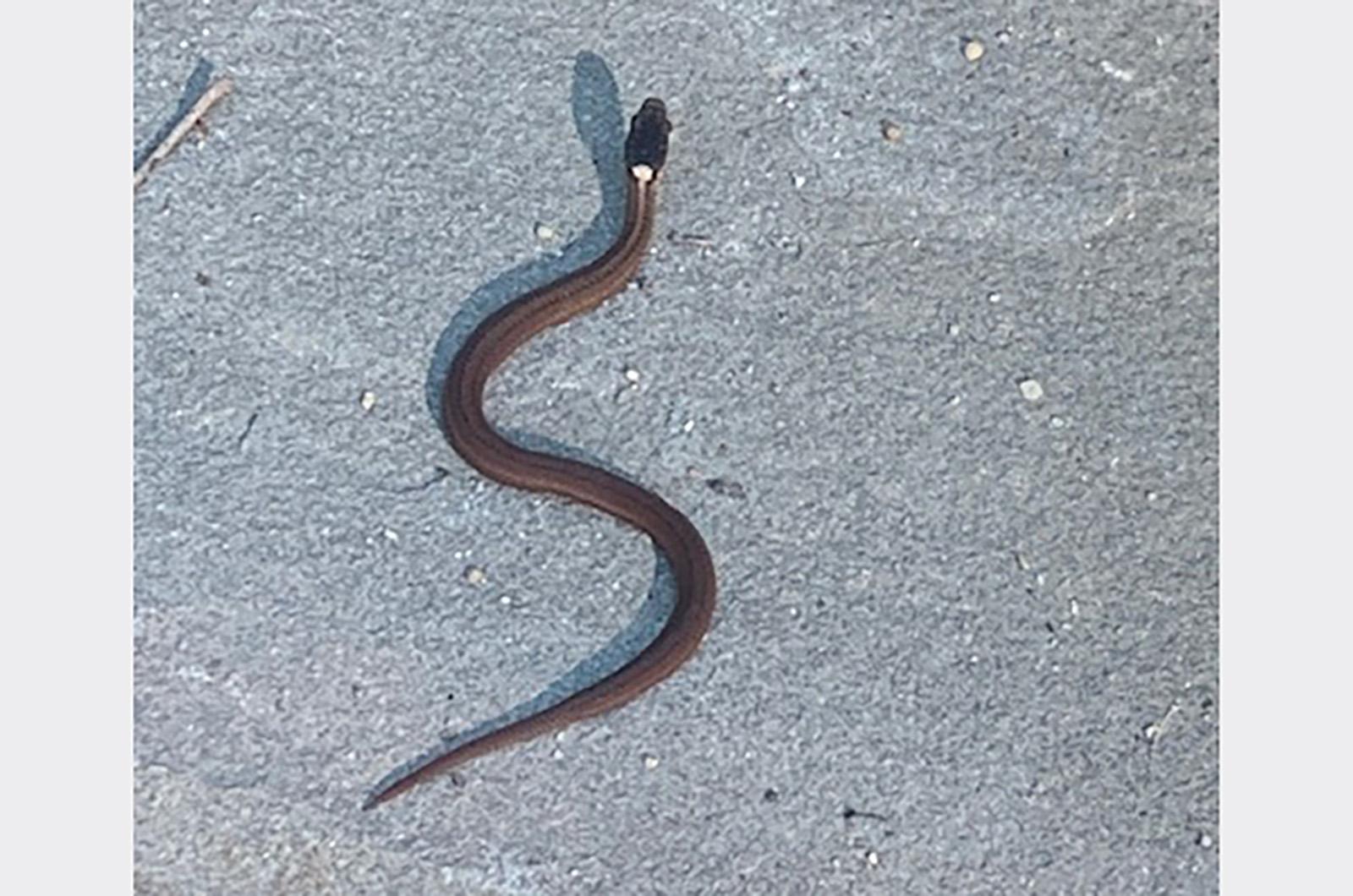
Red-bellied snakes can be elusive and may be encountered this time of year as the young have been birthed and activity increases before they hibernate for the winter. I was fortunate to find one slithering across my stone walkway and disappearing amongst the vegetation around our outdoor shower. Wet environs are where these snakes can find their sluggish prey.
Identifiable by their namesake red bellies, one can be confused since their underside can also be orange, pink, yellow or (rarely in Massachusetts) gray or black. From the top, keeled scales can also be a variety of colors, including orange to gray, black or brown. One indicator for identification of the species is that they are smaller in size than other local snakes. They also have spots behind their head which can fuse and appear as a neck ring.
The northern red-bellied snake is one of three regional subspecies of Storeria occipitomaculata. Its first name, Storeria, is for American physician and naturalist David Humphreys Storer, and the latter, occipitomaculata, refers to those spots on the back of its head. Storer was dean at Harvard Medical School and specialized in humans, fish and reptiles. His legacy also includes his sons, one a chemist and the other an early gynecologist and anti-abortion advocate who was known to have led the charge for laws criminalizing abortion in the late 19th century.
Surely those snakes have no opinion on past or present politics, regardless of their namesake’s impassioned beliefs. As to what they might think of those ideas, I suspect their lips are sealed.
Suzan Bellincampi is director of the Felix Neck Wildlife Sanctuary in Edgartown, and author of Martha’s Vineyard: A Field Guide to Island Nature and The Nature of Martha’s Vineyard.
Add new comment