


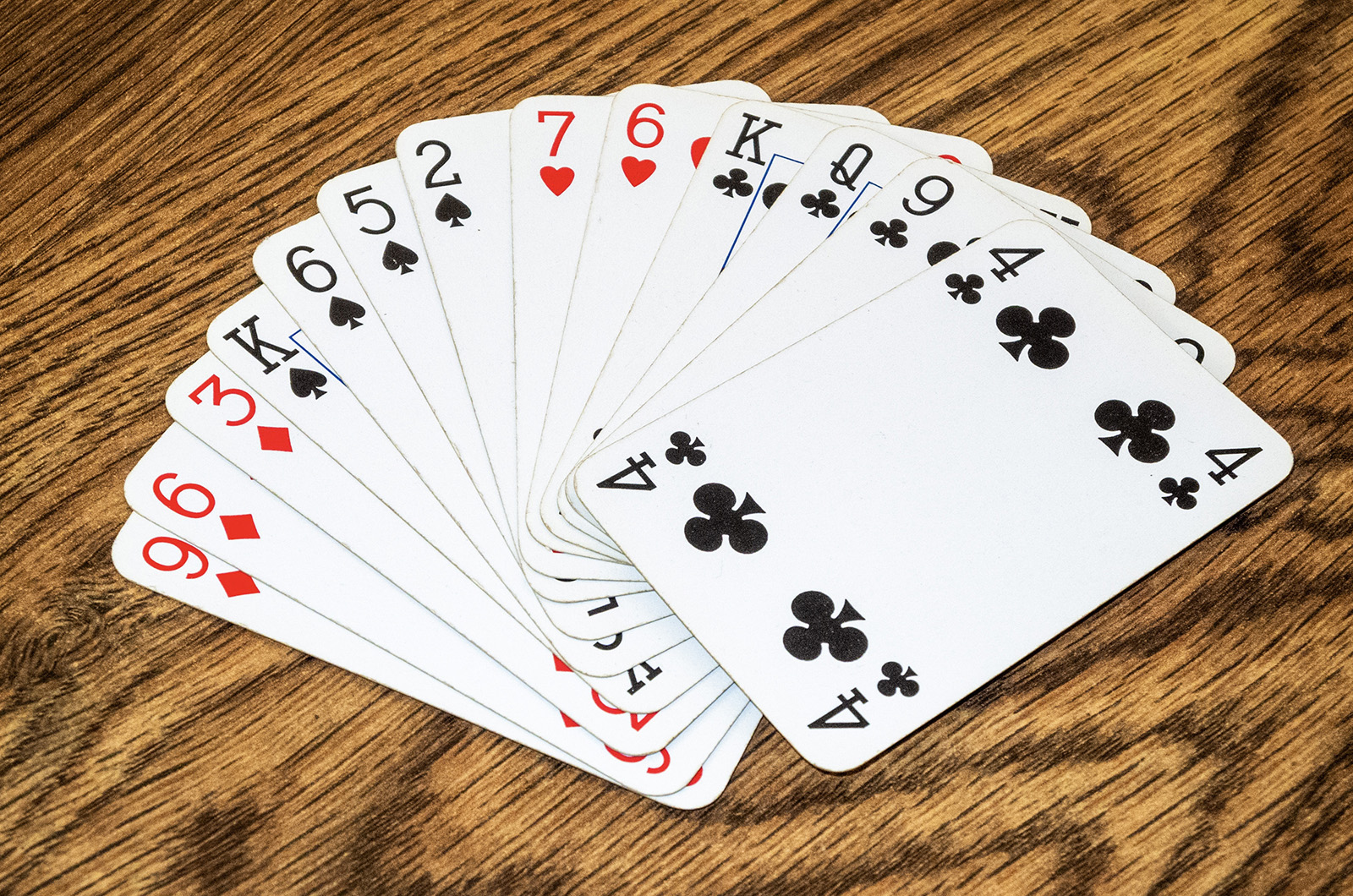
Today has not been lucky. During a session of duplicate bridge, you’ve been dealt two Yarboroughs.
Today has not been lucky. During a session of duplicate bridge, you’ve been dealt two Yarboroughs. A Yarborough is a hand with no card higher than a nine. To make matters even worse, the spots are identical:
♠️ 5 4
♥️ 8 6
♦️ 3 2
♣️ 9 8 7 5 4 3 2
Auction #1:
North (Partner)
1NT
East (RHO)
2 ♥️
South (You)
?
From the North-South perspective, this deal is best played in clubs. Without East’s interference, you would bid 2♠️ (meant as a transfer to clubs}. As South, you would simply pass when partner bids 3♣️, which proves to be the optimal contract. Things change when East bids 2♥️. 2♠️ is no longer a transfer. 2♠️ is natural and to play. I suppose that you could bid 3♣️ (a perfectly legal call) in the hope that partner will pass; however, partner is not likely to do so. Nor would a pass be appropriate because 3♣️ should show a good hand with game-going values. What to do then? The answer is not to bid 3♣️; arrange for partner to bid 3♣️.
Enter Lebensohl. Over 2♥️, 2NT by you serves as a relay to 3♣️. When partner bids 3♣️ by partnership agreement, you pass quietly. What is probably the optimal contract has been reached. If you held a ratty seven-bagger in diamonds instead of clubs, you’d simply correct partner’s forced 3♣️ to 3♦️. Once again, the best contract will have been reached. Although 2NT can no longer be natural and invitational once an opponent has intervened at the two level, the relay to 3♣️ leads to the description of many more hand types not available otherwise. I have already described two in this column. And there are others! As a result, the trade-off is minimal.
Auction #2:
Same “garbage” hand:
♠️ 5 4
♥️ 8 6
♦️ 3 2
♣️ 9 8 7 5 4 3 2
This time there’s a different bidding situation. West is the dealer.
North (Partner)
Dbl
West (LHO) East (RHO)
2♥️ Psss
South (You)
?
Again, it would appear that the optimal contract is 3♣️ You could bid 3♣️ yourself, but partner will take you for a much better hand. 3♣️ by you should be encouraging and ongoing. Partner is not likely to pass; nor would a pass be appropriate. Enter Lebensohl again. Instead of 3♣️ , bid 2NT, meant as a relay. Partner will bid 3♣️, and you will quietly pass. Had your “garbage” been in diamonds, you would have corrected to 3♦️.
Auction #3:
Later in the session you’re dealt more junk. Although the hand is somewhat better, suit quality leaves much to be desired:
♠️ K Q 3 2
♥️ 9
♦️ 6
♣️8 7 6 5 4 3 2
North (Partner)
1♣️
2♥️
West (LHO) East (RHO)
Pass Pass
Pass
South (You)
1♠️
?
As dealer, partner opens 1♣️ After you respond 1♠️, partner reverses into 2♥️ (a one-round force). After surveying the situation, you realize that 3♣️ is the best contract; however, partner does not. A 3♣️ bid directly is ongoing and encouraging, showing club values and (typically) 9-11 HCP. Partner is not likely to pass. To circumvent the problem, bid 2NT: a relay to 3♣️. At that point, pass quietly!
In this column we have learned to use the Lebensohl relay to describe weak hands in certain bidding situations. Again, we’re bidding out of weakness rather than strength. This relay is a mechanism that enables us to put on the brakes to prevent partner from bidding beyond the means of the partnership. Since 2NT is forcing, the traditional meaning is lost; however, so many other doors are opened that the trade-off makes good sense. You and your favorite partner ought to give Lebensohl a try. You’ll be glad you did!
Add new comment