


As I set out one cool spring morning, I heard a Carolina wren singing nearby.
As I set out one cool spring morning, I heard a Carolina wren singing nearby. Several of these little motormouths live in the brushy area not far from my door, and their song is easily recognizable — a whistling, repeated phrase that is written by us humans as jimmy-jimmy-jimmy, or teakettle-teakettle-teakettle. These mnemonics don’t come close to capturing the musicality of the song.
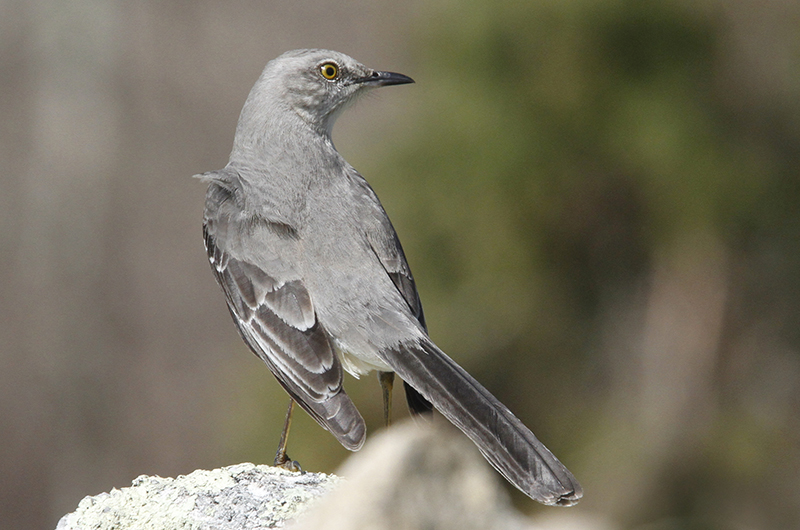
And this morning’s wren had a particularly strong set of pipes. His song was rich, liquid, resonant, and when I located him – he was on my porch roof – I understood why. He was a mockingbird, not a wren. Sensing that my eyes were on him, he fell silent for a moment and then dropped the needle on a different song that sounded like the vibrant trill of a red-winged blackbird.
The arrival of this mockingbird was, for me, the signal that spring had truly arrived. He’s no mere visitor, either. He spends the summer near my place, and I know that I will see him nearly every day.
Note the pronouns – “he” and “my.” Male mockingbirds sing more often than females, who have nesting responsibilities and don’t have as much time for singing. And I use “my” not to claim possession but to identify him as my delightful neighbor.
Mockingbirds are not native to the Island. They appear to have started coming here in the 1960’s, attracted by the habitat; they like open areas, such as lawns and often build their nests in prickly stands of multiflora rose. Providing shelter and protection to the mockingbird is one of few virtues of this prolific, invasive and generally maligned plant.
The mockingbird’s Latin name is mimus polyglottos, which translates roughly as mimic of many tongues. This bird is capable of learning hundreds of songs and sounds, including mechanical sounds like car alarms and rusty hinges. One purpose of his singing is to attract a mate, and it’s understandable that unmated, lovelorn males sometimes sing for hours on end.
I’ve heard mockingbirds engage in a lively call-and-response which sounded to me like the avian version of Dueling Banjos. Naturalist Matt Pelikan, of Biodiversity Works, has a more informed understanding of these exchanges. Ornithological research has shown that mockingbirds, and songbirds in general, regularly communicate with each other for many purposes — to establish territory, note the arrival of a newcomer, to drive away anyone who might threaten the nest.
“Anyone” is a large category, and mockingbirds have many enemies. Indeed, while I am enjoying the spring serenades, my mockingbird neighbor might be singing to scare off crows, squirrels and blue jays, any of which might raid the nest and devour a clutch of eggs.
“The spring is a highly dangerous time for passerines,” Mr. Pelikan told me.
Mockingbirds have been known to fly at humans whom they consider a threat. Researchers have found that mockingbirds can identify individual humans; they will fly at anyone who’s gotten too close to the nest, while tolerating humans who seem harmless.
I like to think that my mockingbird recognizes me and understands how appreciative I am of his vocalizing talents. When he sees me out walking near the house, he often flies to an exposed perch on a wire, a roof, a tree limb, and there he launches into song.
In the judgment of Thomas Jefferson, the beauty of the mockingbird’s song surpasses that of the European nightingale. Jefferson, a bird fancier, owned several caged birds. Mockingbirds were his favorites, and he paid them high homage: “Learn all the children to venerate it as a superior being in the form of a bird, or as a being which will haunt them if any harm is done to itself or its eggs.”
On the Monticello website, it is reported that Jefferson was particularly attached to one bird, Dick, who became “the constant companion of his solitary and studious hours. Whenever he was alone he opened the cage and let the bird fly about the room. After flitting for a while from one object to another, it would alight on his table and regale him with its sweetest notes, or perch on his shoulder and take its food from his lips.”
The historian of Monticello also noted that Jefferson’s birds were given singing lessons by his butler, and learned several popular tunes.
I watch for my mockingbird every time I leave the house. I think I know where he and the missus have nested, but I give him space — I don’t want to get on his bad list.
Though I have now read many plausible explanations for why the mockingbird sings, I am stubbornly anthropomorphic. Yes, he sometimes sings for a specific reason, but sometimes, I am convinced, he sings because he can, because he takes delight in the beauty of his song, because it brings him joy.
The other day I was out back trying to whistle like a bob-white quail. My mockingbird was on the porch railing, listening to me, and when I stopped, he broke out his own, much more melodious rendering — bob-white, bob-white, bob-white.
That does it. I have a relationship with this bird, and from now on, I am calling him Bob.
Stephen Goodwin lives in Vineyard Haven.
Comments
Thank you Stephen
Shelly Jones Vineyard HavenThank you Stephen
When I was growing up in
Kate Ivison Meleney Oak Bluffs and NarragansettWhen I was growing up in Washington, DC, my mother always had a mockingbird trained to beg for raisins. When she opened the front door, he would be waiting on the railing. She kept the raisins on the front hall table, and should she be in a hurry and forget to put them out he'd swoop back and forth in front of her while she walked down the steps. We loved their songs!
Wonderful article, Stephen. A
Lynne Eppel West tisburyWonderful article, Stephen. A good way to start the day!
I get you. Love my birds!
Laura Rose Vineyard HavenI get you. Love my birds!
What a wonderful article!
Penelope Mellon DenverWhat a wonderful article! You even got your Mockingbird's pronouns right :)
Thank you for a lovely change from the news!
A friend gave me a heads up
Anne Luzzatto TisburyA friend gave me a heads up that Stephen had written this story -- I'd missed it as I've just returned to the island after a long absence. Bob's clamorous song and Steve's friendship with him is a lovely reminder of why I am so happy here.
Loved your article, Steve!
Barbara Kassel west TisburyLoved your article, Steve! And I hope that your friendship with Bob continues well into the future! I have one of those birdsong identifying apps and wonder if it would be able to spot the charming interloper. I will be on the lookout!
I love your new friendship
Barbara kassel west tisburyI love your new friendship with Bob! What a delightful article. Thank you! I have one of those birdsong identifying apps and it hasn’t picked up a mockingbird yet, but maybe they were using subterfuge calls! I’ll keep a look out.
Add new comment