
Two towering American elms are returning to West Tisbury for the first time in decades after the species was wiped out by Dutch elm disease.
In the early 1900s, when the main thoroughfare in West Tisbury was still unpaved, soaring American elms lined State Road. But as those venerable trunks stretched towards the sky, below the surface an illness started to spread through their roots.
Over the coming decades, every elm in town, and in many other parts of the country, succumbed to Dutch elm disease.
Now, nearly a century later, two American elms are returning to town for the first time, with a genetic boost to resist the pernicious fungus behind Dutch elm disease. The renewed planting is part of a town plan to ensure a resilient town forest for decades to come. The idea was formulated by the recently formed West Tisbury tree committee, and 14 other trees of several varieties will also be planted alongside the elms this year.
The plantings are some of the first public-facing work by the committee, formed in 2022 to restore the town’s declining crop of trees.
“These trees are beneficial to the town in all sorts of different ways,” said Emily Ellingson, curator at Polly Hill Arboretum and member of the tree committee, who outlined a series of benefits to environmental, personal and community health that a town canopy could provide.

Tree committee member Emily Ellingson points out new tree planting locations around West Tisbury.
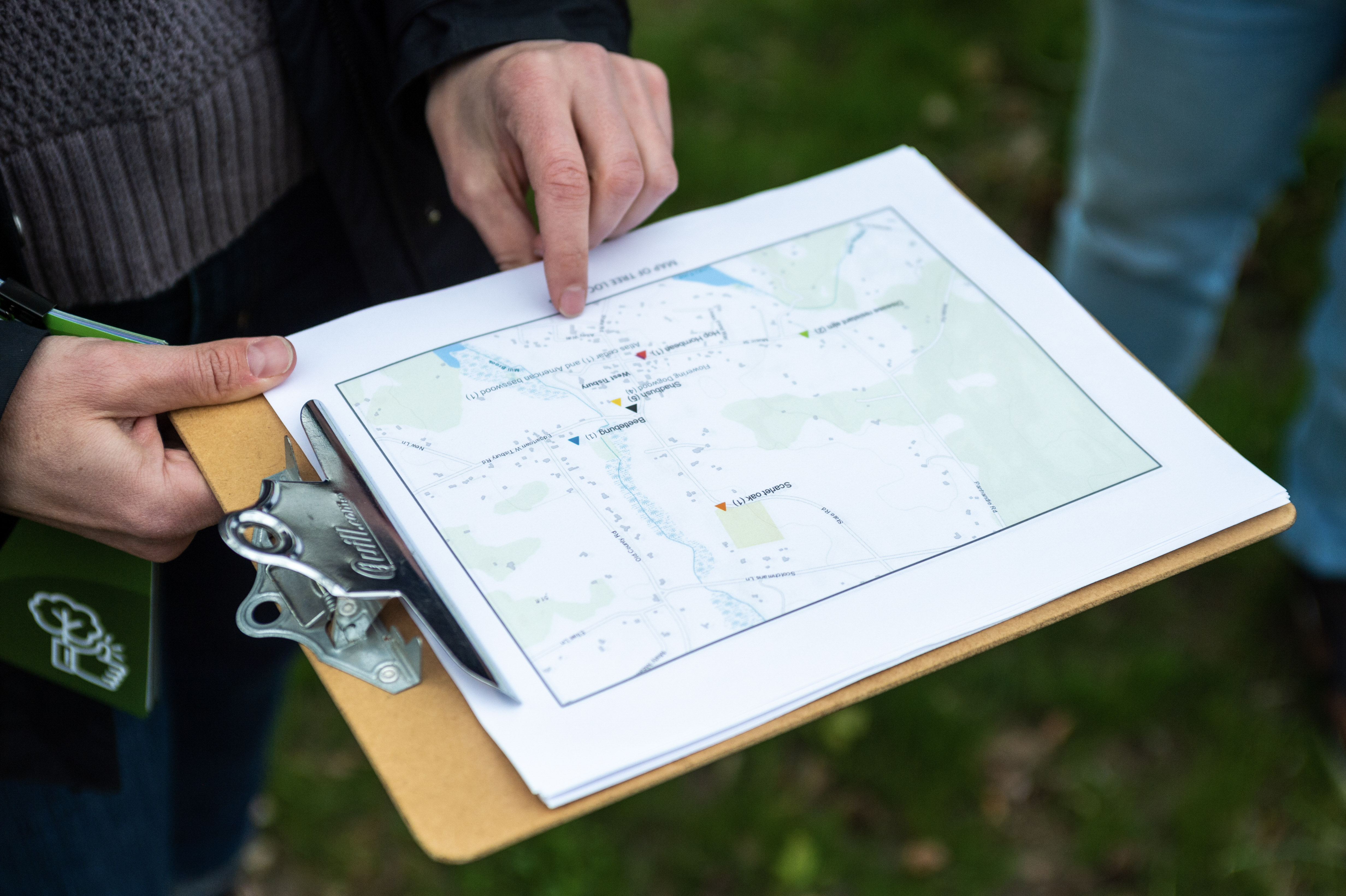
Tree committee member Emily Ellingson points out new tree planting locations around West Tisbury.
In the 1950s and 1960s, after the death of the elms, the town planted dozens of Norway maples without a firm grasp on what it would take to maintain the trees.
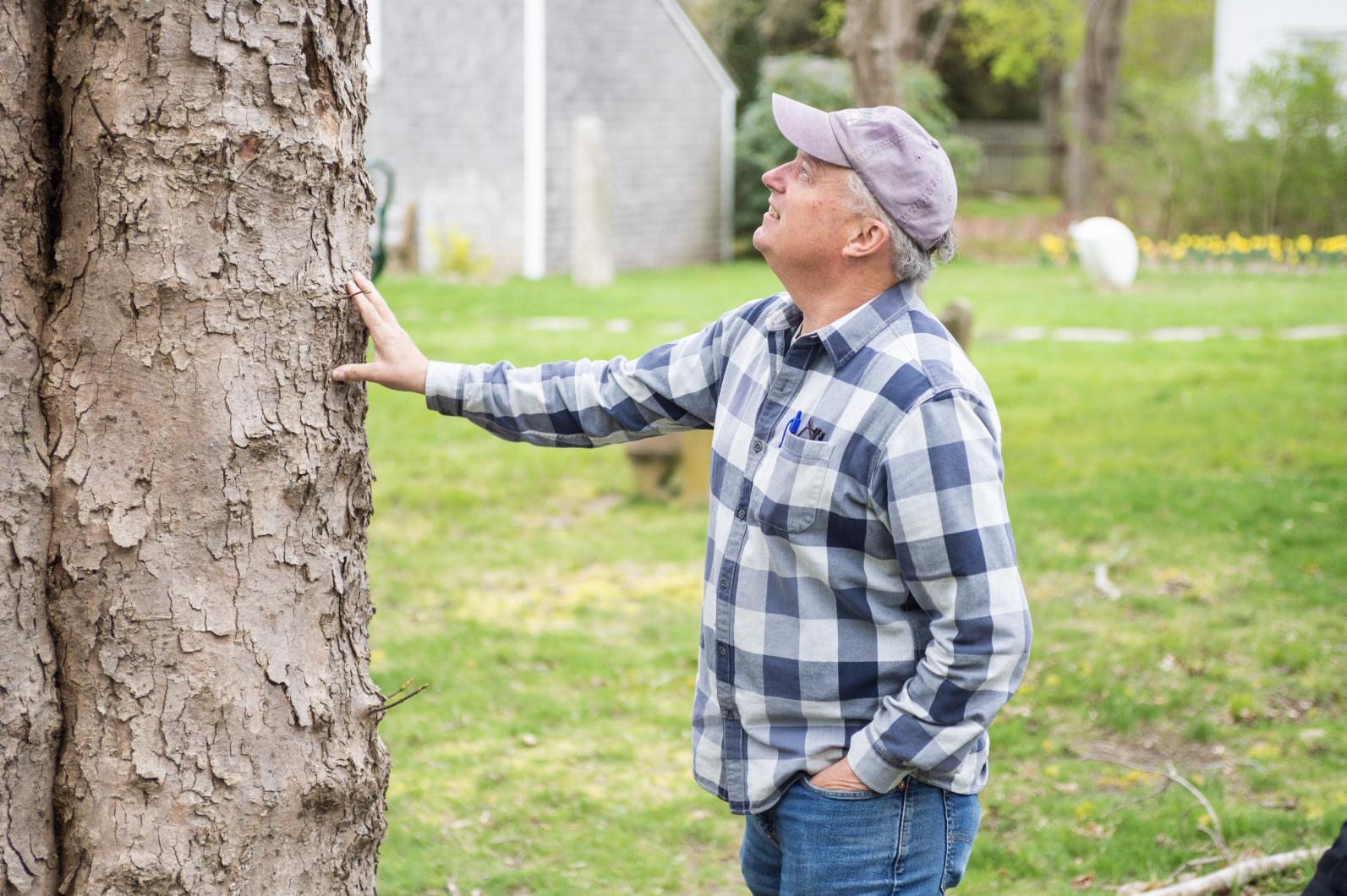
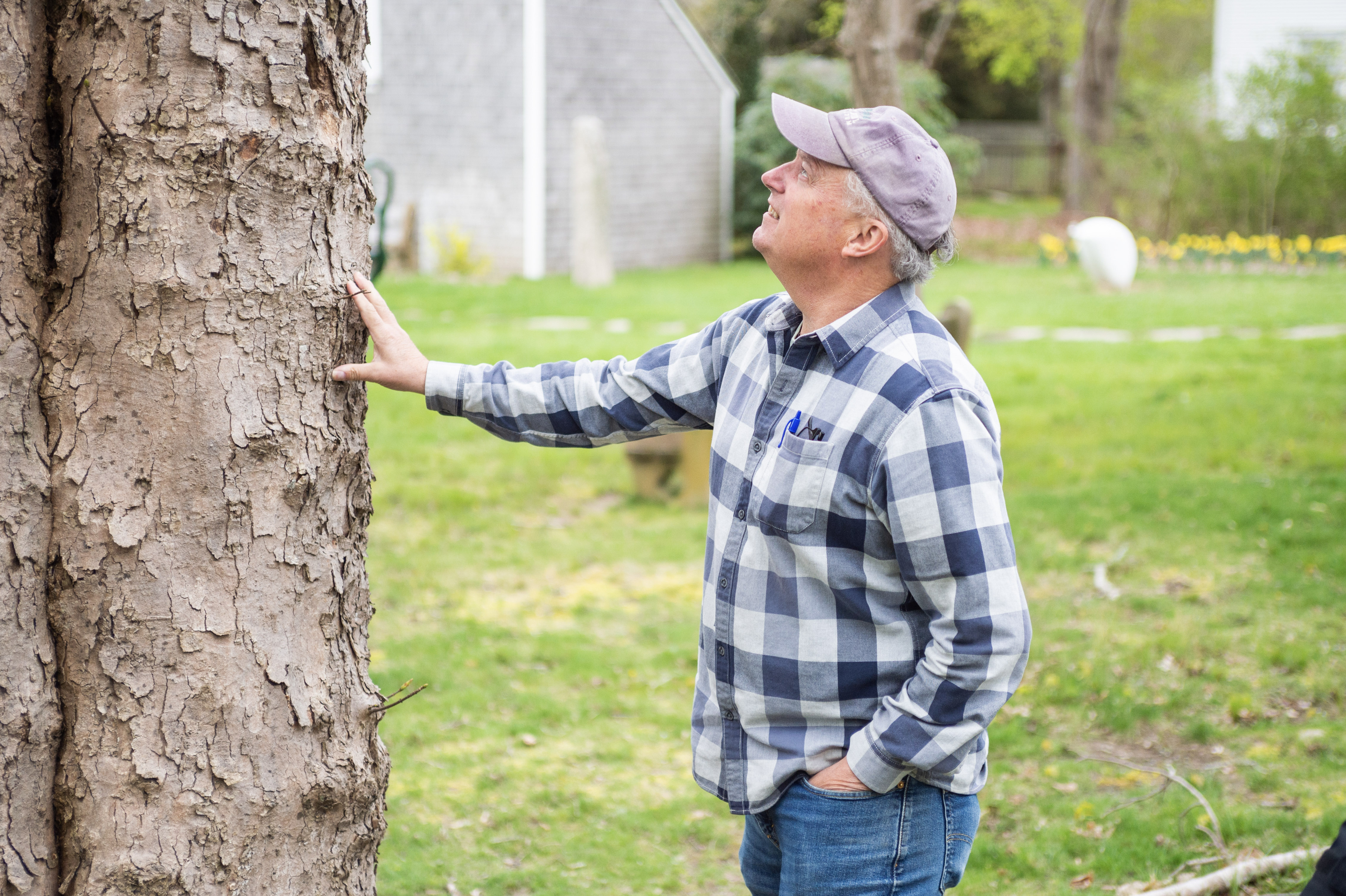
“I try to say that there is no bad tree, only a bad place for a tree,” Ms. Ellingson said, as she looked at two bedraggled Norway maples by Alley’s General Store.
One of the problems was the trees were planted all at the same time.
“They call those ‘even-aged stands,’ and that’s a problem, because they all age at the same time,” said Tim Boland, a tree committee member and Polly Hill director.
As all the maples begin to wither, more and more must be felled, posing a danger to power lines and passing cars.
“Our tree warden, Jeremiah Brown, does a heroic duty,” Mr. Boland said, of his fellow tree committee member. “People get emotional when trees come down…but he’s really maintained an even keel, and he’s also maintained such optimism.”
The committee was formed to provide a counterweight to those feelings, and to plant a variety of species to diversify the town’s canopy. Much of their efforts have been focused on identifying native species better adapted to Island conditions.
At Brandy Brow across from the Mill Pond, for example, native dogwoods will join the iconic flowering shadbush tree, with its delicate white blooms.

Emily Ellingson shows the problems with a tree's roots near the Alley's General Store parking lot.
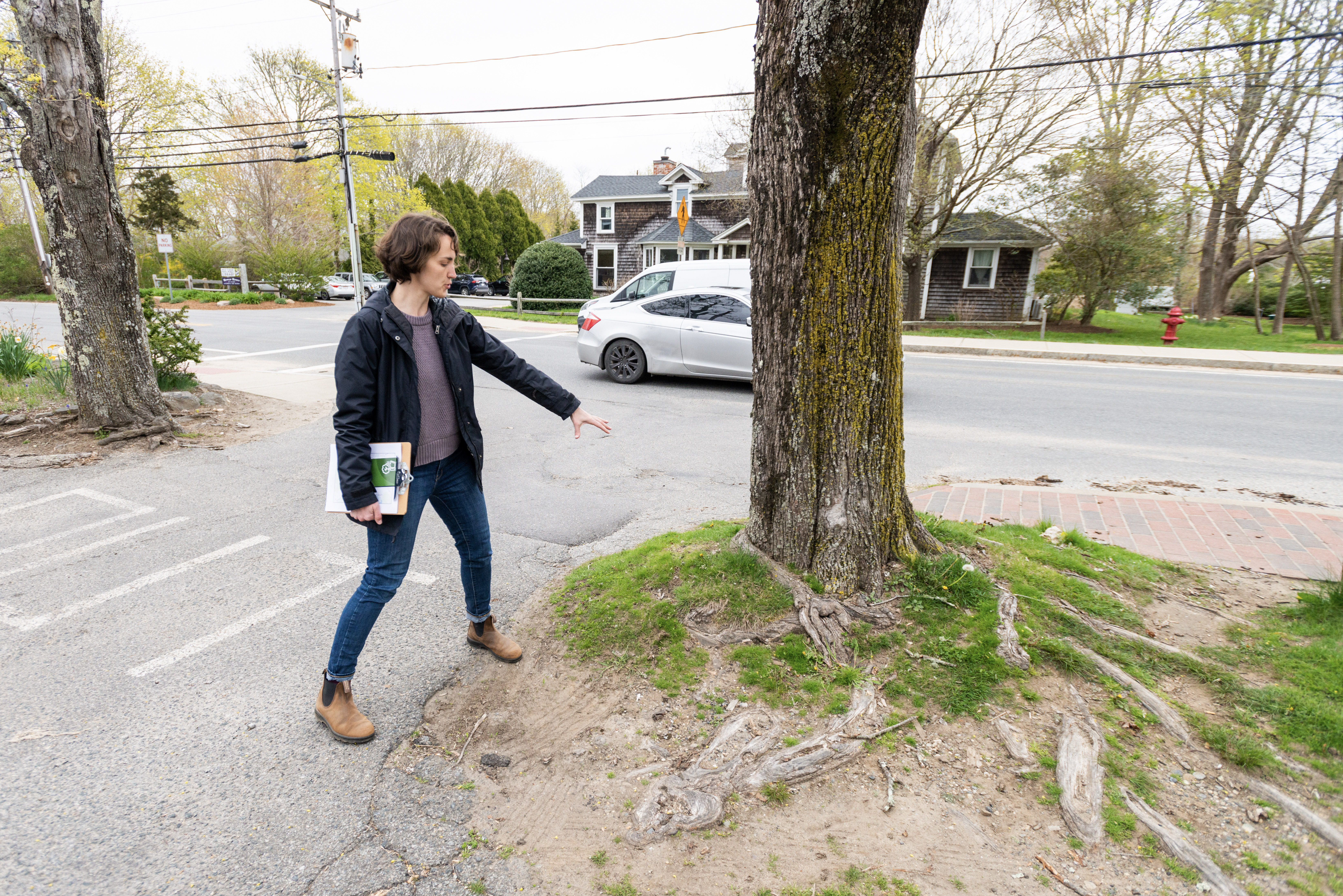
Emily Ellingson shows the problems with a tree's roots near the Alley's General Store parking lot.
Near town hall, the hop hornbeam will be planted. The species is a rare native plant, so-named for its distinctive hop-shaped blooms. Another rare yet native tree, the scarlet oak, will be planted by the town cemetery.
Towering American basswood and atlas cedar will be planted in an open field near town hall. The two new American elms will be planted along Music street, bred with a genetic boost to defend themselves against Dutch elm disease. Though named after the country where it was identified, the disease evolved in China. To bolster the trees, the new American elms have been hybridized with Chinese elms.
Along with those plantings, the tree committee is developing a plan to maintain those trees to avoid the same fate as the wayward Norway maples.
On a recent spring day, Ms. Ellingson uprooted a sapling Norway maple across from town hall. Beside her, Mr. Boland looked up from a tangle of electrical infrastructure to a beleaguered maple, ruthlessly cut and pruned to keep it from powerlines, its trunks curving into each other in a closed wooden loop. Even in this state, it still sprouted new growth.
Despite all the headache these trees have caused the town, Mr. Boland said, it is hard not to admire their resilience.
“It’s invasive,” he said, “but it’s still a good tree.
Comments
At the turn of the century,
Thomas Hodgson WTAt the turn of the century, illness was not spreading in island elms. They were in their glory, and would continue to be so for another four decades. Dutch Elm Disease did not arrive in the United States until 1930. Massachusetts' first case of the disease was not until 1941. The Gazette may have in its archives when it first arrived on the Vineyard. The fifties is when we lost large numbers of our elms. As a child, I watched many of them die and be cut down. Music Street went from elm-shaded to sunny in about a decade. There are trees the article does not mention. Catalpas have thrived and continue to thrive. The great tulip tree on Music Street has been a massive presence. Our native cedars are a fine and long-lasting tree if not crowded out. I would hope that the tree committee would expand its thinking to include fruit and nut trees, which are not only beautiful but can yield food for us to enjoy in the future.
In 1974 I gave the town a
Marty Milner TALLAHASSEEIn 1974 I gave the town a variegated tulip poplar which I planted on the corner of Music and State. It fit into the neighborhood stand but its leaves were notably odd in their coloration. It was one of David McCullough's favorite's, a short walk from his home. I noticed ,on my last visit, there are some structural trunk issues, and some day that spot will become available again. I would suggest that tree sponsorship and diversity might lend a certain momentum to the cause. "Overstory" is a great read btw...
Great article. But if the
Dick AquinnahGreat article. But if the thrust of new plantings is native plants, why the inclusion of "atlas cedar"? While Cedrus atlantica is a beautiful tree, the Atlas Mountains of Morocco are somewhat distant from the hills and plains of Chilmark or West Tisbury. Am I missing something here? I do feel the native plant ideal has now become somewhat overblown. Are we now to get rid of, say, all the wonderful Ginko biloba or Pinus parviflora on the island and elsewhere?
Add new comment