


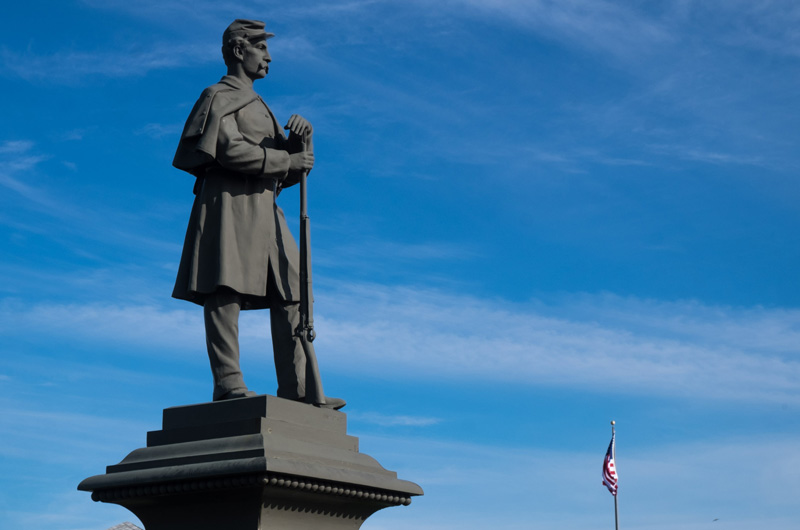
Titled The Chasm Is Not Closed, a new exhibit at the Martha’s Vineyard Museum uses a pair of tributes to the Confederacy to dig deeply into a disturbing chapter in the Island's not too distant past.
Nearly three years after a storm of public debate spurred Oak Bluffs selectmen to remove a pair of tributes to the Confederacy from the town’s 1891 monument to the Union side of the Civil War, the controversial plaques are back on display.
At the request of the Vineyard chapter of the NAACP, the two metal plates were donated to the Martha’s Vineyard Museum, where they are currently on view in a new exhibit titled The Chasm is Not Closed.

Plaque honoring Confederate soldiers was added in 1925.
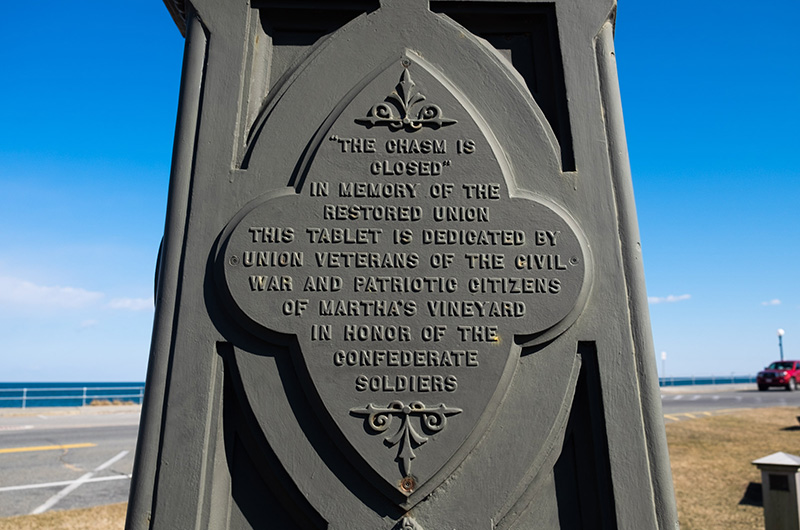
Plaque honoring Confederate soldiers was added in 1925.
Curator Anna Barber said this is the museum’s first step toward creating a permanent exhibition centered on the plaques.
“We are still very much in the process of learning and collecting feedback,” Ms. Barber said in an interview. “We’re trying to figure out how do we fit this statue into its place in history, and how does that help us going forward?”
“This is first time we’ve ever done an exhibition where we’re saying, we’re learning,” she said.
The statue was put up in 1891 by Charles Strahan, a former Confederate soldier who relocated to the Vineyard and began publishing the Martha’s Vineyard Herald. Mr. Strahan had family members on both sides of the Civil War; the statue was created as a memorial to honor Union soldiers. Plaques honoring Confederate soldiers were added in 1925 and were meant to represent a reconciliation between the two sides of the war.
As late as 2001, when the monument was rededicated, the binary brother-against-brother Civil War narrative remained unchallenged.
In 2019, amid the nationwide Black Lives Matter movement, activists and Islanders began to question the plaques and debate their appropriateness. The NAACP became involved, and eventually the town decided to remove the plaques from the statue and donate them to the museum.
In addition to the plaques, the museum exhibit gathers artifacts and new scholarship to draw a fuller picture of Island life, both before and after the Civil War.
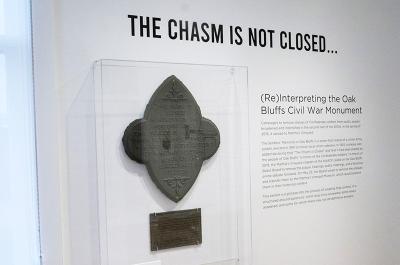
Plaques were removed in 2019 and donated to the museum.
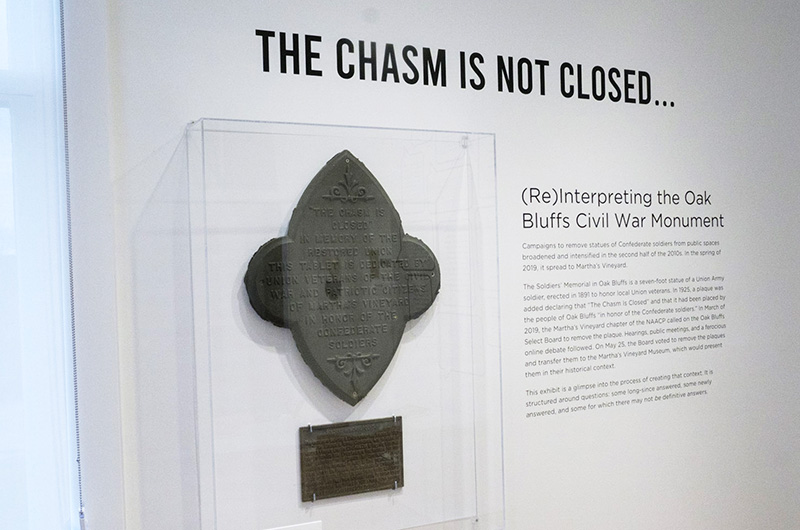
Plaques were removed in 2019 and donated to the museum.
Proving that Martha’s Vineyard was no exception to the racism pervading American life, a printed ticket to a 1922 minstrel show by West Tisbury schoolchildren at the Agricultural Hall hangs below a typed-up list of activities for an early-1930s Vineyard Haven school carnival.
There’s also a grotesquely racist 1886 advertisement for a patent medicine that was printed in the Martha’s Vineyard Herald, the newspaper owned by Mr. Strahan.
These small, but telling testaments are displayed near a gold-fringed, Union-blue commemorative ribbon for the statue’s dedication, on August 13, 1891. An enlarged photo of the dedication wraps the walls of the museum exhibit. The statue was originally placed at the foot of Circuit avenue and moved in 1930 to its current location across from the Steamship Authority ferry landing.
But while Islanders and visitors flocked to the patriotic event, the memorial had already been hit by unknown vandals, according to evidence unearthed by curatorial fellow Austin Davis.
Mr. Davis, now a junior at Princeton university, spent hundreds of hours last summer as a Sheldon Hackney Curatorial Fellow, researching Mr. Strahan and the monument, Ms. Barber said.

Exhibit includes clippings from the Gazette and the Martha's Vineyard Herald.
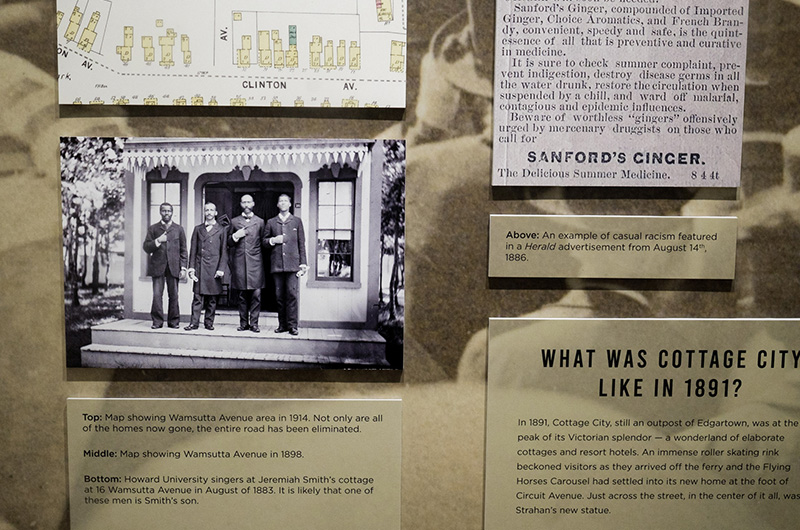
Exhibit includes clippings from the Gazette and the Martha's Vineyard Herald.
Among Mr. Davis’s discoveries were a pair of Herald clippings about the vandalism, which took place less than a week before the dedication when a “person or persons... cut the drapings from the Soldiers’ Memorial, and mutilated the statue on the night of Thursday [August] 6th, or early Friday morning, 7th inst.”
By researching countless archives of the Herald and the Gazette, Mr. Davis also learned how Mr. Strahan, this son of the South — born in Baltimore, later a coffee merchant in New Orleans — found his way to Martha’s Vineyard.
“We were able to connect Strahan to the Island through his in laws,” Ms. Barber said, citing a Gazette item from the 1880s. “That took weeks and weeks and hours and hours and hours of research time, to make that one connection,” she said.
Mr. Davis also created a detailed 200-year timeline, beginning in 1820, that aligns the monument’s history with that of race relations in Oak Bluffs and the nation as a whole.
“It is . . . a way to pull back the curtain on the research process,” Ms. Barber said.
Another scholar whose work is central to The Chasm is Not Closed exhibit is Oak Bluffs historian Andrew Patch, president of the Martha’s Vineyard Camp Meeting Association and a Camp Ground resident.
By poring over MVCMA records, Mr. Patch discovered a hard truth about the organization he heads: In the late 1800s, black and Wampanoag Camp Ground residents were repeatedly removed from their cabins — recorded as “shanties” — after neighbors complained, while the association continued to proclaim a policy of non-discrimination.

Exhibit invites commentary from museum-goers.
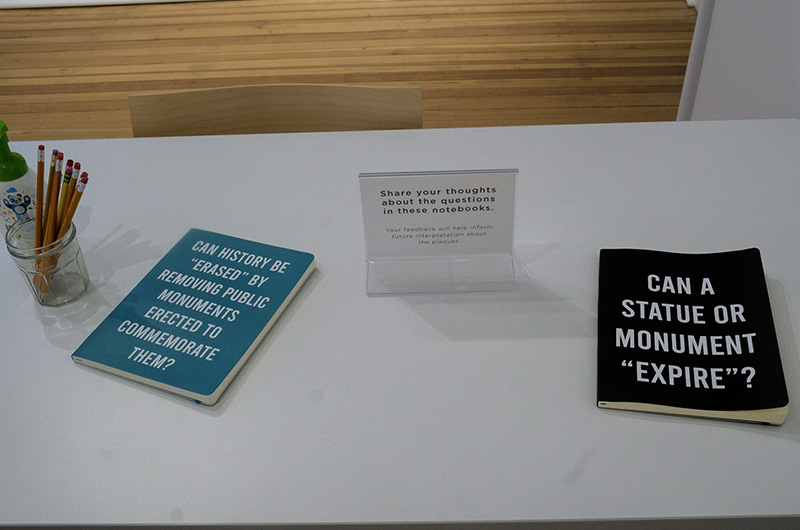
Exhibit invites commentary from museum-goers.
One of his most damning discoveries is represented in the museum show as The Purge of Wamsutta Avenue, which took place the year after the statue was dedicated and saw an entire black neighborhood eliminated.
Mr. Patch’s research, with family-by-family notes and photographs, will be published in the spring issue of the museum quarterly.
Islanders and museum visitors are invited into the process of designing the permanent exhibition, with a trio of blank notebooks and plenty of pencils for answering questions like “Can a statue or monument ‘expire’?” and “Can history be ‘erased’ by removing public monuments . . . ?”
Ms. Barber said the museum also plans public events and discussions once Covid precautions make such gatherings possible.
“We’re going to be having some evenings when we’re inviting community groups in . . . to talk about how this exhibit resonates with them,” she said. “All of that will be factored into our planning for a permanent display in the future.”
The Chasm is Not Closed is showing at the museum through April 29, Tuesday through Sunday from 10 a.m. to 4 p.m.
Comments
Contrast this willingness to
Peter oak bluffsContrast this willingness to acknowledge the truth of our past with the efforts in many states to censor any talk of white privilege by bedeviling it as Critical Race Theory. Go MV Museum!
This comparison incorrectly
Ron EdgartownThis comparison incorrectly projects your views onto this exhibit. The exhibit merely recounts historical events which illustrate the opposing beliefs and attitudes which divided this country for years during a certain period of our nation's history. It is not intended to attribute to all current residents the worst of those historical beliefs or attitudes held by some of the people living at that time. Based on the information in this article, it is apparent that no part of this exhibit is intended to either support or rebut the modern theory of "white privilege." If anything, this exhibit shows the damaging impact that such divisive theories and rhetoric can have on our society.
I am pleased that this
Marie R Albuquerque. / Lamberts coveI am pleased that this exhibit is up. Too bad it isn’t permanent tho. These cruel aspects of our history need to stay in the public eye.
Agree! It is a PERMANENT
Marina Lent EdgartownAgree! It is a PERMANENT part of MV and US history. It should be a permanent part of MV Museum representation in some form. An exhibit allows the Museum to go deeper and focus its events and education for a period of time, but some form of this history must remain part of the museum, ongoing. Please and Thank You.
Agreed. At the very least,
Jeffrey DelawareAgreed. At the very least, extend it through the fall of 2022 so that summer residents (like me) will have the opportunity to see it.
You may want to read the
R Scott Patterson EdgartownartownYou may want to read the entire article before commenting. The last paragraph clearly states "It will become part of a permanent exhibit". They are still gathering information and input before making it permanent.
Very proud of the Museum for
John EDGARTOWNVery proud of the Museum for taking this on.
It is what it is. Live and
Robert Hunter W.Tisbury/Hoboken, N.J.It is what it is. Live and let live.
Thanks to the museum for
Michelle N Moon Atlantic HighlandsThanks to the museum for digging deep into a complicated history. IT's already produced so much learning - looking forward to more opportunities for thought.
Whew. I appreciate the
Valerie OregonWhew. I appreciate the thoughtfulness you’ve put into this, particularly when it’s accompanied by Andrew Patch’s meticulous research showing what else was happening then. I knew about this, and it’s still sobering. Thank you!
The plaques on statue should
Joseph Oak BluffsThe plaques on statue should have never been removed.
Also the way the NAACP and the Chief went about it was appaling.
This simply makes me sad. I
Ted Box Vineyard HavenThis simply makes me sad. I thought were better than that, but then I remember conversations with Milton Jeffers concerning the dirty tricks played on the Wampanoag boys during competitions at the games that used to be held at the fair. Athletic races that were rigged. One I remember, was the Indian boys were told that it was just a practice start, that they would start add pull up after a few yards. They lied to them. It was the sherif. I don’t remember his name but it would have been when Milton was 16.
When are we going to stop
Jonathan Vineyard HavenWhen are we going to stop looking for someone to hate? White, black, rich, poor - focus on being your best self. History should not be re-written and people should not be shamed or made into victims hundreds of years afterward. Slavery is alive and well in many countries today. Let's work on that - we might actually be able to help the course of history.
Interesting that your take
Ed EdgartownInteresting that your take away is that “history should not be rewritten“ when the exhibit shows us pieces of history that have remained unwritten and forgotten.
These painful civil war
E.Redd Oak bluffsThese painful civil war relics are best consigned to the museum and not the first thing you see disembarking the ferry.History cannot be erased but by creating a environment where it can be discussed will hopefully prevent us from repeating past mistakes.These are positive steps!
These statues bring pain to
Jose Oak BluffsThese statues bring pain to the viewer and certain communities but I think it is a mistake to relegate them to a museum. Putting historical artifacts of this significance in a museum among thousands of other relics makes them less impactful. They will be easy to walk past. As a society, our concept of right and wrong is much advanced and not comparable to when these statues were erected. We are not perfect as a nation but we have improved greatly so much so that our nation is a destination for the downtrodden of all races and creeds across our planet, many of whom risk their very lives to get here. These statues should continue to be located where they originally were and be a topic of discussion, however painful, and growth for our community. There is precedent for this. For example, Auschwitz was not dismantled and put in a museum but continues to be located where it operated, and where the unspeakable horrors occurred. This treatment is so impactful that every visitor who sees it is transformed, making the likelihood of history repeating less likely.
This approach has the support of the Jewish community which suffered like no other community in these death camps.
"The Jewish community which
Carolyn O'Daly Edgartown"The Jewish community which suffered as no other community"??? In this country alone African slaves and Native Americans have suffered cruelly. Man continues to be inhuman to man all over the world and if nothing else we need to acknowledge that fact.
Why not attempt to link
gaston vadasz West Tisbury MAWhy not attempt to link historical truth with the concept of reconciliation??The original intent of the statue was one soldier's feelings of camaradrie between lowly recruits, whose blood was spilled even though they were born into different societies.
I am all for lifting the wale from the murky past... the Museum is the correct place to have that conversation.
I am delighted to learn more
Judie Mopsik EdgartownI am delighted to learn more about this statue and the plaques. We were at the OB town meeting in the spring of 2019. There was a wonderful show of community support for moving the plaques to the MV Museum and building an exhibit around their historical significance. In these times of alternate histories it is important to do this research and erase the revisionist history that surrounds the Civil War and its aftermath.
So appreciate this museum
JoAn Dunn Clay New YorkSo appreciate this museum search and agree keep it in front till fall of22 for us seasonal folks it is history but all learning the truth brings us closer together in our understandings We did not do the deeds but can apologize and have empathy for the pain it caused. Then each vowing to do better we can improve all contacts between peoples. Thanks for giving it a chance
It's said our country was
John Fuller ChilmarkIt's said our country was under the sign of Gemini during the war of the brothers. Historical correctness like political correctness is a way of altering the past to fit modern political narratives, a mistaken way of really understanding the chain of cause and effect that links us to our past. The plaques should not have been removed, it's good the museum's putting them on display.
I completely refinished the
Barney Zeitz Vineyard HavenI completely refinished the sculpture about 10 years ago with Community Preservation Act funds. It was very interesting how many people were curious why it was there and there was a lot of confusion over the years when it had been painted gray. That was clearly a mistake on someone’s part because it is clearly a Union soldier.
Add new comment