


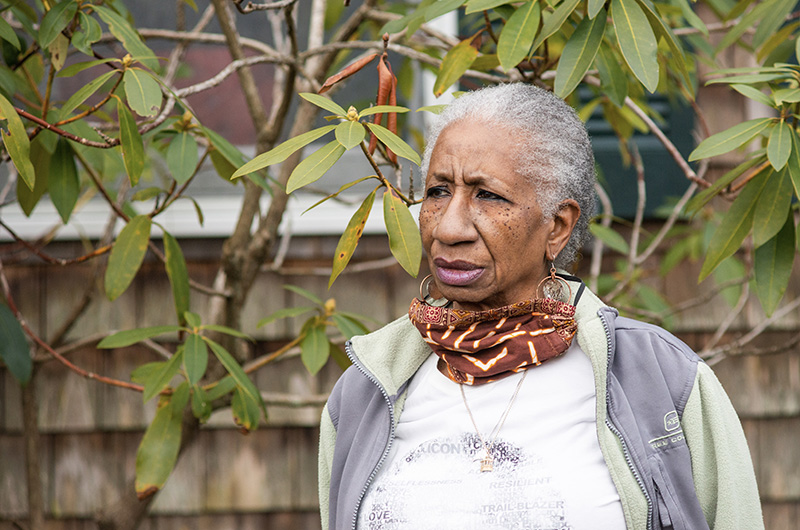
In a presentation hosted by the charter school, Caroline Hunter described how a small grassroots effort grew into an international revolution that helped end apartheid.
What does it take to start an international activist movement? This is the question that Caroline Hunter, Oak Bluffs resident and co-founder of the Polaroid Revolutionary Workers Movement, answered Thursday night as part of a series hosted by the Martha’s Vineyard Public Charter School in honor of Black History Month and the school’s 25 anniversary.
In an interactive presentation, Ms. Hunter described how a small grassroots effort grew into an international revolution that helped end American involvement with South Africa, helped free Nelson Mandela and eventually led to the end of apartheid in South Africa.
“My story is about the power of a good book, the impact of a good teacher and a strong family foundation,” Ms. Hunter told the audience of 75 viewers. “It’s about the power of the people and the power of black people.”
The story began, Ms. Hunter said, with her personal journey and her childhood under legal segregation in New Orleans.
“I have sat behind the colored signs on the bus. I have drunk water from the colored-only fountains and I have shopped at department stores where black people could not try on clothes, could not sit or eat at lunch counters,” Ms. Hunter said of her childhood.
She cited an inspiring social studies teacher from her youth who introduced her to the book Cry, the Beloved Country by Alan Paton as a key inspiration. The book marked a turning point in her path, she said.
“The book had similarities to my segregated life and it resonated with me,” Ms. Hunter said. “It was about the oppression of black South Africans under apartheid. I was so deeply moved by the suffering of black South Africans, I memorized passages and recited them to family and friends.”
After earning a degree in chemistry from Xavier University of Louisiana in 1968, Ms. Hunter landed a job as the first black research scientist for the Polaroid Corporation. This was where the story shifted, Ms. Hunter said.
One day, not long after she began work, Ms. Hunter and fellow black colleague, Ken Williams, noticed a strange photo ID with the words Department of the Minds, Union of South Africa at the Polaroid headquarters. The photo was a South African passbook ID, she realized.
“We froze,” Ms. Hunter said, recalling the moment. “Black South Africans considered the passbook to be the handcuffs of the heinous government and Polaroid, our employer, was supplying the South African government with the film and technology to make passport photos.”
And the story was larger still, Ms. Hunter said. Hundreds of U.S. companies were profiting directly from South Africa’s sanctioned segregation. Ms. Hunter and Mr. Williams set to work on a divestment movement, and the Polaroid Revolutionary Workers Movement was born.
“All the memories of Cry, the Beloved Country, the lessons from [school], the words of Dr. King, the lessons of my mother came flooding back to me reminding me of the suffering of blacks in South Africa and the pain of apartheid,” Ms. Hunter said.
Drawing on newspaper clippings, photographs and personal anecdotes, Ms. Hunter illustrated how, over the next seven years, the movement grew into an international boycott to force corporations to withdraw from South Africa. The group distributed leaflets, held rallies and began working with Boston advocacy organizations, she said. They spoke to congress, protested with company stakeholders and even testified before the United Nations Special Committee on Apartheid in 1971.
The effort lost Ms. Hunter and many others their jobs, she said, displaying a photocopy of her termination letter.
“Despite the fact that we were fired and on unemployment, the campaign continued with leafleting, picketing at stores, speaking at events, rallies at colleges, high schools, community events,” she recounted.
And on November 23, 1977, Polaroid withdrew from South Africa, becoming the first company to divest due to public pressure, Ms. Hunter said.
“[It was] a victory for and by the people, a lesson in grassroots organizing and harvesting the collective power of a diverse coalition of groups and individuals across the United States and around the world,” she said.
But the work didn’t stop there.
Soon after, the anti-apartheid movement gained momentum around the country and the globe, Ms. Hunter said, describing the role of universities, churches and stockholders in pressuring state organizations to divest their pension funds and establish TransAfrica. In 1986, Congressman Ron Dellums, with whom Ms. Hunter and Mr. Williams had worked, succeeded in enacting U.S. sanctions against South Africa’s apartheid government.
Apartheid officially ended in 1994.
“When we got involved, the South African people had been at the struggle for a very, very long time,” Ms. Hunter said of her role. “We just threw rocks at the giant, tried to distract and do what we could.”
Reflecting on the movement and the many challenges along the way, Ms. Hunter concluded with a message to the audience.
“This is my challenge to you,” she said. “What are you willing to fight for? Apartheid was legal. The Holocaust was legal, slavery was legal, colonialism was legal. Legality is a matter of power, not justice.”
Comments
Thank you Caroline . A
Edward Sussman ChilmarkThank you Caroline . A remarkable story , an inspiration, just a part of your lifelong commitment and involvement in the struggle for racial justice. Not just young people need to reflect on our history and understand your statement that legality is a matter of power, not justice.
Your wonderful story is such
Antigone Rosenkranz West TisburyYour wonderful story is such a valuable reminder of Margaret Mead's admonition that we should "Never doubt that a small group of thoughtful committed citizens can change the world. Indeed it is the only thing that ever has". Your reflective conclusion says it all ....."Legality is a matter of power, not justice." And it is up to each generation to take up the struggle of ensuring that justice prevails.
BRAVA Caroline. Thank you for
Christine Andretta Naples, FloridaBRAVA Caroline. Thank you for sharing your story, I did not know all the specifics previously.
I am so proud of your passion, hard work, relentless drive, character and integrity. Social Justice’s urgency is so palpable at this time. Thank You for all you are and all you do for others. Blessings to you.
Great to read this wonderful
Karen Mapp Roxbury, MAGreat to read this wonderful piece about your courageous and inspiring work. This history is important to demonstrate how each one of us has the potential to do movement work. Miss running into you around town!
Kneeling beside Caroline at
Vicki Divoll ChilmarkKneeling beside Caroline at Beetlebung Corner has taken on new meaning after reading her story. The power of small movements is astounding to behold. Thank you Caroline for your lifelong commitment to racial justice. We learn from you today, and tomorrow, in our renewed quest to save Black lives and end systemic racism.
Thank you, Caroline.
John ChilmarkThank you, Caroline. Inspiring story with a necessary challenge. I'll add Cry to my reading list.
Thank you for this article!
Kathy D. Indianapolis and AquinnahThank you for this article! And, thank you for your work Ms. Hunter! What are we willing to fight for??!!
Your strength and wisdom are
Paddy Moore West TisburyYour strength and wisdom are inspiring, Ms. Hunter.I'm grateful for your challenge to us, today, to be clear about the injustice in our own time, and to stand strong, together, for however long it takes to bend Dr. King's arc.
Caroline is a treasure whose,
Harry Seymour Oak BluffsCaroline is a treasure whose, story exemplifies and amplifies the kind of personal sacrifice so many have made in the struggle for equity and human dignity for us all. Thank you Caroline.
This was a beautiful article.
Annette Taylor Cambridge, MassachusettsThis was a beautiful article. I remember Ms. Hunter from CRLS. I got excited when I saw her picture.
A courageous champion for
Andrea L. Taylor Oak BluffsA courageous champion for human rights and a role model for an emerging generation of changemakers!
Add new comment