

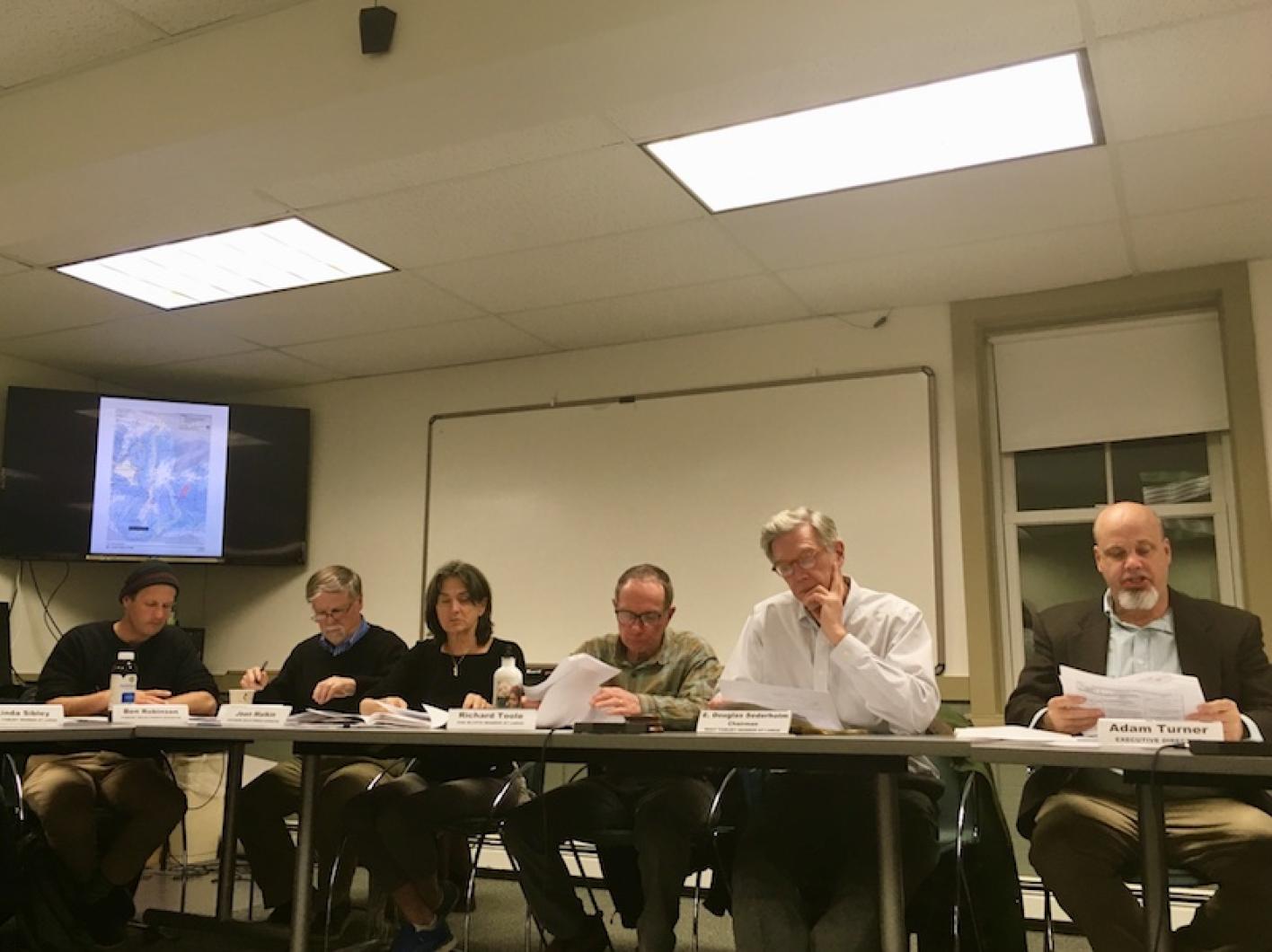
<p>The Martha’s Vineyard Commission voted Thursday to approve the undersea cables that will transmit electricity from a giant wind farm off the Vineyard. The approval comes with conditions.</p>
Vineyard Wind, the company that plans to build a massive offshore wind farm south of the Vineyard, won approval from the Martha’s Vineyard Commission Thursday night for its undersea cables that will transmit electricity to mainland.
The commission was reviewing the project as a development of regional impact (DRI) because part of the cable will through Vineyard waters off the eastern shore of Chappaquiddick. A public hearing opened in February.
The approval comes with two conditions: the company must return to the commission if it decides to decommission the wind farm, and the commission reserves the right to require a modification if there are unforeseen environmental impacts.
Out the outset of deliberations Thursday night, MVC executive director Adam Turner urged continued oversight of the cables, which will be buried five to eight feet deep about 1.2 miles from the Edgartown shoreline. He said he supports Vineyard Wind, but he expressed doubts that federal agencies including the Bureau of Ocean Energy Management (BOEM) could be trusted to adequately protect the ocean and its wildlife.
“[BOEM] consistently puts the natural environment and sea animals way behind the economic development of energy,” Mr. Turner said. “We are the ones responsible to protect this place, whether BOEM protects it or not.”
Commissioners agreed.
“It may be that evidence comes back that is inconsistent with what their proposal and their testimony said,” said commissioner Joan Malkin of information provided by the company. “If it turns out there are impacts, that would constitute a change.”
Responding to concerns raised during the hearings, Vineyard Wind has promised to share approvals from federal and state agencies with the commission, including a copy of BOEM’s federal environmental impact statement. The company also committed to modifying the cable installation process to protect the North Atlantic Right Whale. In a final offer Thursday night, Vineyard Wind committed to continued monitoring of the benthic habitat to document potential disturbances and recovery.
Based in New Bedford, the company was formed through a partnership between Avangrid Renewables and the Danish company Copenhagen Infrastructure Partners.
The Cape Cod Commission also approved underground cables Thursday in Barnstable. The regional decisions marked a milestone for the proposal, but by no means conclude the permitting process. The project still awaits a sign-off from the Edgartown conservation commission among other local authorities. And multiple state and federal regulatory agencies, most prominently BOEM, still need to grant approvals before the project can begin. In the end, the vote to approve the project was 14-0-1. Clarence A. (Trip) Barnes 3rd abstained, citing concern for wildlife.
Chairman Douglas Sederholm acknowledged Mr. Barnes’s concerns, but said the conditions are designed to monitor unforeseen impacts.
“I think a lot of this is, we don’t know, but we’re going to keep our hook in.” Mr. Sederholm said.
In other business, Mr. Turner updated the commission on the unexpected partial demolition of a historic home in Vineyard Haven. Known as the Mill House, the home is located on the harborfront near the Vineyard Haven Library. Parts of the house date to 1750 and its history intersects with the Revolutionary War. It was owned by playwright Lillian Hellman from 1955 to 1961.
“It’s definitely sort of iconic,” Mr. Turner said. He said he was called two weeks ago about the possible demolition, and builders were unsure whether the house, which had multiple modifications, still qualified as historic.
“I instructed the building official to not let them do anything and to bring the demolition to the commission,” Mr. Turner said. “Sometime in that period, the building was demolished.”
Mr. Turner said he had since ordered workers to cease and desist, but much of the historic building has already been destroyed. The signature mill tower remains, but it’s condition is unknown.
“This is a major deal. This is a historic house,” Mr. Turner said. “Somebody went around our regulations.”
Comments
Interesting condition "the
reality check edgInteresting condition "the company must return to the commission if it decides to decommission the wind farm". What WOULD be appropriate is for "Vineyard Wind' to provide a performance bond, so when they go broke, the bond will pay for the eventual removal of the cable if this scheme fails due to economics. Unless public utilities are forced to pay three times the current electric rates by legislation the project will fail. Did you already forget the ill fated 'cape wind'? Cape wind needed revenues that were THREE times the electric rate at the time in order to break even..and that was YEARS ago before the abundance of cheap natural gas was available to make electricity much more economically.
My thought EXACTLY!!! Where
BMMy thought EXACTLY!!! Where is the bond?? This commission is in dire need of some additional advice.
There are approximately 13
Ted VHThere are approximately 13,000 wind turbines now in operation through out the US. If they were not economically viable, I don't think
they would contnue to build them. Cape wind failed because of continued opposition from wealthy beachfront property owners that didn't want them in their view.
Very disappointing that the
Quitsa ChilmarkVery disappointing that the MVC would appear to acknowledge the likelihood that the Federal and state regulators will totally abdicate their responsibility to protect the environment and then approve the permit. Go look at the right whale sighting maps, you will see the greatest concentration smack in the middle of the lease block for the so-called "Vineyard Wind" but really "Danish money" farm. Do you think the Trump Interior Department will care one bit about that or the destruction of important fisheries? Harvard professor Cass Sunstein just published a comprehensive study of the cost/benefits of mandated renewable purchase contracts like the Massachusetts law that makes this project viable. It shows that these laws have huge negative impacts on the public (through higher rates) that far outweigh the benefit from any reduction in carbon emissions. These giant offshore windfarms are among the poorest, least efficient ways to do anything to mitigate climate change. They just happen to have great public relations. Vineyard Wind is a terrific way for a few guys to make lots of money (including certain locals and environmental groups whose support has been bought with token gifts much like the early colonials used trading some trinkets for land -- and we know how well that turned out for the native tribes).
In a few years, the crushing negative economic impacts of this project and the irretrievable industrialization of one of the most pristine areas on the entire coast will be lamented by almost everyone on the island except the handful who took the money and ran.
What a clear and eloquent
From a hill in Aquinnah AquinnahWhat a clear and eloquent comment. Please take this compliment from someone who is still on the fence on offshore wind. If we had a different model, a socialist model like Europe, with the gov investing and funding the transmission lines to create a central "grid" for all developers, would you agree that some of the issues you raise would be moot? With regard to destruction of fisheries, marine mammals, wildlife and habitat - Have you read the March 2019 NOAA comment letter on Vineyard Wind? Here is a link - https://static1.squarespace.com/static/511cdc7fe4b00307a2628ac6/t/5c8fe… Wind Comments with Attachments A and B.pdf
I see this letter is a strong critique of the draft EIS (DEIS). I have faith that the environmental arm of BOEM will take NOAAs comments and concerns very seriously. As stakeholders, we need to continue to communicate with BOEM staff about our concerns. We should also talk to our Fed & State elected officials. One point made by NOAA in this letter regards marine mammals and outlines the law & regs behind the Marine Mammal Protection Act - MMPA. NOAA points out that this law is not included in the DEIS and must be so that the proponents of Vineyard Wind know how rigorous the MMPA is regarding "harm" or "harassment" to marine mammals. The ESA has been weakened by the Trump admin. with regard to harassment and incidental takes - but the MMPA still appears to have strong regs and oversight. NOAA also points out and addresses the lack of analysis & mitigation on impacts to cultural and economic resources as well as a lack of analysis on various scenarios that are being considered regarding siting of turbines, cables etc. These are dark times but there are good people in government.
This project is required to
Carol formerly ChilmarkThis project is required to provide electricity that is free of carbon emissions. Thank you for doing the right thing & approving this.
Add new comment