


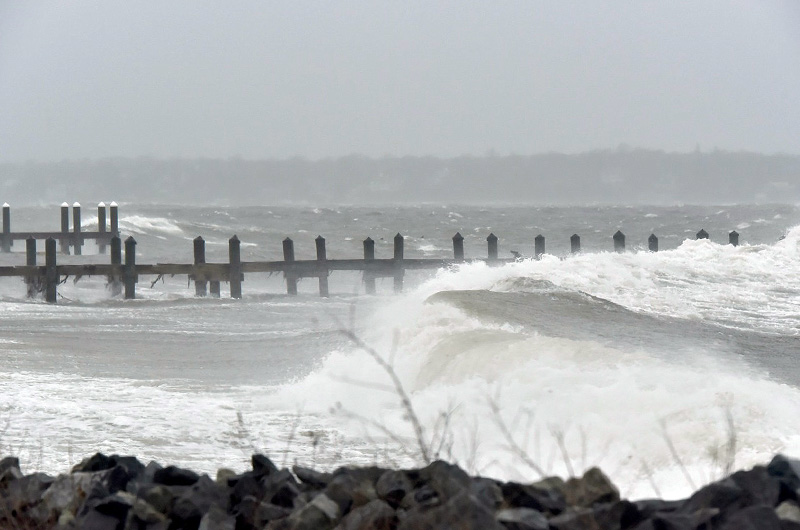
<p>During the peak of the recent winter storm on Jan. 4, the electricity network that serves Cape Cod and the Islands faced a significant test.
During the peak of the recent winter storm on Jan. 4, the electricity network that serves Cape Cod and the Islands faced a significant test. The Pilgrim nuclear station in Plymouth went off line when a transmission line snapped in high winds and blizzard conditions, an event that forced curtailment of generation at the canal plant generating station in Sandwich.
The two plants, which provide power to more than 180,000 homes in the region, didn’t come fully back online for 72 hours. And during those long hours another outage could have triggered blackouts during three days of horrible conditions.
If Vineyard Wind been built and online prior to the storm, the offshore wind project’s 800 megawatts of clean energy not only would have eased the threat of an electricity grid crash, it would have dramatically reduced environmental impacts.
Frigid arctic temperatures and stormy conditions strained the capacity of interstate natural gas pipelines to transport enough fuel to meet the region’s demand for heating and electric generation. The bitter conditions led to a spike in wholesale gas prices, more than 10 times the 2017 annual average price.
While most electricity in the region comes from burning natural gas during normal conditions, during extreme cold the gas is prioritized for home heating, and electricity generators turn to stored oil. During cold weather conditions that force electric generators to burn emission-intensive oil to fuel their turbines, they release tons of excess greenhouse gases like CO2, as well as pollutants impacting local air quality, into the atmosphere. Commonwealth magazine reported that during 14 days of extreme cold after Christmas, New England’s power generators burned close to two million barrels of oil, more than they used in 2016 and 2017 combined.
Wind data provided by the Massachusetts Clean Energy Center’s offshore measurement station show that had Vineyard Wind or a similar project been in service, it would have operated at full power during the storm’s peak. In addition to more than making up for the outage at Pilgrim (which only generates 685 megawatts), Vineyard Wind would have reduced carbon dioxide emissions by more than 67,000 metric tons during the so-called bomb cyclone, based on figures reported by the regional grid operator, ISO New England. That level of greenhouse gasses is roughly the same as the volume of tailpipe emissions produced by 14,000-plus cars over the course of a single year.
During the storm, power prices spiked to their highest level in years. Vineyard Wind would also have mitigated this situation by providing enough clean, emission-free electricity over the four-days during and after the storm to limit price spikes that occurred in regional wholesale electricity market. Based on actual grid prices and weather conditions from early January, potential power production from the Vineyard Wind project would have saved Massachusetts customers nearly $15 million and another $31 million for customers in other New England states.
When it comes to electricity, the recent extreme weather reminds us why the Cape and Islands need offshore wind energy soon than later. More cold extremes will come in future winters.
Mike Jacobs is chairman of the Vineyard Power Cooperative and heads the Union of Concerned Scientists climate and energy program’s electricity markets and regulatory division.
Comments
In a storm of that magnitude
C MartinIn a storm of that magnitude a wind turbine is typically taken offline. For starters ice forms on the blades which can cause the turbine to have issues. Secondly, if the wind is that severe the turbine most likely will be shutdown for fear of over speed.
Like a power plant at some point the turbine is connected to a grid via cables. Some places they are underground and others they are overhead.
Turbines are a great asset but there is a need for conventional fossil fired or nuclear fueled plants.
Not to pile on, but wind
Chip Coblyn OBNot to pile on, but wind turbines in tough locations like the North Sea, are set to go offline when wind gusts reach 65 mph. Hopefully in the future, installations will have heavy duty turbines that can survive such storms, but they aren’t over here yet. It will be possible some day to store the power generated by wind. In that case the power will continue to be distributed despite the turbines being locked.
Interesting article
KateInteresting article
Thank you for pointing this
CraigThank you for pointing this out. It’s one issue that off shore wind proponents avoid. Atlantic hurricanes, seawater, high winds, strong tides... what happens when a storm damages the precious wind mills? I have a feeling the consumers will foot the bill, like it or not. This whole idea is ridiculous. It more about profit and “ feel-good” technology than electricity. Vineyarders should be fighting this tooth and nail!
Craig. You obviously have no
Jim R FalmouthCraig. You obviously have no idea how this works or what a renewable energy power contract looks like, fixed price over many years. Consumers are already footing the bill every time we have a gas shortage in New England. Why don’t you complain about the status quo instead of continually spouting misinformation? Please stick to bike repairs in Hawaii.
Typical. Liberals are all
Bob FargoTypical. Liberals are all for free speech and inclusiveness as long as you agree with them!
I don't know what a renewable
CraigI don't know what a renewable energy contract looks like?? What's to know? It's a contract where a few investors make money on a supposed "needed" development. I know quite a bit about this whole subject, and I know a bad idea when I see it. What does gas have to do with this? I am complaining about the status quo! It's developers destroying the environment for their personal profit! And still my question that is always avoided: How will these machines fare in an Atlantic Hurricane?I doubt they will be on-line during a hurricane, and more relevant, the power goes to the mainland grid, so Mr. Jacobs touting that the Vineyard would have windmill power during a major storm is just silly. How can we be assured there will be no negative impacts on fishes birds, Right Whales? Studies that I have seen that claim "no negative impacts" are studies provided by the proponents! So while I'm busy fixing bikes in Hawaii, I still care about MV and the surrounding waters. What's your stake in this Jim R? Something tells me your looking to bring in some dividends on this development.
Vineyarders should be
Daniel phelanVineyarders should be fighting tooth and nail for offshore wind. The technology is nothing new. Monied interests have convinced a number of people that offshore wind is bad. What is bad is that people are fooled so easily by monied interests.
Tiny little Denmark has 513
Ebba Hierta West TisburyTiny little Denmark has 513 turbines in operation in the North Sea, with installations going back to 1991 still in use. Technology is here. Need is here. Please do some homework. It's not new around the world. Time to tell the petroleum lobby that has had a stranglehold on our national energy policy to get with the program. Just saying.
Thank you Ebba. The European
Mike Jacobs Concord, MAThank you Ebba. The European expertise is directly involved in the planning and design of the offshore wind turbines here. The issues of turbines turning off in high winds is a) a design choice; and b) a means to make the turbine able to withstand much greater wind speeds. As for the suggestion made by others that there is some risk that the cost of a mechanical failure will be paid by consumers, that is like Ebba said, not something that holds up to the facts.
thank you guys. we can solve
Daniel phelanthank you guys. we can solve any problem with engineering. I don't know why people don't understand this.
Above a certain wind speed
Cathy H Manchester, CTAbove a certain wind speed they have to pitch the blades so they don't spin to protect the turbines. However, as soon as the wind subsides the turbine can be back up and running very quickly. Conventional power plants can be down for days or weeks after a severe storm or flooding events. Look at the poor state of PR, they have been down for months.
The comments here saying
Daniel Phelan Vineyard HavenThe comments here saying offshore turbines would not operate in the storm are silly. Most modern turbines are designed to operate in very high winds, more then the storm in question produced. The Bomb Cyclone produced average wind speeds on the open Atlantic around 40 to 50 mph with gust up to 75mph. Offshore windfarms off the coast of England and Scottland are build to operate in nearly any storm. Many models shutting down only after sustained wind of 75mph for 10 minutes.
There’s a lot to follow up on
Helen ParkerThere’s a lot to follow up on and clear up in this piece, starting with the title: Wind Power a Boon for Island. Hardly. For the developers, maybe.
Mike Jacobs notes that “…another outage could have triggered blackouts .…” Blackouts and forced load shedding [switching off customers’ power supply when the power system is at risk of failing due to greater demand than supply] is standard with chimeric wind-sourced power generation.
That threat is greater in summer than winter, as Southern Australia, with its extensive wind buildout, is facing just now. [see http://www.abc.net.au/news/2017-02-09/sa-heatwave-further-potential-pow…]
…but see also: http://canadianenergyissues.com/2018/01/04/renewable-energy-in-the-onta…
Jacobs cites “the offshore wind project’s 800 megawatts of clean energy….” Where in the range of meaningful figures does this number fall? In 2014 Germany, for example, 24,000 turbines with a total rated capacity of almost 36 gigawatts, delivered on average only 5.85 gigawatts.
Again Jacobs: “…would have dramatically reduced environmental impacts.”
You can look at the CO2 numbers for the smaller turbines being built in 2014 here: https://stopthesethings.com/2014/08/16/how-much-co2-gets-emitted-to-bui…
And yes, that website has an attitude, but they back up their points with facts from real world data, not models. From manufacture thru installation and maintenance, industrial wind turbines are responsible for more CO2 emissions than what their brief operational life will ever save. And think for just a moment what an energy source which consumes such vast areas per-energy-unit-produced does to our on-shore or off-shore environment.
“…potential power production from the Vineyard Wind project would have saved Massachusetts customers nearly $15 million and another $31 million for customers in other New England states.” Does anyone who has seriously looked into energy options need to see a rebuttal of that nonsensical claim?
That this is coming from the "head of the Union of Concerned Scientists climate and energy program’s electricity markets and regulatory division" [sic] should be of some concern, whatever his connection to the Vineyard Wind project.
Add new comment