


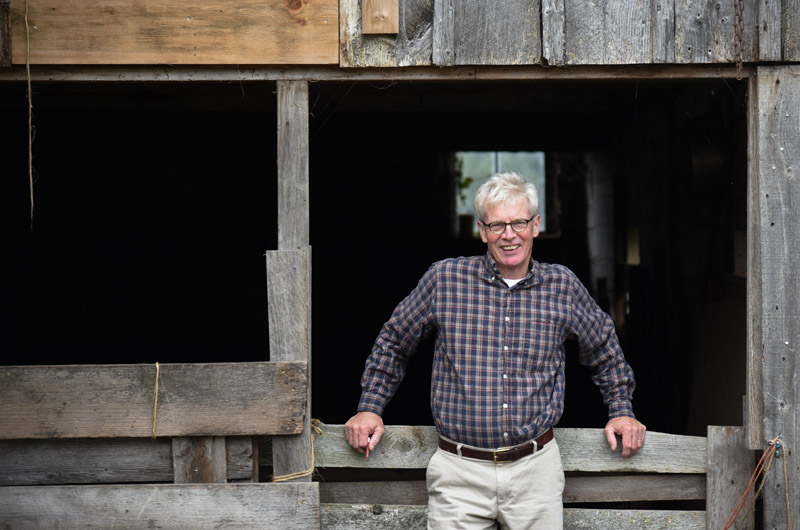
Sixty-four of Allen Whiting's 70 years have been spent on his family farm, tucked in the heart of West Tisbury.
A human skull, a green door from the Edgartown dump, a key from a plantation house in Bequia, an old plastic plate with the name Bea written on it in faded letters, jars stuffed with paint brushes. Tom Maley’s easel, Stan Murphy’s easel, a Miami Hurricanes helmet, a bunch of wilting dahlias and about 300 paintings.
These are a just few of the things you’ll discover in Allen Whiting’s West Tisbury studio.
The studio itself is a patchwork, made from a piece of the old Grange Hall, part of the former West Tisbury town office and a shed roof structure that artist and friend Jay Lagemann helped Allen tack onto one side.
“I am a bit of a hoarder,” the renowned landscape painter confesses. “I just can’t seem to throw anything out.” A pause and a laugh.“What can I say?”
It turns out that Allen Whiting can say a lot.
First, there’s the land. Sixty-four of his 70 years have been spent on his family farm, tucked between the Panhandle and State roads in the heart of West Tisbury. The house he lives in was built by his father’s uncle, Judge Davis, sometime in the 1870s.
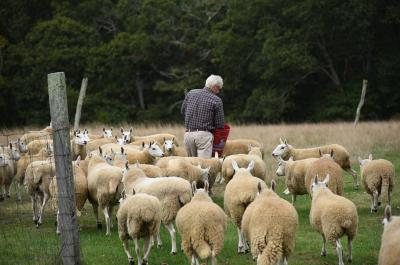
Not all of his fans are people.
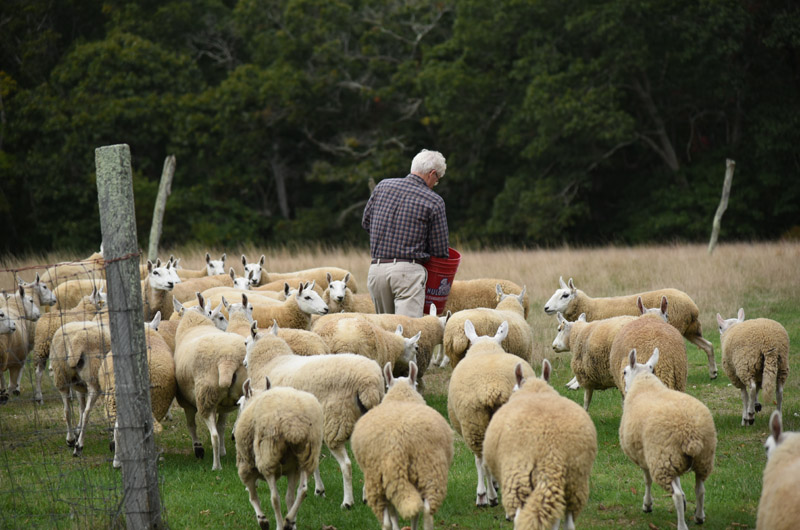
Not all of his fans are people.
When his father, Everett Whiting, died in 1981, Allen and his siblings, Daniel and Prudence, were advised to put the 57-acre farm into conservation to ensure that the land will always be agricultural. “My oldest son William [from his first marriage] came out of the house one day to read me a quote — he was reading Thoreau — and I’m going to botch this, but essentially, the essence of what Thoreau was saying was, it is a great misfortune to inherit land because you’re always pushing a 90-foot barn with junk in it in front of you for the rest of your life.”
Seated at his kitchen table on a chilly and damp early fall day, he cradles a cup of coffee and runs a hand through thick white hair. Pointing in the direction of his barn, which he inherited with his brother and sister, he says: “I am always running into generations worth of stuff.”
Still, he disagrees with Thoreau. The farm been his constant inspiration, he says. It is the place where as a young boy he became interested in his grandfather Percy E. Cowen’s drawings and paintings. Cowen was a promising illustrator in New York before he was drafted for World War I. “He was in the trenches and got an infection. There were no antibiotics. He came home, but he died very young. His work fascinated me.” He shows off one of his grandfather’s paintings of men trap fishing in Menemsha, and another of five geese at Flat Point Farm. He recalls finding a painting by Frederic Remington in an Encylopedia Brittanica that was lying around the house. “It was a very famous work of his called Fight for the Waterhole. I would make copy after copy of it, just looking at it trying to understand the lines. How he made it work.” He still admires Remington’s work. “He did these pictures of cowboys and Indians later in life, but I believe it was the highest point of impressionism in this country. He pushed it to the limit.”

The land is his studio and his muse.
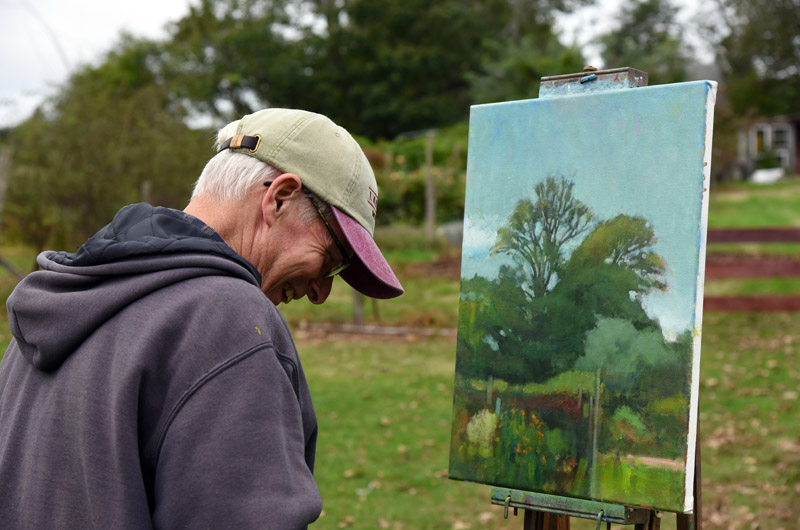
The land is his studio and his muse.
He also credits Stan Murphy, who lived just up the road from the Whiting farm — and whom he describes as “my father’s best friend and my best friend’s father” — with being a great influence. “I watched him develop. Seeing new paintings come into the house. His new images. That was my art education. I didn’t go to a museum until I was 24,” he says.
His formal education came in fits and starts. He was sent off to boarding school at Cornwall Academy, shortly after his high school guidance counselor told his mother told her to “sharpen up the lawn mower for the boy,” suggesting that a farm hand might be the greatest thing she could hope for in her son. “It wasn’t one of those tough love schools,” he recalls. “We could smoke. I could have a car. But there was no ivy on those walls. And there was also no art program.”
After high school he went to the University of Miami to play baseball and paint. “I mean, I have no idea where I got this idea. We had no little league or baseball here on the Island. What made me think I could play baseball with these kids who grew up playing every day?” he says. “And I hadn’t really done any formal painting training. I just knew I liked it.” Later Allen returned to the Vineyard to help his father on the farm. But while he left his dreams of professional baseball down south, painting was still with him.
Fast forward a few years, and again he found an artist just up the road from his home who would further his art education. Thomas Maley and a group of his artist friends had just begun setting up the Field Gallery as a kind of cooperative art space. “Tom was wonderful. The Field Gallery allowed me to show my work way before I was ready. It was 1970. I was 24 years old,” he says. “But I sold some work and that gave me the impetus to keep going. Ten years later, I think I made about $10,000. I thought I was on my way.”
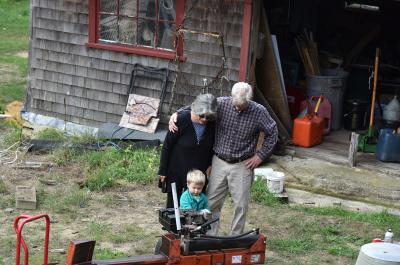
Allen and his wife Lynne have been married for 38 years.
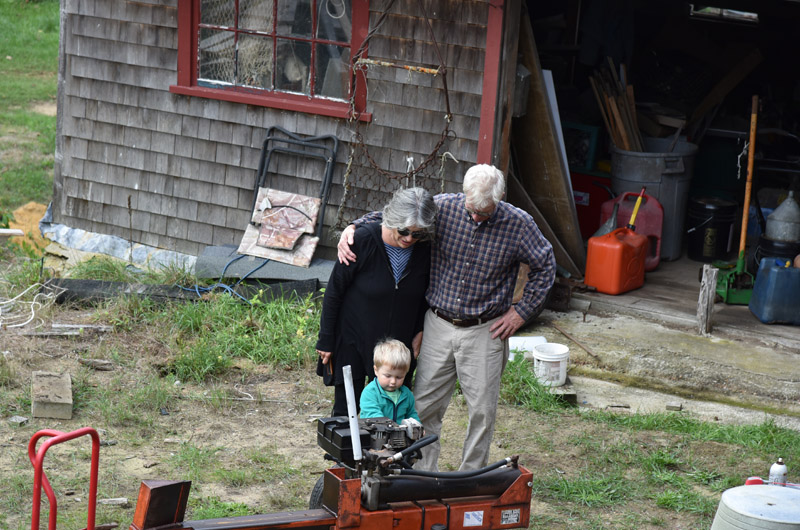
Allen and his wife Lynne have been married for 38 years.
In the mid 1970s, Allen met his second wife, Lynne, who was working at the Field Gallery. “She is from Salt Lake City, but fortunately, she is from an old English family and likes old stuff,” he says. A retired teacher, Lynne now helps Allen manage their art gallery, which takes up half the front of the Davis House. “She’s amazing. I wouldn’t be able to do it without her,” he says. “She’s a great painter too. An interior decorator recently came to our gallery and wanted to buy the great painting in the bathroom. I told them they’d have to talk to Lynne.”
He takes a last sip of coffee and checks his watch. It’s 8:30 a.m. Time to get to the farm chores. “I am not one of those farmers who likes to get up as soon as they can see their hands,” he says. “I’d rather stay up a little later and paint. Or read about Monet in the morning.”
Wearing New Balance sneakers, khakis with a few paint splatters on them and a brown plaid shirt, he heads outside to the sheep barn. In the driveway, he is greeted by his daughter Bea and her two-year-old son Asa, who calls him Papa. Taking Asa’s hand, they walk toward the barn. “Right now, my grandson has not figured out the value of my wife’s charms because I have the ultimate attraction: five tractors,” he says.
Sheep are let out to graze; chicken coop doors are opened and Allen looks for eggs. Then he heads for the big barn, half of which was once a church. He shows the old plaster walls from the church, and the hay mow, which is not as full as usual due to the drought on the Island. “Watch your head,” he cautions. “Everything here is built for short Englishmen.” He points to the first Allen Whiting painting, small blue handprints on a door frame.
The story continues; with his grandson Asa, age two.
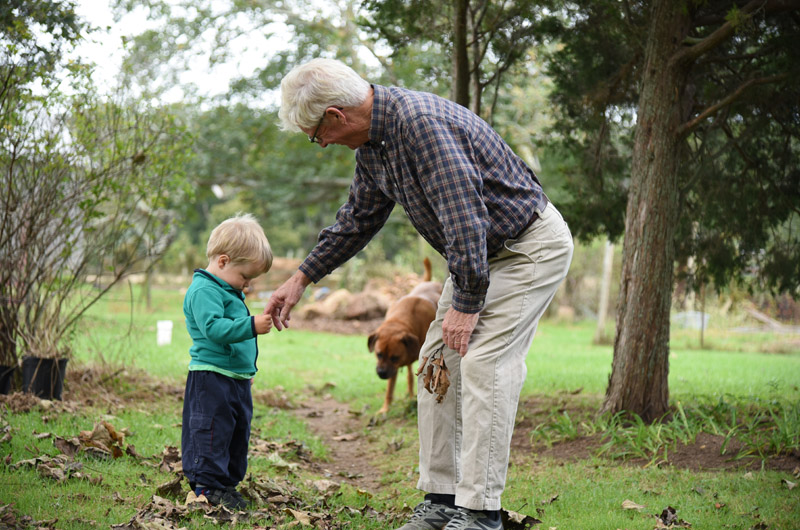
The story continues; with his grandson Asa, age two.
He walks through the barn toward his studio, on the other side of the farmhouse. In the studio there are more piles of old stuff: a wooden duck boat, a pile of black socks, buckets of nails, chains, fencing, wrenches, an orange buoy with the name Whiting written on it, old rake heads. “This is where I make my frames. Usually in April. When it is cold and miserable,” he says.
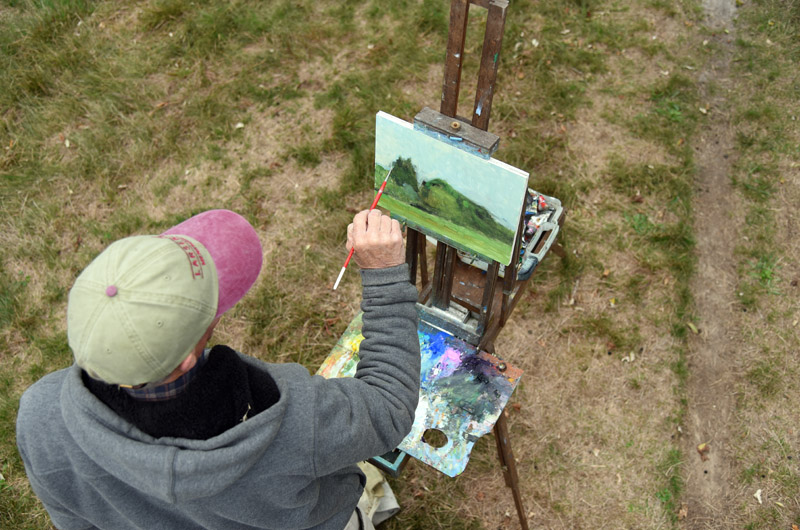
An hour later Allen stands at his Julien plein air easel, in the middle of one of his fields. Sheep roam in the distance. He points to a line of trees. “I’ve been looking at this for a while and want to see about it.” He makes a few dark green vertical swipes and a swoop, then dips his brush in some turpentine and rubs it with a cloth. He mixes a lighter green and returns to an earlier thought. “I have come to realize that I always have a lot to do around here and I have accepted that I am not going to get it all done. I am not going to outlive it.”
He begins to map the sky with his brush. His moves are loose and feel almost unconscious. “You know, you can’t mix blue and white and get a sky that looks like a sky,” he says. After a few more slashes of a gray-blue, he begins to lay the foundation for the field. “No one was doing landscapes in school. I did go back to school. Windham College in Vermont. I think they would have let anybody in. Anyway, I used to feel so provincial.” He pauses. The brush goes back into the turpentine, another color is mixed.
“I have had this fascination with this land, this property since I was little. Gosh, it had to be sixty years ago, that I was driving with my father to one of our fields down near Quansoo and I saw this line of trees that went down to the beach near one of our hayfields. And I didn’t think, well all I want to do is pull potatoes out of that land. But I felt there was something there for me. My father was no goober. He was a farmer, but he encouraged me to paint. I wanted to see if I could paint what I was seeing, recreate it. Get it. I have been reading my grandfather’s letters. He was close with Thomas Benton. I wonder what he was thinking about. I wonder what they talked about. I wish I could have talked to Benton. I feel like I have a lot to learn. I hope I have 10 more good years.”
He works on the new painting, talks about Benton, Picasso and Richard Diebenkorn, among others. Later he puts the palette and brushes away. “I’ll know if I like it when I look at it tomorrow,” he says.

Stan Murphy was one of his earliest influences.
Stan Murphy was one of his earliest influences.
He slides the wet painting onto the dashboard of his green Toyota pickup and drives back through a field, passing son Everett’s four giant pigs. He points out things he has painted, trees he appreciates, a particular part of a skyline. “Nature has all the answers,” he says. “Monet didn’t have more to look at. Look at Monet’s water lilies. Look at what nature gave to Monet.”
After lunch, he measures a beam in the sheep barn that needs to be repaired. Then it’s back outside to work on another small painting of a scraggly tree perched over Lynne’s tidy garden. At this time of year, he tries to get as many small paintings done as possible. Some stand on their own, others serve as studies for larger works. “I make big ones to legitimize the little ones,” he says. As he reworks the tree, he talks about missing his friend and fellow artist Bill McLane, who moved to California. They painted together every day for eight years. “There were maybe two days when we went out and couldn’t get it together to paint. We’d talk family. Art. Or just say nothing.” He pauses and sighs. “But ultimately in this game, you are alone.”
He switches the subject to family. “I never wanted to be an autocrat. I like cooking and eating with my family. I want to be a part of the farm. I want to spend time with Lynne. I ought to be doing a lot of things. Around the farm and in art. I think I have one pencil drawing of Asa. I should have 50. But I’m not a portrait artist. I’m trying not to regret not doing more drawings of my family. But I’m drawn to paint this ragged tree.”
He shakes his head. “You see, I’m avoiding dealing with the garden. But I need to address it.” He mixes another color. “I’ve used the same 12 colors as my foundation for 40 years. If that isn’t the definition of insanity, I don’t know what is.” He shrugs. “But these are my colors.”
He muses about sending a few of paintings to a gallery in Santa Monica, Calif. But he would only make half what he could make selling in his own gallery.
He admires Wolf Kahn. “The first time I went out to paint with Wolf I took him to Quansoo. I was so nervous, I left all my gear by the tree in our driveway. It was cool. He let me borrow his stuff and we painted next to each other and were able to chat rather than be 100 feet apart.” He steps back to look at his work. “I could take a photo of the tree and paint it, but I wouldn’t get the mess of it. I like the idea of the limited time, the speed with which you need to work outside, the anxiety. When I see my paintings, it’s like a postcard of the experience from wherever I’ve been. But this garden. Oh, I’m way in over my head. But that’s true most of the time. It is invigorating.”
Jay Lagemann strolls into the yard. He’s just back from meetings in New York city for an installation of his work there. He describes the machinations it takes to get a sculpture installed in the city. Allen shakes his head. “Well, did you decide where you are going to sign your name?” he asks.
Jay doesn’t know, but he knows he is going to have all his grandchildren sign it too. They talk some more. The sun is getting lower in the sky, the sheep have gathered in a pack in the near distance.
Allen folds up his palette, puts away his brushes and packs up the easel. “It’s a red-letter day when you get a painting done,” he says.
Then walks to the house to see what Lynne wants to do for dinner. Later, he’ll head to the studio to paint some more.
Allen Whiting, Painter at 70
Profession: Painter, farmer.
Education: Bachelor of arts from Windham College, earlier stint at University of Miami.
Parents: Everett Whiting, Jane Mayhew Whiting.
Spouse: Lynne Whiting, married 38 years.
Children: William Whiting, 44, Beatrice Whiting, 36, Everett Whiting, 34.
Grandchildren: Asa Ruel and Prudence Ruya Whiting, both 2 years old.
Animals on the Whiting farm: 50 sheep, 30 chickens, 4 pigs, 2 horses, 1 dog, Roxy (Everett’s dog), 1 cat, Georgina (Bea’s cat).
Unlikely new addition to the Whiting Farm: A basketball court. As Allen says: “Swish one and you think you’re great.”
Comments
What a treasure of a story...
Kathleen Kopec Murrells Inlet, SCWhat a treasure of a story....a glimpse into the magic of the Vineyard and the life of a special resident.
Well penned and a simply
Douglas Korves Always on IslandWell penned and a simply touchinh article. It is refreshing to see another from the class of 1946 adding some soul and talent to the field besides Clinton, Letterman, Trump, and Korves.
When I first touched the island in my 20's, I yearned to capture the oldness of the land, the air that was of the sea, the trees that were wrapping themselves in the blues, greys, and clouds. I had never seen "that light" that appears suddenly in late August and sharpens not only the shadows; but your eyes, each breath, and your soul.
It is that joy of now and being alive and a part of this earth that I yearn for and search to feel each time I get back on-island.
It is this patient search that Allen Whiting grasps for in each painting that takes one's breath away. It reminds me of when I had my nose inches away from an Andrew Wyeth painting, marveling at its realness and realizing that he was an impressionist, that I saw a small straw nest of eggs in a coop. I marveled at the light and texture on the surface of the eggs and sighed. Then I realized Wyeth had rolled his fingerprint on to the wet eggs.
This island will always have Allen Whiting's fingerprints on its trees, fields and soul. Thank you for this sketch in time Jenna Shepherd.
Allen doesn't mention that
Jim Pringle TisburyAllen doesn't mention that for years he was a excellent third baseman in the Island fast pitch softball league. A great story about a special person.
Centerfield. He was fast
Mr. B ChilmarkCenterfield. He was fast enough to get everything and had a terrific arm.
Allen is my favorite painter
Jay Handy Abel's HillAllen is my favorite painter and I thoroughly enjoyed this article.
Allen Whiting is one of the
Scott Ryan West Caldwell, New JerseyAllen Whiting is one of the kindest and loveliest people whom I have ever met. When I have visited him in his wonderful gallery/home, not once did he ever hurry me along as someone with a fatter wallet or a more famous face walked through the door. Mollie Doyle surely encountered the very same gentleman when she was lucky enough to spend the day with Allen. I am also fortunate enough to have a few of Allen's works hanging on my walls and not a day passes that I don't stop and gaze at the sky of one particular one and feel blessed. I think he has more than ten "good" years in him!
Your article caught the real
Kathie Bridges Surprise, AZYour article caught the real Allen! I felt like I was there with you... his wife Lynne is my first cousin and I've been fortunate to spend time with them on the farm, on the island, and love him immensely... A true talent and gentle man.
Allen and Lynne are not only
Debbie Phillips West TisburyAllen and Lynne are not only two of my favorite people on this island, but two of the loveliest, kindest, most interested and interesting people on the planet. I'm deeply grateful to know and love them. I never pass their home without thinking of Allen's heartfelt letter-to-the-editor a few years ago thanking workers for the caring way they removed a dead, beloved tree that had graced his property since he was a boy.
What a great read. A day in
Lori Franciose Salt Lake City, UtahWhat a great read. A day in the life of Allen Whiting is a humbling, exciting, colorful, exhausting and treasured experience. He paints with honor, he loves the earth and is such a good example of a person who learns from everything and everyone around him.
I am honored to be surrounded by "A" Whiting's in our home. Our collection goes back far enough that you can see his artistic development over 4 decades. I am a girl from the mountains with paintings of the sea shore throughout my home though my favorites are still the paintings of hay fields and forests straight from the Whiting farm.
Thank you for this article, Mollie and the photographs, Jeanna. Another piece of the Vineyard to take me back.
This was a great article on
William Ross Searle Mashpee, Ma.This was a great article on Allen Whiting. His sheer honesty, whether it is how he paints, or, how he lives his life, is so admirable. The author got the real Allen Whiting. He grew up with Vineyard soil in his veins and has lived his life, tended his farm, and animals, and his painting with an honesty admired by all. Allen has numerous fellow painters who have copied aspects of his painting style, or, just plain copied him. That may be testament to how his paintings and honesty, capture what is most valuable about the Vineyard.
Add new comment