

<p>Turning the seasonal economy of the Island into year-round industry could mean looking toward the ocean for a so-called blue economy, representatives from the Cape Cod Chamber of Commerce said this week.</p>
Turning the seasonal economy of the Island into year-round industry could mean looking toward the ocean. At a well-attended talk Wednesday, Cape Cod Chamber of Commerce staffers Christopher Adams and Peter Karlson presented the idea of a sea-based “blue economy” to about 50 Vineyard residents who were asked to think creatively and work proactively on coastal industries.
“We all know the Vineyard has to find new sources of economic development. Using our water based resources makes a lot of sense,” Peter Temple, executive director of Martha’s Vineyard Donors Collaborative, said as he introduced the speakers.
Mr. Adams, the chief of staff at the Cape Cod Chamber of Commerce, said the three major stakeholders in creating an emerging blue economy — businesses, the government, and the education system— need to work together. He noted funding is available for towns interested in pursuing a blue economy, using the Seaport Economic Council Awards as an example. In 2016, the Seaport Economic Council gave out $11 million in grants. The Cape Cod Chamber of Commerce received a $180,000 grant to develop maritime economy expansion. Other towns received grants for buying seaside land, developing a town brand or repairing docks.
Peter Karlson and Christopher Adams with Cape Cod Chamber of Commerce led blue economy discussion.
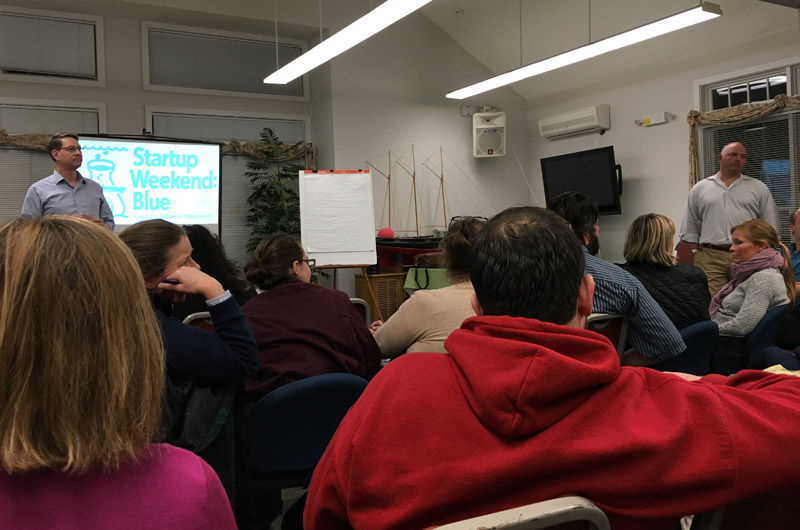
Peter Karlson and Christopher Adams with Cape Cod Chamber of Commerce led blue economy discussion.
The meeting on Wednesday was both informational and an opportunity for brainstorming.
Currently in phase one of their three phase plan, Mr. Adams asked the audience to take stock of Island resources, identify what is missing, and figure out how the missing pieces can be filled. A blue economy includes auxiliary ocean-based industries from manufacturing to education and health services.
Mr. Adams outlined how the Vineyard went from a native culture to a production economy to a tourist economy, and projected the future to be a blue economy. He noted that the seasonal economy forces young people on the Island to look to the mainland for job opportunities. Growing coastal industries may incentivise young people to stay on the Island to make a living, he said.
“Everyone on the Cape that I know live here because you love the place. You’re invested, you care about it. Otherwise you wouldn’t be here,” Mr. Adams said. “You chose to fight it out. It’s not the easiest place to make a living.”
“Overall, the underpinning thing here is the water, it’s what makes us attractive,” he said. “If we don’t have a healthy environment our economy will crumble. This is how it began at Cape Cod Chamber of Commerce.”
Mr. Adams and Mr. Karlson, the entrepreneur in residence at the Cape Cod Chamber of Commerce, encouraged people to run with ideas and build on existing industries, instead of waiting for the town to take control or building only from scratch.
“One thing we don’t want to do is create another planning document that will just sit on a shelf as a document,” said Mr. Adams.
They shared examples of what Cape Cod is doing, including an increased focus on maritime science and technology.
“We’re not dumping the tourism, we’re building on top of it,” said Mr. Karlson.
When the conversation turned to brainstorming for the Vineyard, the focus remained mainly on fisheries.
Lynne Fraker, a commercial fisherman, noted docks are a major problem for those who make their living on the water. Most of the docks are recreational, making it very difficult for commercial fishermen to have proper access.
“There is a need for commercial fisherman to have a place to work from,” she said. “We need to solve the problem in Vineyard Haven.”
Other ideas included a community supported fishery, similar to community supported agriculture programs, where people could buy shares and receive a weekly box of seafood. Others suggested a manned field station that would attract scientists to the Island and compost from leftover shell matter.
Martha’s Vineyard Shellfish Group director Rick Karney noted that Island oyster farms did not take off until a few intrepid entrepreneurs made the first breakthrough.
“A couple of guys stuck it out. Now they are successful and there is a waiting list to grow oysters,” he said. “The first people who get into it have to work out the bugs.”
What was most important, Mr. Adams and Mr. Karlson said, was to not let the ideas die in the room, but to go out and act on them.
“If anybody wants to run with any of those ideas, have at it.” Mr. Karlson said. “Great ideas are worth goose egg until you act on them,”
Comments
Chambers of Commerce as a
Chamberkid On island not offChambers of Commerce as a rule exploit. They are never in it for the long game. The ocean has been exploited for all it is worth locally. Now only major corporates can make a buck from it. Chamber of Commerce members always promote entrepreunership, and they speak of job creation. As if menial jobs are a contribution to our society. With a lack of affordable housing, I would call these job creators a burden. And call the ocean spent. I don't buy this thinktank pitch. Solving our social and economic problems will take a lot more than a handful of limousine liberals speaking from up high. And I say that as a true liberal...a real one.
Generally must people look at
John ElsewhereGenerally must people look at the Chamber of Commerce as being Republican, not limousine liberal
Mr C Kid - I don't know if
JMM ChilmarkMr C Kid - I don't know if you were there. I was. I didn't see any limousines in the Senior Center, just a lot of pickup trucks and a bunch of small and mid sized cars. I also saw about 50 or 60 people trying to pick up any information that they might use to the benefit of themselves and the island.
This can be summed up with
Joseph Paul Uranker Oak BluffsThis can be summed up with the previous article in the Gazette,the difficulties and the expense of just starting the process. https://vineyardgazette.com/news/2014/12/23/eastville-resident-sues-tow…
The best quote and what says it all is Martha’s Vineyard Shellfish Group director Rick Karney noted that Island oyster farms did not take off until a few intrepid entrepreneurs made the first breakthrough. “A couple of guys stuck it out. Now they are successful and there is a waiting list to grow oysters,” he said. “The first people who get into it have to work out the bugs.” -
Community supported fishery -
Carol formerly ChilmarkCommunity supported fishery - what a brilliant idea!
Now if you can just get OB back on track to get rid of plastic bags. Taking care of the oceans (in part by reducing the waste stream of plastic pouring into them) is obviously required for any sustainable fishery.
Add new comment