

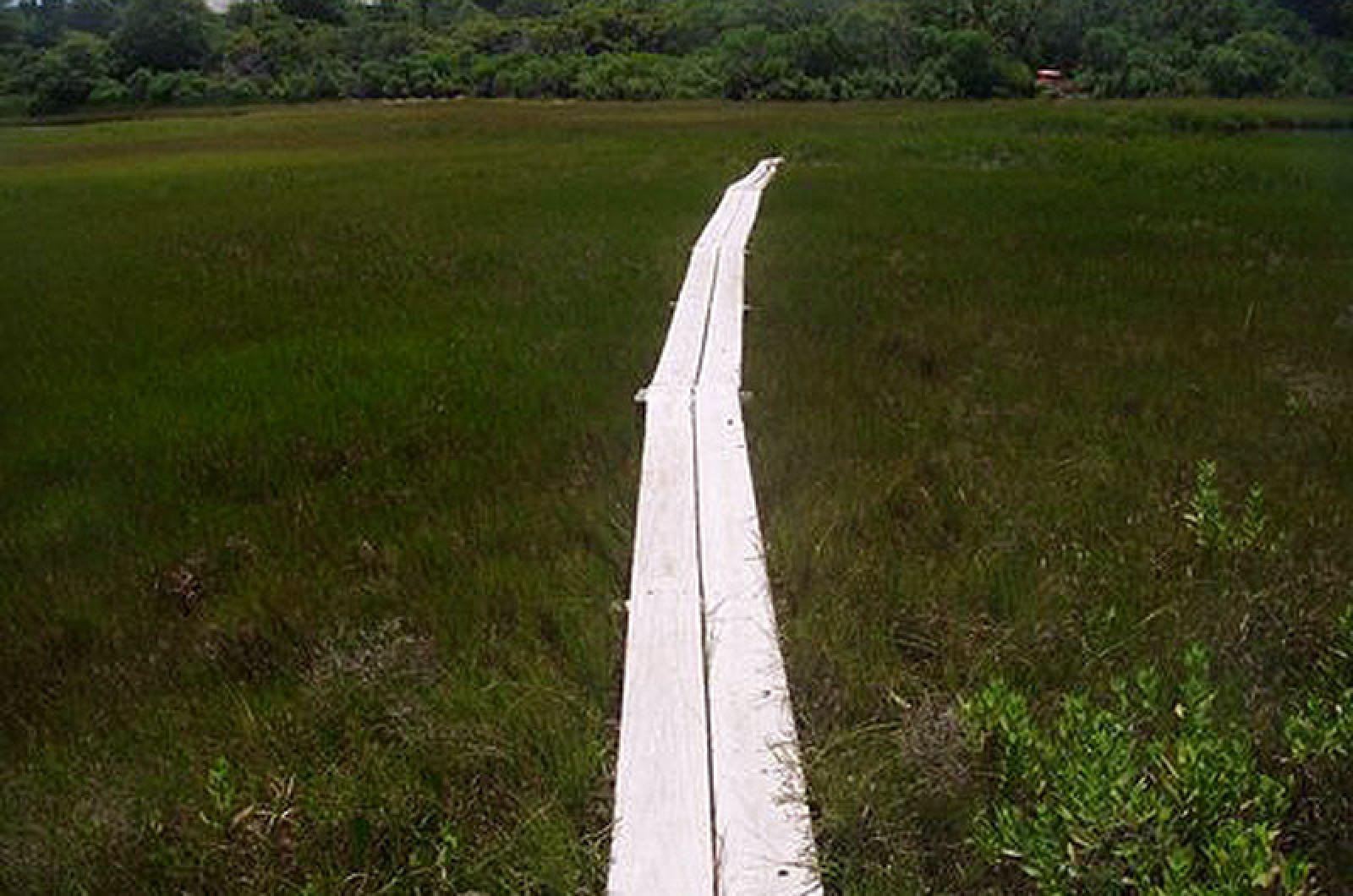
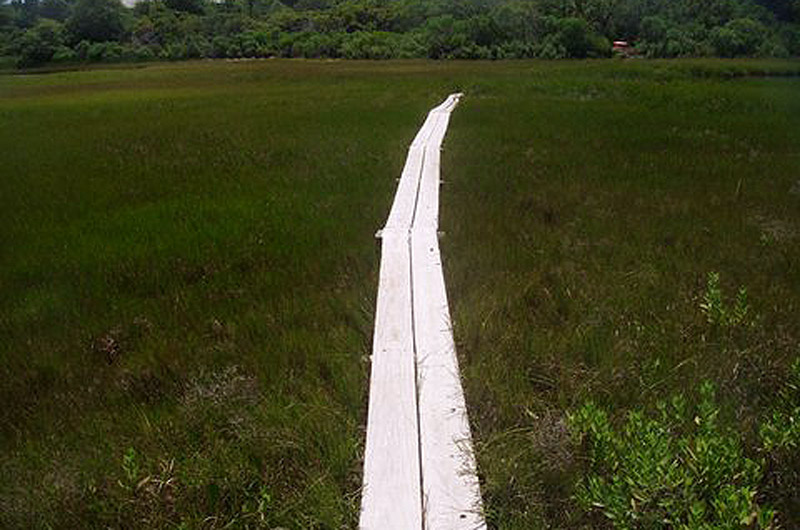
<p>The Edgartown conservation commission recently prevailed in a long-running legal dispute with a Chappaquiddick property owner over whether he could build a boardwalk over a salt marsh.</p>
The Edgartown conservation commission recently prevailed in a long-running legal dispute with a Chappaquiddick property owner over whether he could build a boardwalk over a salt marsh bordering Cape Pogue Pond.
Theodore Roosevelt 4th had sued the commission, challenging its denial of his plan to build a 169-foot elevated boardwalk across the marshland. The case dates to 2009, when Mr. Roosevelt, a seasonal homeowner on Chappy, built a 141-foot walkway across the marsh without obtaining approval from the conservation commission.
Subsequently he applied for permission to replace the unpermitted boardwalk with a 170-foot elevated walkway across the marshland. In July 2014 the plan was denied and an enforcement order was issued to remove the illegal boardwalk, court records show.
The conservation commission administers two wetlands bylaws: the state wetlands protection bylaw and also a town wetlands bylaw which is more stringent than the state law. Mr. Roosevelt appealed the denial to the state department of environmental protection, which administers the state wetlands bylaw, and the superior court, which is the avenue of appeal for the town wetlands bylaw.
The state DEP overruled the conservation commission and issued a superseding order, but this year the superior court upheld the commission after first remanding the case back to the board for more detailed fact finding.
The final ruling was issued late last month.
Without approval on both fronts, the project could not go forward.
Edgartown conservation commission agent Jane Varkonda said the unpermitted boardwalk has since been removed. “There is nothing out there now,” she said.
She also noted that the conservation commission sometimes allows boardwalks across marshland if the property owner has no other way to reach the beach. “The commission will at least take that into consideration,” she said. “But the Roosevelts have an ability to get to the beach without going across the salt marsh.”
Comments
Let him have the walkway!!!!
Stephen Jones Salt Lake City/Wasque FarmLet him have the walkway!!!!
Really. I guess you can
Island Mike MVReally. I guess you can build what you want with no negative impact. Perhaps someone should take a closer look at your property to see what you have cheated on???
Just get a good pair of boots
Islander EDGJust get a good pair of boots!
Or a couple of high speed
Eddie All Over NoepeOr a couple of high speed ATV’s with big balloon tires
Another outspoken protector
Chapitizer ChappyAnother outspoken protector of the environment showing very little regard for it and the rules designed to protect it in his own backyard....trust fund hypocrite with a famous last name...classic.
While not opposed, per se, to
Stephen Cofer-Shabica Oak BluffsWhile not opposed, per se, to boardwalks over marshes, it appeared that the subject walk was nestled in the marsh within the marsh grass itself; biologically not a good thing. Many years ago the US Department of the Interior resolved the board walk issue for marshes and coral reefs. Their research showed that for each 12in of width, the walkway needed to be elevated at least 18in above the land's or water's surface. This ensured that the detrimental effects of shading would be greatly reduced on the grasses and corals.
Add new comment