

Voters up-Island have been taking a hard look at what it costs to educate their schoolchildren. According to the most recent data available, the up-Island school district ranked sixth in per-pupil spending among other districts in the state.
With a decision looming on the West Tisbury education budget, voters in that town are taking a hard look at what it costs to educate their schoolchildren. On Tuesday, voters will convene at a special town meeting at 7 p.m. at the West Tisbury School gymnasium. It will mark the second attempt to approve funding for the regional school district it shares with Chilmark and Aquinnah, following a failed Proposition 2 1/2 override question for an additional $300,000 at the annual town meeting in April. Since then, school officials have worked to trim fat from the budget, and last week they agreed on a revised $10.3 million budget to take to voters on Tuesday.
The up-Island school district has long paid top dollar to educate its students, statistics show.
According to the most recent data available, which describes the 2013-2014 school year, the up-Island school district ranked sixth in per-pupil spending among other districts in the state. The district, which includes the West Tisbury and Chilmark schools, paid $25,311.68 per student, according to the numbers provided by the state Department of Education.
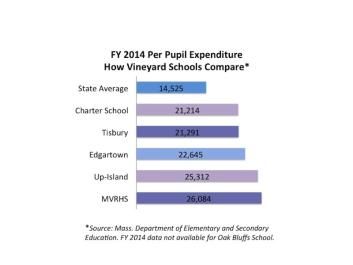
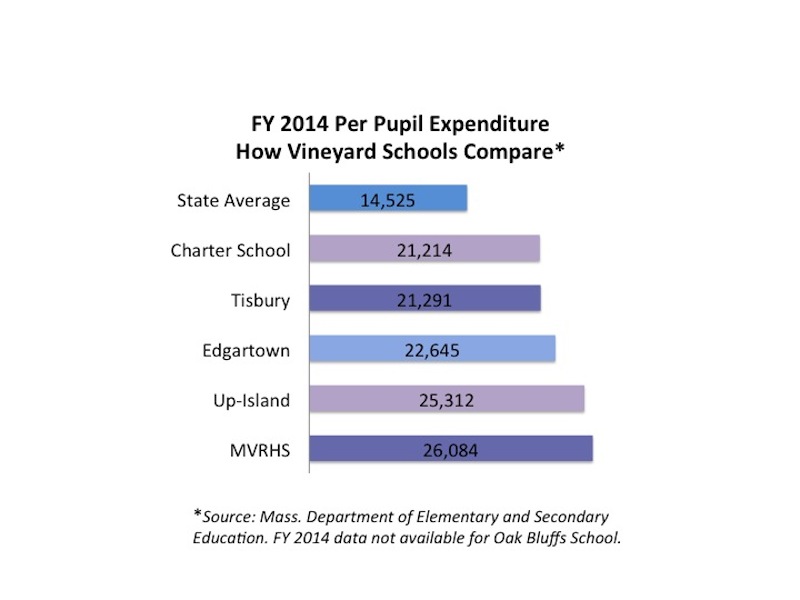
The state average for per-pupil spending that year was $14,525.
And Vineyard schooling in general is not cheap.
In 2014, the regional high school ranked fourth in the state in per-pupil spending, at $26,083 per student. The Edgartown School was ranked 14th in per-pupil spending at $22,645, and the Tisbury School was 22nd at $21,291. Data for Oak Bluffs was submitted to the state behind schedule and are not yet available. The Martha’s Vineyard Public Charter School, which is not counted among traditional public schools in state tallies, paid $21,214 per student.
In a conversation with the Gazette this week, Vineyard schools superintendent Dr. James H. Weiss attributed the high costs of schooling to two general factors. First, he said Vineyard educators are paid more due to the high cost of living on the Island. Because of that high cost of living, Vineyard schools tend to attract teachers who earn at the higher end of the pay scale, while those who earn less are less likely to make the expensive move to the Island.
“People who come here either don’t last because they can’t afford to stay here, or they stay here forever and become highly paid individuals,” Mr. Weiss said. Even with that, he said teachers are not compensated enough to afford the high housing costs on the Island.
The other factor affecting high schooling costs is class size, which on the Vineyard tends to be smaller than other districts. Mr. Weiss said small class sizes have been a Vineyard tradition for many years. “School districts on the Island have chosen to have smaller classes because they believe it is important to the education of their students,” he said.
Another less significant factor, he said, is the slightly higher percentage of Vineyard students who have identified learning disabilities. Statewide, an average of 14 to 15 per cent of students are identified as special needs, while on the Vineyard the number is closer to 18 or 19 per cent, he said. It costs more to provide special needs services.
In addition, the Vineyard provides many extracurricular opportunities for kids, including athletics, music, and arts, enrichment programs which have been eliminated in other school districts. “We have a very broad, rich curriculum here,” Mr. Weiss said.
Jeff Wulfson, the deputy state commissioner for education, also cited the so-called Island factor as a reason why education costs might be high.“Costs are high on the Islands and that translates into higher transportation costs, shipping costs, heating costs and living costs,” he said. “You may have to pay teachers more money to attract the workforce.” He added that there may be higher aspirations on the Vineyard in terms of additional programs and resources than some communities.
As for whether all this extra spending means students are better educated in the Vineyard schools than their counterparts across the state, Mr. Wulfson said not necessarily. He said there has been little research showing that if all other factors remained constant, spending more on schools necessarily brings better academic outcomes.
“All things being equal, in most of the research over last 34 years, there has been no evidence that just spending more money creates better schools or higher achievement in schools,” Mr. Wulfson said. “It’s not an easy comparison. It is possible to spend a lot of money and not get good results.” The more important issue is how the money is spent. “The total amount per student is probably of less interest than the breakdown in the different [spending ]categories,” he said.
Meanwhile, the topic of per-pupil spending surfaced this week at the West Tisbury selectmen’s meeting. Selectman and school committee member Jeffrey (Skipper) Manter 3rd sought to distinguish between the state’s per-pupil calculation and what the town actually pays. Mr. Manter claims it will cost the town on average $32,396 per student to educate the 197 students at the West Tisbury School next year. (That figure does not include revenue, estimated at $1,954 per student, and debt service, he said.)
“I think as we go forward, especially in the next year, we need to stay focused on the school spending — the amount of money we are paying,” Mr. Manter said.
On the whole, Mr. Weiss, who will retire in a few weeks and recently conducted a speaking tour in Island towns, was unapologetic about the resources the community devotes to education. While he’d like to spend less, he said it’s important to look at the factors that drive spending. After all, he said the school system is one large company that employs 550 people and serves 2,122 students. “This is what it is,” he said. “This is what it takes to maintain it.”
Alex Elvin contributed reporting.
Comments
The greedy teachers are a big
Bob EdgartownThe greedy teachers are a big part of the problem as they are the most coddled group on the island. No matter how much we pay them they want more. Remember they only work about 38 weeks a year but get paid like they work 52. Lets not talk about trying to get rid of the bad ones and there are plenty who should go. Many have left all ready but still show up and pretend to work. They love the paycheck.
I spent some (enjoyable) time
Mr. B ChilmarkI spent some (enjoyable) time filling in other groups for "teachers." I tried SSA employees, plumbers, electricians, county employees, small business owners, a variety of ethnic groups. Everywhere I turned I found undeserving people, out to strip us (the innocent, unsuspecting, honest-day's-work ones) of our hard-earned dollars as they lolly-gag around. Even my ex-brother-in-law wasn't a bad fit, and he was a good guy!
Thanks for the reminder, Bob--it really is that simple: they are all alike!
This is perhaps the most
Carla Cooper EdgartownThis is perhaps the most ignorant comment Ive ever had the displeasure of reading. The starting salary, on average, for a teacher is about $36,000. Most teachers make around $53,000. That is a pittance for the responsibility they have for educating every single public school student in the nation. These are remarkably dedicated individuals who must deal with an astounding spectrum of children, as well as small minded people such as yourself. Its shocking that with the level of disrespect and disdain teachers receive, that anyone wants to pursue teaching as a profession. None of these folks are getting rich from teaching. Ive had the privilege of getting to know many of the teachers on the island as my daughter went through the school system here. These teachers dont make nearly enough money for the job they do. unless youve been a teacher, you have no clue what they actually do.
Then you have never read the
Very Annoyed Vineyard HavenThen you have never read the town report. The music teacher makes close to 100K.
This is the only response
Chris Vineyard HavenThis is the only response your comment warrants. That and perhaps an invitation for you to spend 7 hours a day, 5 days a week from September 1 - June 29 caring for the social, emotional, physical, and cognitive needs of 20 eight year olds and just "pretend to work."
"OK, you can pay me what you pay your babysitter. Ten dollars an hour for six hours (even though I actually work 9 or 10 hours a day) is $60 a day, times five days a week (even though I often work weekends) is $300, times 36 weeks a year (even though I’m taking classes and professional development year-round), is $10,800 — but that’s just for one student. Multiply that by 30 students and that’s $324,000. That’s a good start."
This has been going on for
Ms.g west tisburyThis has been going on for years. In the past, when I read such reports, the real shocker was this: despite the high costs, student performance is not that great. There is no mention of this fact, if it still is a fact. As to people complaining about teacher's salaries, that is one small part of the budget. The capital expenditures are enormous. Nothing about that in this article either.
What these high expenditures cost tax payers is another issue. What percentage of town expenditures goes to education? Island parents want special advantages for their kids. This costs money. But let's get some perspective on the issue.
I know 5 teachers who retired
rick v havenI know 5 teachers who retired within the last 5 years. Each one gets between 50 and 60k a year for pensions and cheap medical. That means they made between 60 and 80k a year. They also don't pay state income tax. Stop whining
you are right Rick I forgot
Bob Edgartownyou are right Rick I forgot about the whining they do. The previous commentators have it down to a science. Remember you can never say anything bad about a teacher. Again they work 38 weeks a year so pro rate that to a year and it is around $95K. And I worked in the school system for 3 years and have first hand knowledge of how teachers work. One of the problems is the good teachers will not rat out the bad it is a brotherhood.
Warm wishes to all Vineyard
John Wiener, J.D., Ph. D. Boulder, CO - University of ColoradoWarm wishes to all Vineyard folks... I must add to the comments that I think most folks have no way of knowing the devotion that so many people put in to teaching. I am a research-driven person, so I list my J.D. before my Ph.D., but I just completed a "guest lecturer" class of 3 hours for a friend, with a mere 80 hours or so preparation, here at U of Colorado Boulder. What teachers do is hard to observe, hard to understand, and essentially driven by the will to pass on a perspective of history and how things happened that has very little to do with some cartoon of calculating benefits from retirements... That view of human nature may reflect the values of people who write from that perspective but fortunately, it is now who most of us are and does not reflect what most of us care about... Thanks for the caring people and the long-viewing people!
John Wiener
Everything on Martha's
Susan Murphy ChilmarkEverything on Martha's Vineyard is expensive: our gas, our food, our housing, our freight. To point to our schools and say they are among the most expensive in the state is simply acknowledging a link in this chain of pricey items. The politics of education is another matter, and that is a national and state, as well as a local issue. What we expect from our teachers is a great deal more than the resources and support we consistently give - on every level. The pressure to get high test results supersedes the mission to educate for understanding and for skill development. We are not buying spiles for the dock here. We are investing in our children. The pay-off is often years down the line. Not everything on the town warrant should be about the tax rate. Educating children should be more important, and consequently more expensive, than gas, food, housing, and freight!
It is an incorrect statement
m MVIt is an incorrect statement that teachers don't pay state taxes. State taxes are most definitely taken out of my paycheck.
The federal government is too
designgirl MVThe federal government is too involved. We need to educate ourselves on what Common Core is...I urge you to independently research this and get involved in yending it. We will have no voice in our childrens education before long.
Add new comment