


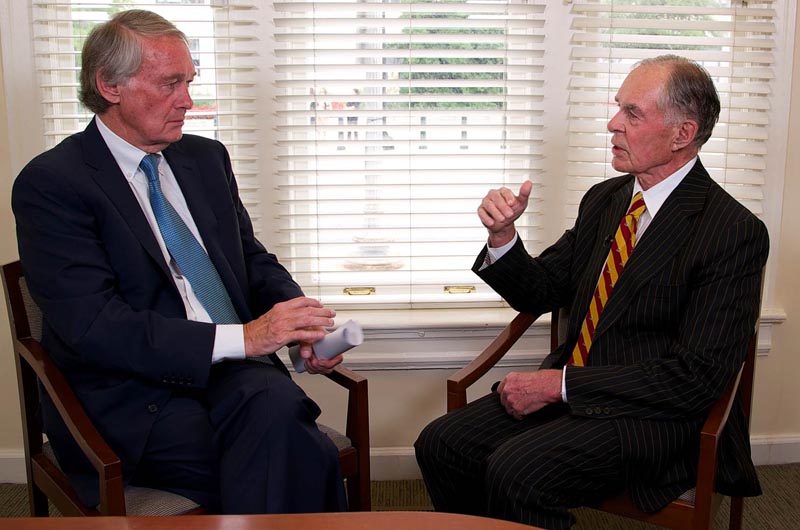
<p>For three decades, Alzheimer’s research has been stymied by a debate about how the disease behaves in the brain. New research coordinated by Dr. Rudolph E. Tanzi and presented on the Vineyard this summer settles the debate.</p>
For three decades, Alzheimer’s disease research has been stymied by a debate about how the dreaded illness behaves in the brains of its victims.
The most common form of dementia, Alzheimer’s is marked by a progressive and irreversible deterioration of the brain in middle or old age. There are three hallmarks of the disease: the accumulation of beta-amyloid plaques, neurofibrillary tangles and inflammation of the brain.
Scientists have wondered whether the amyloid, which is present in Alzheimer’s patients 15 years before symptoms develop, caused the production of the tangles and thus the progression of the disease.
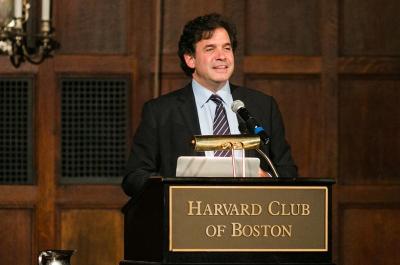
Neuroscientist Rudolph Tanzi led research.
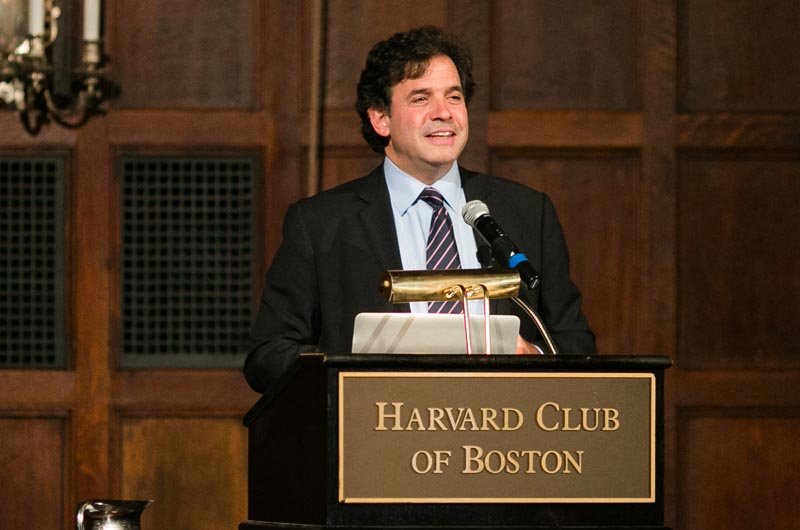
Neuroscientist Rudolph Tanzi led research.
“The big question has been, is the amyloid an innocent bystander or does it actually cause the tangles?” Rudolph E. Tanzi, a neuroscientist, told the Gazette in an interview this week.
Now research coordinated by Mr. Tanzi in the past year and presented on the Vineyard this summer, settles that debate. In a new procedure which revealed truths about the disease and provided a new way to test treatments, his team grew what they call “Alzheimer’s in a dish,” a three-dimensional recreation of the disease using human cells in a brain-like gel. The research was coordinated and funded in part by the Cure Alzheimer’s Fund, a nonprofit started by Edgartown residents Jeffrey and Jacqueline Morby.
As Mr. Tanzi and his team watched the disease develop, they confirmed the amyloid hypothesis — that amyloid does in fact stimulate tangles. Unlike previous models, which attempted the culture in a liquid, they used gel this time, which better simulates the brain.
“It lays to rest 30 years of debate,” Mr. Tanzi said. “Think of the amyloid like a match that is lit, and the tangle is the fire that spreads.”
The research was published in a recent article in the journal Nature, to wide acclaim. Mr. Tanzi presented the work in July at the Martha’s Vineyard Hebrew Center Summer Institute. His host was Mr. Morby, an engineer by training, who had little background in genetic research when he started the decade-old Cure Alzheimer’s Fund with his wife, a venture capitalist, and two other couples.
The fund, which celebrates its 10th anniversary this year, is also backing an ambitious Alzheimer’s genome sequencing project with a goal of identifying the key genes associated with the disease.
But lately, it’s the Alzheimer’s in a dish project that’s captured the attention of the scientific community.

Dick Pratt: "I met Jeff picking up ice cubes."
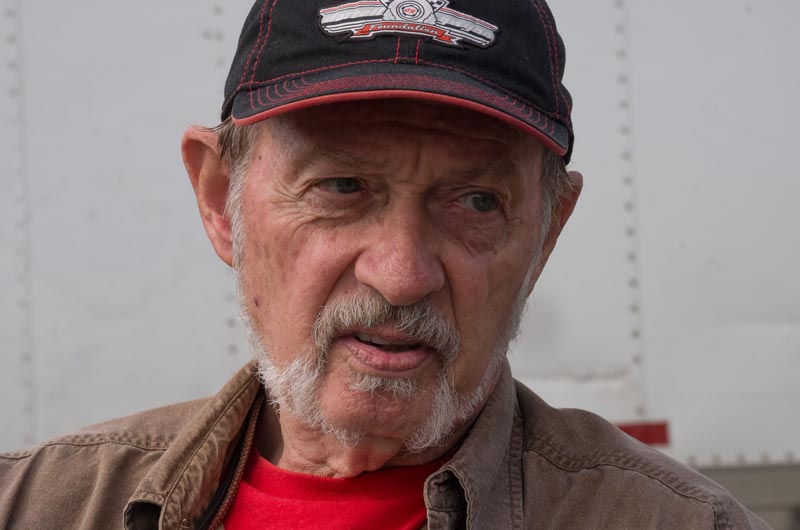
Dick Pratt: "I met Jeff picking up ice cubes."
The debate about amyloid and tangles had persisted for so long in part due to the inadequacy of the subjects usually used to observe the disease: mice.
“When you put the Alzheimer’s in mice, they get the amyloid but it doesn’t lead to tangles,” Mr. Tanzi said. “That is what led many to say the amyloid doesn’t lead to tangles.”
Now, with the cell culture, researchers throughout the field have access to a complete model of the disease. For testing experimental drugs, the model is also more efficient than mice, Mr. Tanzi said.
“In six to eight weeks, at a fraction of the cost of using mice, you can get actual human neurons to make amyloid and the neurons react to the amyloid to make tangles,” he said.
Mr. Morby, who is fully immersed in the project and now trades emails with Mr. Tanzi several times a day, first met him while researching a book on the brain. At the time, he was looking for a worthy cause to support. “When we started this we had been looking for something we could do for humankind that would make a big impact on people,” he said.
It was clear to him that Alzheimer’s disease research was not getting the public funding it needed to find a cure. “The National Institute of Health was funding a very small amount compared to the damage Alzheimer’s was doing to the health care system,” he said.
The organization looks to advocate for more public funding, while also fundraising on its own.
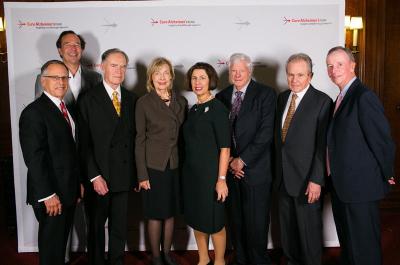
Board and founders of Cure Alzheimer's Fund.
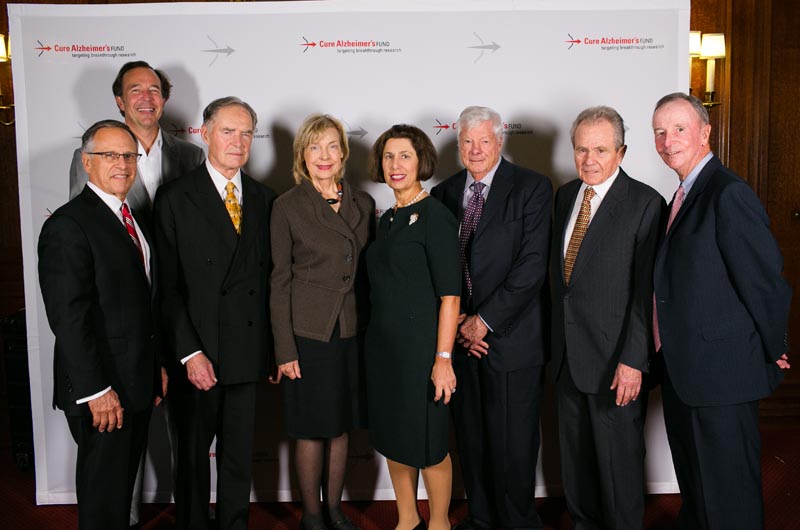
Board and founders of Cure Alzheimer's Fund.
And the Vineyard connections to the story don’t end there.
The Island chapter of Rotary International, a service organization, has become an advocate for the Cure Alzheimer’s Fund in recent years. It all started with a spilled drink at the Vineyard Golf Club. The spill occurred at Mr. Morby’s table, and longtime Rotarian Dick Pratt, who sat nearby, rushed to assist.
“I met Jeff picking up ice cubes,” Mr. Pratt recalled this week. Mr. Morby invited Mr. Pratt to join him and his wife at his table, and over the next two hours, he told him about his work to cure Alzheimer’s disease.
Mr. Pratt was intrigued, and soon brought Mr. Morby to speak to the Rotary Club during their weekly Wednesday meeting. From there, word spread around the Rotary network. Dr. Tanzi was asked to present at the district-wide meeting, and later at an international meeting in Bangkok, Thailand.
“The ripple effect from his presentation at our little dinky 50-some odd member Rotary Club on Martha’s Vineyard has been across all five continents,” Mr. Pratt said.
In September of 2012, former Rotary president Delos (Dee) Lander traveled to Rotary headquarters in Evanston, Ill., with representatives from the Cure Alzheimer’s Fund.
A year later, the cause became officially recognized as a Rotarian Action Group, one of 19 worldwide. Mr. Lander acts as treasurer and so far, the group has raised more than $10,000. Rotary International has a membership of 1.2 million worldwide, so there is potential to raise much more, Mr. Lander said.
“What we hope is as the Rotarian Action Group grows, we will be able to fund some research,” he said.
For more than 30 years, polio has been the primary focus of Rotary fundraising.
The disease has been eradicated from most parts of the world, thanks in large part to Rotary’s involvement.
As Rotary nears its goal of eradicating polio completely, the question is what is next, Mr. Lander said. Based on the response he’s gotten, he said Alzheimer’s disease is a strong candidate.
“I think we are in the top three, top five, for sure,” he said. He added that unlike polio, Alzheimer’s and dementia are prevalent in the United States, which raises a majority of Rotary funds.
“Those issues hit a little closer to home than polio in the United States,” he said.
Mr. Pratt said his commitment to the cause of Alzheimer’s disease is personal. “Everyone has Alzheimer’s,” he said. “It’s just a matter of degree. I was worried about myself.”
And as the name suggests, the fund was established to help find a cure for Alzheimer’s — and in light of recent developments, Mr. Morby feels a cure is closer than ever.
“If we hadn’t discovered the Alzheimer’s in a dish, it would have seemed a lot further than it is now,” he said. “It’s my belief we will have a cure within five years. We are that close.”
Comments
This study is phenomenal!
Maria Gilsenan Edgartown and Cross River NYThis study is phenomenal! Gazette, please keep us updated, this is one disease that affects us all. My theory has always been that viruses are a cause of many diseases and no one body is the same and therefore the reaction to disease and treatments
can be very different. That's why it takes so long to find a cure.
Families of Alzheimer's patients grieve so profoundly in watching their loved one who at one time was a vital part of society, living in a world of the past not knowing who their family or friends are. We must cherish every day as our last. This is one disease I know I will be happy to contribute and see it through to the cure.
What a wonderful humanitarian
Harry Seymour Oak BluffsWhat a wonderful humanitarian effort this is. Jeffery and Jacqueline Morby and others involved in this project are to be commended. I can think of few more worthy endeavors given the devastation the Alzheimer disease wreaks on so many lives--those who have it and their loved ones.
Exciting work. Article does
Pat Gage Bryn Mawr, PA & EdgartownExciting work. Article does not say where Dr. Tanzi does his research.
Dr. Rudolph Tanzi is a Professor of Neurology and holder of the Joseph P. and Rose F. Kennedy Endowed Chair in Neurology and Mental Retardation at Harvard University.
I am 64 years old and
Mary Annunziato New JerseyI am 64 years old and diagnosed with alzheimers I am still active and hoping for a cure I would like to see my granddaughter grow up as well as my sons new baby I pray everyday for a cure
I am 62 years old and have
Imogene Fratt Gold Canyon, AZI am 62 years old and have been diagnosed with early stage Alzheimer's and I do not want to be statistic. I love my family and I don't want them to suffer watching me slowly disappear. I want my sons and grandchildren to live a life without the fear of this disease attacking them. I want my life back.
This is great news. I am in
Billie H. Jones Wharton, TxThis is great news. I am in the Houston area and a long time Rotary Club member. Was Dick Pratt ever a member of the Houston Downtown Rotary Club?
Thanks. Will this program be presented to local clubs in the future in District 5890?
Add new comment