

Footage from home movies shows Hurricane Carol as she howled her way across Martha's Vineyard 60 years ago this week. Longtime Islanders recall that summer morning in 1954 when forecasters said Carol would weaken and turn out to sea, but the hurricane had other plans.
You can’t hear it because the movie is silent, but you can pretty much guess the pitches at which the wind must be moaning, hissing and crying.
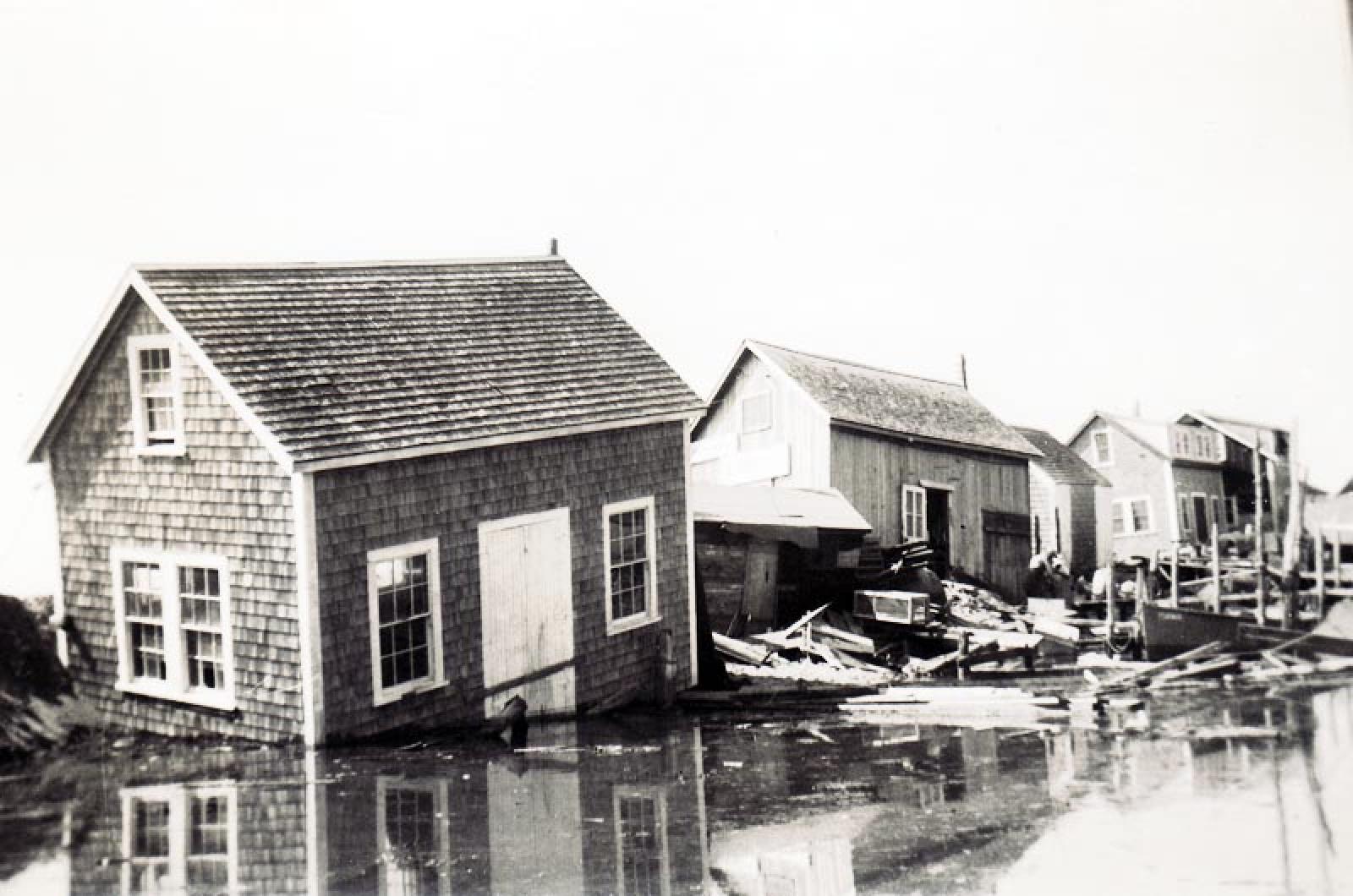
Menemsha harbor in the aftermath.
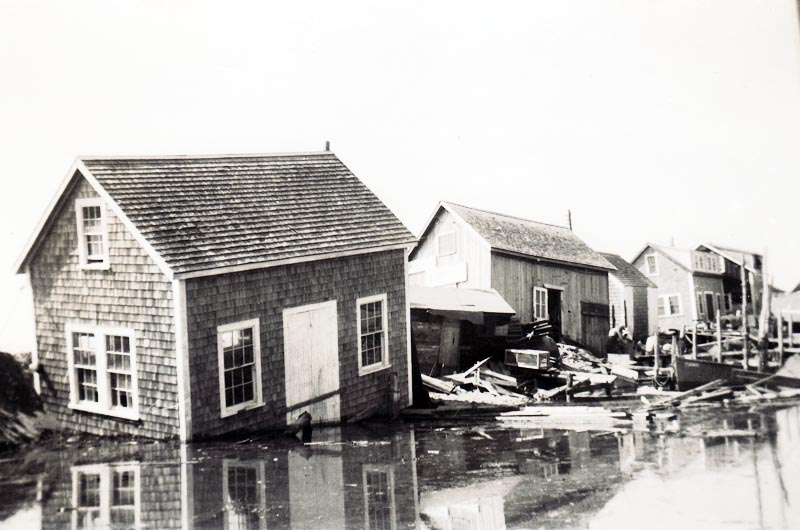
Menemsha harbor in the aftermath.
The gale drives rental sailboats over a stone bulkhead and onto the flooded lawn of the Harborside Inn at Edgartown. As the froth and spume tear past their heads and shoulders, three men, wading and swimming, try to guide an overturned sloop into the courtyard invaded by an angry sea. Four others lean forward almost horizontally, hoping to shove another sailboat bow-first into the breeze, which is probably just then gusting to 70 or 80 miles an hour.
The surf looks like missile fire as it busts into seawalls, bashes against the Edgartown Yacht Club building and crashes into the sterns of sloops that snap and struggle at their lines, lashed to underwater piers. The color is the smeary gray-blue of a blizzard, but this storm is tropical: We’re looking at footage of Hurricane Carol as she howled her way across the Vineyard 60 years ago this week.
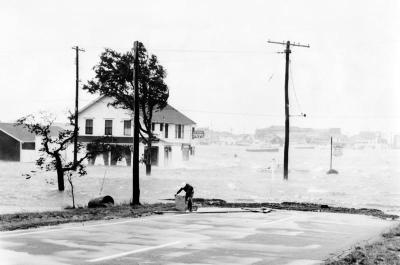
New York avenue and what is now Our Market were hit hard by the winds and surf.
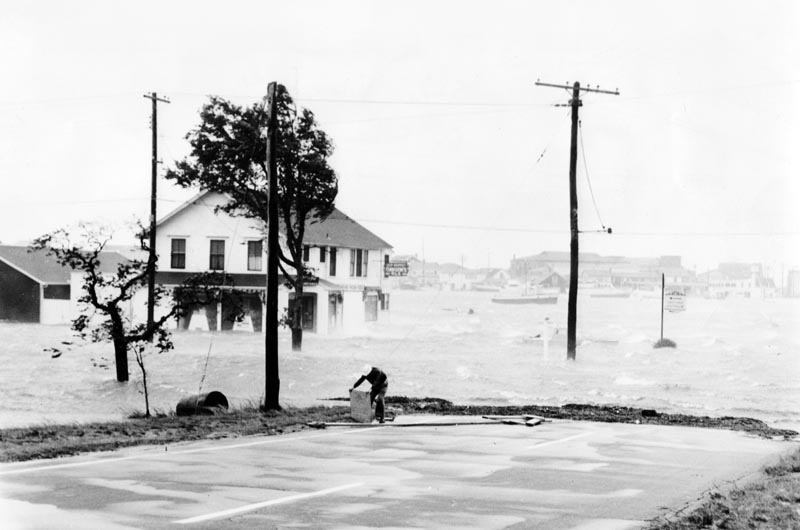
New York avenue and what is now Our Market were hit hard by the winds and surf.
Through its Historic Movies of Martha’s Vineyard project, the Gazette has prepared a clip from three home movies shot during and after the landfall of Hurricane Carol on August 31, 1954. From the films, it’s clear that Edgartown, Chappaquiddick and Menemsha were all unprepared for what was homing in on them late that morning. The fault lay in the forecasting, which was still a fairly new science in this country. Radio reports at breakfast said that Carol, whirling up the Eastern Seaboard, was weakening and turning out to sea.
The three eight-millimeter movies shot that day by the families of Phil Jackson, Warren Vose and Dianne Durawa, as well as Edith Potter, make plain that the storm neither weakened nor turned away. Instead, Carol crossed eastern Long Island, moving northward with speed and purpose. To the east, winds topping 90 m.p.h. thundered across the Vineyard just as the summer season was cresting, with boats riding at every mooring in every Island harbor.
The signs of unreadiness are everywhere. In the Jackson footage of the Harborside Inn, patio furniture made of wood and aluminum lies jumbled along a wrack line against the buildings. A flotilla of small sailboats — their hulls chafed, wire stays swinging in the wind, sails torn from furled booms and masts — lie at every angle on the front plaza, most pointed south, the direction from which Carol came.
Taking a bite out of bridge by Quitsa.
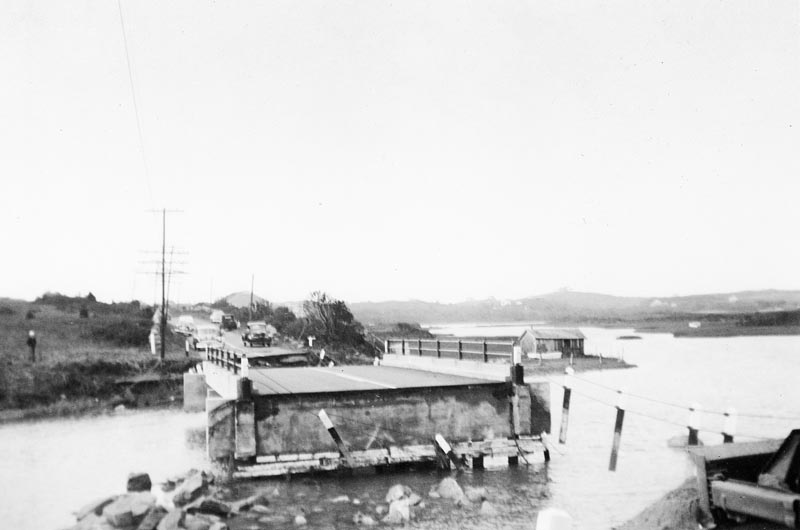
Taking a bite out of bridge by Quitsa.
“As we arrived up on the hill and felt the strength of the wind, we could see that it was more significant than we had anticipated,” recalled Mr. Vose in an interview with the Gazette. His family owns the two-story boathouse overlooking Edgartown harbor. He and his older sister Dianne were sent back to the family home on Dunham Road while his mother, father and another older sister Dennise stayed behind. “They rode out the storm, my father on our cabin cruiser tied up to the boathouse, and my mother and sister upstairs at the boathouse, where they reported later that it was moving quite dramatically, as you could expect in that wind.”
From the powerboat, the senior Mr. Vose filmed seas breaking across the harbor, spray ripping in foggy blasts off the top of the whitecaps. Dennise, wearing a Mae West life jacket, labors along the walkway toward the safety of the Tower Hill embankment, the tide rushing past her almost hip high. In one shot, the neighboring I. Richmond Hoxie boathouse bears up even as the harbor courses through its doors and windows. In the distance a cream-colored surf assails the iconic but befogged waterfront shapes of the Reading Room, yacht club and Memorial Wharf. It looks like the sea has risen halfway to the rooflines.
The Potter film takes us west to Menemsha just after the hurricane, where the storm lifted and dislocated most of the fishing shacks along the shoreline, canting them this way and that, as if by earthquake. It also sent boats driving hard into piers and other boats.
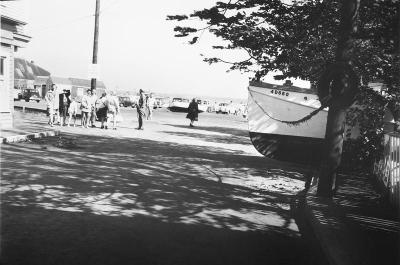
Boats were cast up on land during hurricane.
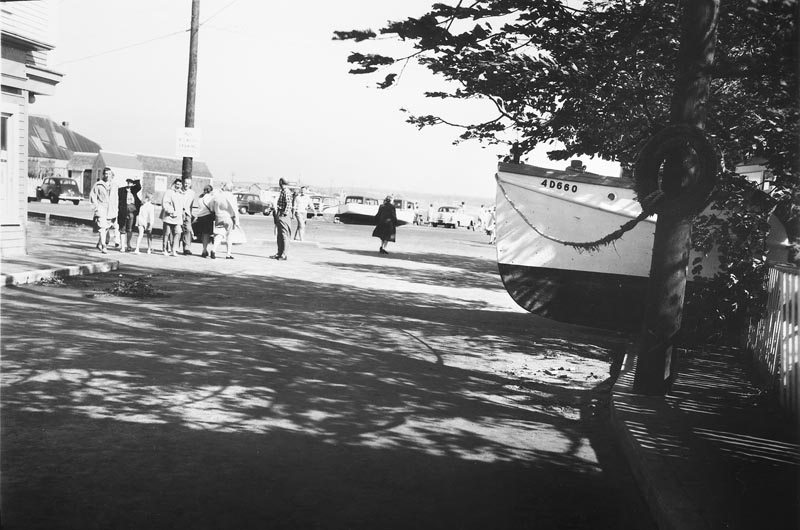
Boats were cast up on land during hurricane.
As in Edgartown, inhabitants of Menemsha listened to the erroneous early morning radio forecasts and had almost no time to prepare. “The chief from the Coast Guard station came down and told us [the storm was coming]. We put out extra lines. That’s all you can do,” recalled Herb Slater, who was swordfishing out of Menemsha that summer with his father in a former rum runner called Aloysius. Because the owner of a skiff fouled her lines, Aloysius broke loose and damaged another converted swordfishing boat, the Seer, but both boats survived.
In the Potter film, you can just see the top of the fish market Everett Poole owned below Creek Hill. It lies tipped over and two-thirds sunk in the basin. “There was just one wall and the roof left,” said Mr. Poole in an interview. “Earl Vanderhoop was running the fish market for me at that time because I was in the Coast Guard. He had taken all the fish out and put it in ice up on the bank. We never lost a thing except the cash box, which he’d forgot. So while I was home, we tore the rest of the market apart and hauled it up to get it out of the harbor. And up in the eaves was the cash box. We were one cent short. And I’ve got the cash box around here somewhere. It was wooden, so it floated up in the eaves.”
The three films also show a startling tableau after Carol. The Jackson footage shows water lapping up Mayhew Lane in Edgartown, half a pier lying across the road about where Among the Flowers stands today. The Vose movie shows the Daniel R. Anthony cabin cruiser Possum rocking uneasily bow-down and rudders and propellers pointing skyward off the end of one Edgartown pier, and the power boat Nancy Lee belonging to R.L Coulter balanced neatly atop six pilings a couple of wharves away.
Menemsha boats took a beating.
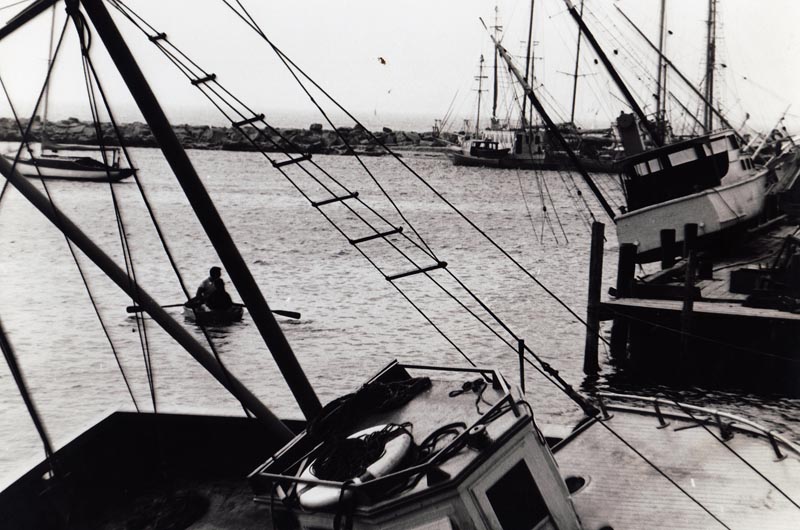
Menemsha boats took a beating.
In the Potter films it is evident that the seas swirled and dug out sinkholes beneath automobiles left on Chappaquiddick Point; a car belonging to Joseph Serpa wallows in a moon-like crater, and others belonging to Manuel Terra and Cesar Lopes list to starboard, sunk up to their running boards. Catboats and the old ferry City of Chappaquiddick lie beached on the harbor shoreline of Chappy. Telephone poles lean over the main road, which has been torn up into chunks and washed over with sand.
One death was attributed to the storm: George Hinckley, a lineman, was electrocuted repairing a pole on State Road in Vineyard Haven. And elsewhere on the Vineyard, in towns, harbors and along shorelines where the only records are written or photographic, the damage done matches the scope of what the Jackson, Vose and Potter films reveal in the movies of Edgartown, Chappaquiddick and Menemsha.
But that was not all. Only 11 days would pass before the Vineyard was struck again, this time by a hurricane named Edna, whose top winds of 120 miles an hour are the strongest recorded here in modern times, and whose eye passed directly over the Island, wide enough to be seen from Menemsha Pond to Wasque Point. There is film of this remarkable phenomenon as well. Look for that story in an upcoming edition of the Gazette.
The Historic Movies of Martha’s Vineyard project saves, archives and introduces old Island films to the public. John Wilson, a television director and filmmaker in Edgartown, edited the Hurricane Carol clip from digital files created by Art Donahue of Motion Picture Transfer in Franklin. For more information about this Gazette initiative, contact [email protected]. (To avoid damage, please do not run an old film through a projector.) To see the collection of nine Vineyard films presented to date, go to mvgazette.com/historicmoviesofmarthasvineyard.
Comments
My brother Edward and I lived
Alison Kern StitzerMy brother Edward and I lived summers on board our parent's (Dr and Mrs. E. Clarence Kern) 35' sloop "Alised", then moored off the Three Reefs stilted cottage on Chappy. We first heard of Carol on the 6:20 AM Boston marine channel weather --and then the look of the sky --the storm was said to be in Rhode Island and weakening but my Dad added to the mooring pennant and set an anchor at a good angle, lots of chafing gear and everything possible below. We watched the 110's swamping. Tony and his catboat "Priscella" took us ashore on his last trip. We were all roped together (the wind blew Dickie Sherbrook off the pier, which was a foot under water-the adults pulled him back) and stayed very close climbing the stairs and crossing the bare hill to the Armstrong's house, then thru the pines to Barbara and DeWitt Livingston's cottage-- from the second story window we could see water covering the road between Caleb Pond and the outer harbor. During the eye, we walked to the bluff --the tide was WAY out -- big yawls flopped on the sand looked like beached fish. "Alised" swung proudly on her mooring-- and stayed put during the rest of Carol. For days after, we were the only with a telephone (the marine one) and a refrigerator (50 lb blocks of ice) so were very popular. My Mom Florence Kern wrote a long article for the Gazette - later published in "Yachting" - very good reading. I am looking forward to the movies!
Alison, what a coincidence; I
David C. Kimball Boca Raton, FLAlison, what a coincidence; I remember your family and my dad, Dr. E. Robbins Kimball, was an admirer of your dad. He said he much preferred looking at the land from sea, than the sea from land. We finally chartered an Alden schooner in 1959, but we lost track of your family. I was 5 during Carol, but don't remember if we were still there or traveled back to Chicago. My dad, too, only got to spend a couple of weeks away from his pediatric practice in the summers, so we sold our home, Lagoon Edge in 1962. I have vague, but fond memories; it's wonderful to hear your story; I'm working on one myself, but it's of early Virginia, with ties into Rhode Island... but might just get a Pease of a Mayhew involved... My dad always wanted a twin keel, as in 'Blue Bird of Thorne' cutter. That's on my bucket list... the sea waves to me.
Just saw your comment
Alison VirginiaJust saw your comment
..Remember for sure the name of your Dad...mine admited yours! Recall you all summered on the Lagoon - right? Our parents were pals !
.
What a fascinating story and
Katama Kid Cape CodWhat a fascinating story and video. Can't imagine the long hours of research that went into this great article. And you are right - you can't hear the storm but you can feel it - both through the video and your words. Great job. Look forward to the follow-up on Edna.
My Grandfather, S.S.A.
David Hamblen Los Angeles, CAMy Grandfather, S.S.A. Captain Walter Kszystyniak sailed the ship in the hurricane!
On Time!!!
Add new comment