


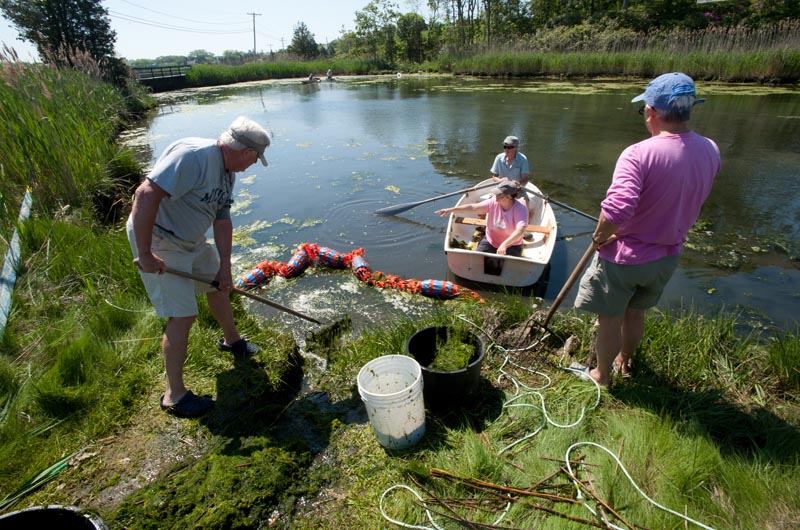
<p>A dozen volunteers gathered at the Lagoon Pond last Saturday morning to do something no one could recall being done on the Vineyard. They came to harvest floating mats of algae in Mud Creek in Vineyard Haven. It was both an experiment and a beginning for an expanding effort to manage and improve the water quality in coastal ponds.</p>
A dozen volunteers gathered at the Lagoon Pond last Saturday morning to do something no one could recall being done on the Vineyard. They came to harvest floating mats of algae in Mud Creek in Vineyard Haven. It was both an experiment and a beginning for an expanding effort to manage and improve the water quality in coastal ponds.
In three hours of harvesting and lifting, the group filled the back of a pickup truck with wet, emerald green algae.
Megan Ottens-Sargent, chairman of the Martha’s Vineyard Water Alliance who headed the effort, said the algae harvest is part of an effort to improve water quality in the creek. “We are basically harvesting the algae bloom, before it dies off and sinks to the bottom,” she said. Nitrogen makes its way into the pond through groundwater. The algae feeds on the nitrogen and grows, soon becoming a mat. When it dies and sinks to the bottom, the algae decays and smothers sea life on the bottom, including shellfish.
As for the algae taken from the pond, Ms. Ottens-Sargent said: “We’ve got some interested farmers who see it as a great addition to compost.”
The Saturday morning project had the support of members of the Lagoon Pond Association, Martha’s Vineyard Shellfish Group, the Great Pond Foundation and the Martha’s Vineyard Commission. Tisbury shellfish constable Danielle Ewart also joined the group. Maciel Marine, a neighbor, assisted by providing the small boats. Among those offering expertise was Emma Green-Beach, who works for the Marine Biological Laboratory in Woods Hole and also at the Martha’s Vineyard Shellfish Group.
Ms. Ottens-Sargent said she was pleased by the experiment. “This is a beginning which I think will become Islandwide,” she said.
Comments
what happen to the
roger w. oak bluffswhat happen to the aquaculture farm for the lagoon? ob told those kids to go away. want to remove nitrogen? that would reduce 100x more nitrogen in a day then what these people collected. same ol' politics. 30 years I've never seen it fowl so bad. worthy cause. good luck.
An Aeration Program would
Donald Muckerheide Oak BluffsAn Aeration Program would solve the whole problem in short time. The vast majority of nitrate pollution is from runoff. It rains 80 billion gallons per year on MV. Wind mill aeration units are only about $2,500.00 per unit, large air compressors could aerate inlets on the incoming tide, anyone with water front property on any inland pond should not be allowed to use fertilizer unless they have an electric aeration pump, about $600.00 for a good sized unit,or a wind powered aeration system. They have fish farms in the mid-west that are larger than Sengy and they have no tidal exchange. It is easy to clean all the ponds on the island with nothing more than air at a cost of a few million dollars which will work when a billion dollars of waste water treatment plants, which is what is planned, will accomplish nothing. A dissolved oxygen meter is $1,500.00. When water gets close to 10 ppm dissolved oxygen it is pristine. It is not really even a difficult problem to solve but no one really wants to solve the problem. There is much more money to be made trying, and failing, to manage the problem. I bet we could clean all the ponds on the island, with provable and measurable results, within 5 years for less than 5 million dollars.
Add new comment