

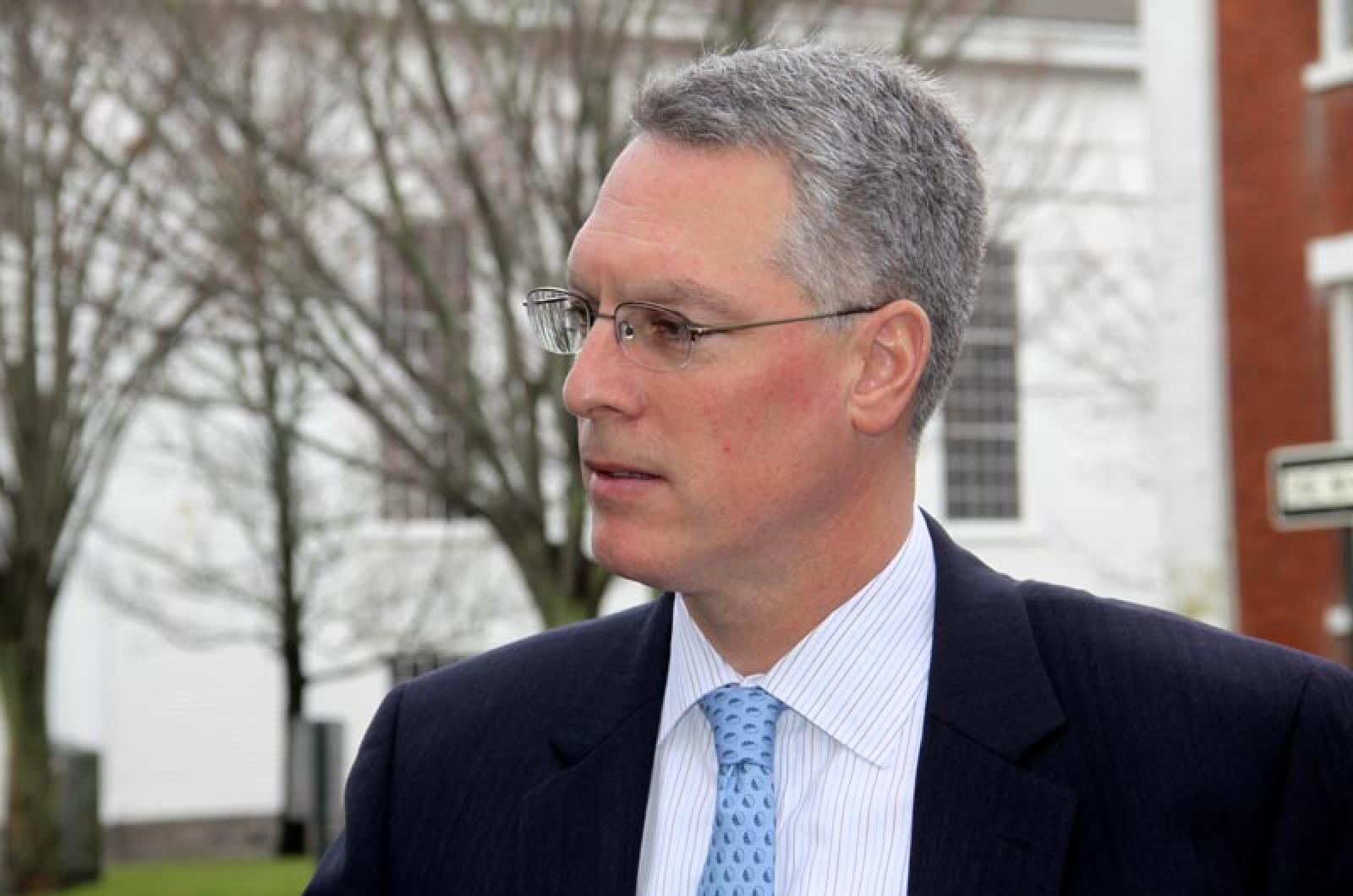
<p>Almost six months into his job as president of Martha’s Vineyard Savings Bank, Paul Falvey said the bank is on solid financial footing and has restructured its staff to adapt to a tighter regulatory environment.</p> <p>In the last two months, chief operating officer Richard Leonard has retired and the job of senior loan officer, held by Brad Egan, was eliminated and their duties divided among several employees, he said.</p> <p>At the same time, Tom Sharkey has taken on additional responsibilities as chief financial officer, Mr. Falvey said.</p>
Almost six months into his job as president of Martha’s Vineyard Savings Bank, Paul Falvey said the bank is on solid financial footing and has restructured its staff to adapt to a tighter regulatory environment.
In the last two months, chief operating officer Richard Leonard has retired and the job of senior loan officer, held by Brad Egan, was eliminated and their duties divided among several employees, he said.
At the same time, Tom Sharkey has taken on additional responsibilities as chief financial officer, Mr. Falvey said.
“Functions have been split up and reshuffled across the organization,” he said, noting that the reorganization had been begun by the bank’s board before he arrived. The changes were spurred by a “comprehensive look of what’s the right structure today for this bank and this environment.”
In a wide-ranging interview this week with the Vineyard Gazette, Mr. Falvey talked in detail about the financial condition of the Island’s largest bank, heightened regulatory scrutiny facing all banks and how Martha’s Vineyard Savings Bank is responding.
Saying he was legally prohibited from doing so, he declined to talk about his predecessor, Christopher Wells or the circumstances under which Mr. Wells was permanently barred from banking by the Federal Deposit Insurance Corporation.
Mr. Wells left the bank abruptly last May with no explanation from bank trustees. The FDIC order against Mr. Wells was made public last week.
But Mr. Falvey stressed repeatedly that the bank’s financial condition is strong, with total assets of $505 million and an additional $182 million in assets in the trust division as of March 31. At the end of 2011, assets were $525 million plus $170 million in trust assets. With banks contracting all across the country, the decrease in assets is not unusual or a cause for concern, Falvey said.
Losses from loans that had to be written off also have been modest, he said. In 2011 the bank lost $88,000, with $68,000 in residential loans and $20,000 in commercial loan writeoffs. In 2012, the bank saw $248,000 in loan related charge-offs, including just $3,000 in residential loans and a $200,000 charge-off on a loan to an affordable housing development in Oak Bluffs. The bank was assisting in trying to produce affordable housing and “the project didn’t go well,” Mr. Falvey said.
In the first quarter of this year charge-offs are less than $20,000 he said. “For a bank this size these numbers are approaching zero in terms of losses,” he said. “We see modest losses going forward approaching, as a relative term, that zero level.”
In 2012, Martha’s Vineyard Savings Bank was 24 out of 152 Massachusetts banks in terms of capital, he said, and Massachusetts banks are among the strongest in the country.
At 12.94 per cent, the bank’s capital ratio, that is, the bank’s capital relative to its total assets, is higher than the national average of 11.4 per cent for banks between $300 million and $1 billion in assets, he added.
Return on assets, the earnings compared to the size of the bank, puts the bank at 40 out of 152 in the state.
Mr. Falvey said the need to restructure had its roots in the origin of the bank, which was created by the 2007 merger of the Duke’s County Savings Bank with Martha’s Vineyard Cooperative Bank: “Two relatively small community banks that came together right before the financial crisis in 2008.”
While the bank grew and commercial lending expanded, he said: “You have bank structure, talent, expertise, experience that’s consistent with two relatively small community banks doing fairly traditional things.”
At the same time, “You have scrutiny, the quantity of regulation, the intensity of it, going like this,” he said, gesturing upward. “It’s just the dynamic of the industry.”
The senior lender position, held by Mr. Egan, for example, “was structured in my opinion consistent with a much smaller, less complicated bank,” he said. Mr. Egan left in late February, and his job split into two: one focused on credit and administration and the other focused on lending, Mr. Falvey said.
“It is the typical and preferred structure for a bank of this size and complexity,” he said. A new role was created for an audit/risk manager within the bank who will manage internal audit functions, a position the bank did not have previously.
Mr. Leonard, who was president of Martha’s Vineyard Cooperative Bank before the 2007 mergerand had been in community banking on the Vineyard for 28 years, retired at the end of March. Mr. Falvey called his departure “just an unfortunate coincidence in timing, absolutely unrelated [to other events going on at the bank].”
He underscored the bank’s role as a community banking institution. “This is about long-term commitment to the community,” he said, citing charitable giving and a willingness to write local loans that might not meet national standards.
While he said he was barred by FDIC regulators from saying whether or not the bank experienced losses, Mr. Falvey said the period of transition, including hiring outside consultants, came with expenses.
“The bank has spent a lot of time, effort and some expense . . . doing this comprehensive review,” he said. “I’m certain the bank comes out of this in much better shape, but investment has been made.”
Comments
If it was a restructure, why
concerned tisburyIf it was a restructure, why not give Mr.Egan a different position inside the Bank? And how much has the bank spent on attorneys?
I don't understand. The bank
Puzzled MVI don't understand. The bank is strong and rated 24th in the Massachusetts; it's earnings are strong and losses are very low, but Mr. Falvey and the bank board think it makes sense to eliminate 2 senior management positions (and rumor says some additional support staff) and tax other employees with their workload. Lets see how long before the bank moves from 24 to 124. None of this makes sense including the FDIC' s actions.
What people are forgetting is
Simple.What people are forgetting is that only one position was cut, Mr. Leonard retired, he was not "let go". People here just like to look for more than what the situation really is, just read the article without making it into some big escalated issue. People need to stop making up soap operas in their minds.
The situation is that the
KS MVThe situation is that the FDIC banned the former head of the bank from ever working in the industry again. They probably did that because the bank's practices were sound and nothing was wrong. Where there's a raging fire there's hardly any smoke...
Something happened, it seems
Patches Oak BluffsSomething happened, it seems to be serious but no one can talk about it. They are somehow all sworn to secrecy. How can the FDIC bar anyone from making a statement. If I was falsely accused of wrongdoing you can bet your tail that the FDIC would not bar me from making a statement. What kind of baloney is this?
This is not just some internal personnel problem. People have savings in the bank and want to be sure their money is safe.
I never knew an insurer that
safe savings ChilmarkI never knew an insurer that liked to pay out claims, but they have no problem collecting their fees. Savings deposited in MV Savings are federally insured, therefore, safe. If the bank goes under, the FDIC will cover the depositors. Why would people put money in a bank if this were not true? They may as well hide their cash in their mattresses, especially these days of so little interest on savings. All depositors are insured, but the FDIC, the insurer, has no such insurance. Thus, the action was taken. That's their insurance. People can guess all they want, the FDIC took their action for their own protection. They do not want to pay out if there;s a loss, and that's just simple business sense. There was obviously danger of loss to the bank that the FDIC will/would have to cover.
This is a very sad and
debmv West TisburyThis is a very sad and frustrating situation. I have been a long time customer of the MV Coop Bank, and always appreciated the high level of service and professionalism, while still maintaining a warm and community feel. Richard Leonard was a banker who inspired confidence and a passion for serving the community. It is unfortunate that what is coined as "talent and experience" often results in the sleazy and unscrupulous practices that are too often seen in the Wall Street banking world. After the financial crisis of 2008, I think the public is more savvy and less trusting of large financial institutions. It may be naive, but we always hope things are different on our Island. Richard Leonard embodies the moral character that we say we want in our banking professionals. My sense is that he retired because he could no longer be part of the world that MV Savings had become.
0 •Edit•Reply•Share ›
Im sure that Mr. Leonard is a
Loving MV TisburyIm sure that Mr. Leonard is a wonderful man to his friends and has served the MV community well over the years. So, fully knowing the backlash this comment will get from the blind supporters of Mr. Leonard, I'm going to state it anyway. Why wasn't he made President instead of hiring Mr. Falvey who has little experience as a bank President himself. Afterall, Mr. Leonard was President of MV Cooperative for many years and he's not quite at retirement age. Perhaps its that Mr. Leonard was told to retire with the very beneficial retirement package he orchestrated for himself while still at the Cooperative Bank or be terminated himself. Perhaps it's that last year he put his own self interests ahead of the banks, it's employees, and the MV community. Perhaps he should have fought harder against the merger rather than fighting so hard afterward to become President of MV savings bank. Unfortunately for him, the end result was not exactly what he hoped to gain by his actions, but he certainly came out ahead of the others effected by this fiasco.
Add new comment