

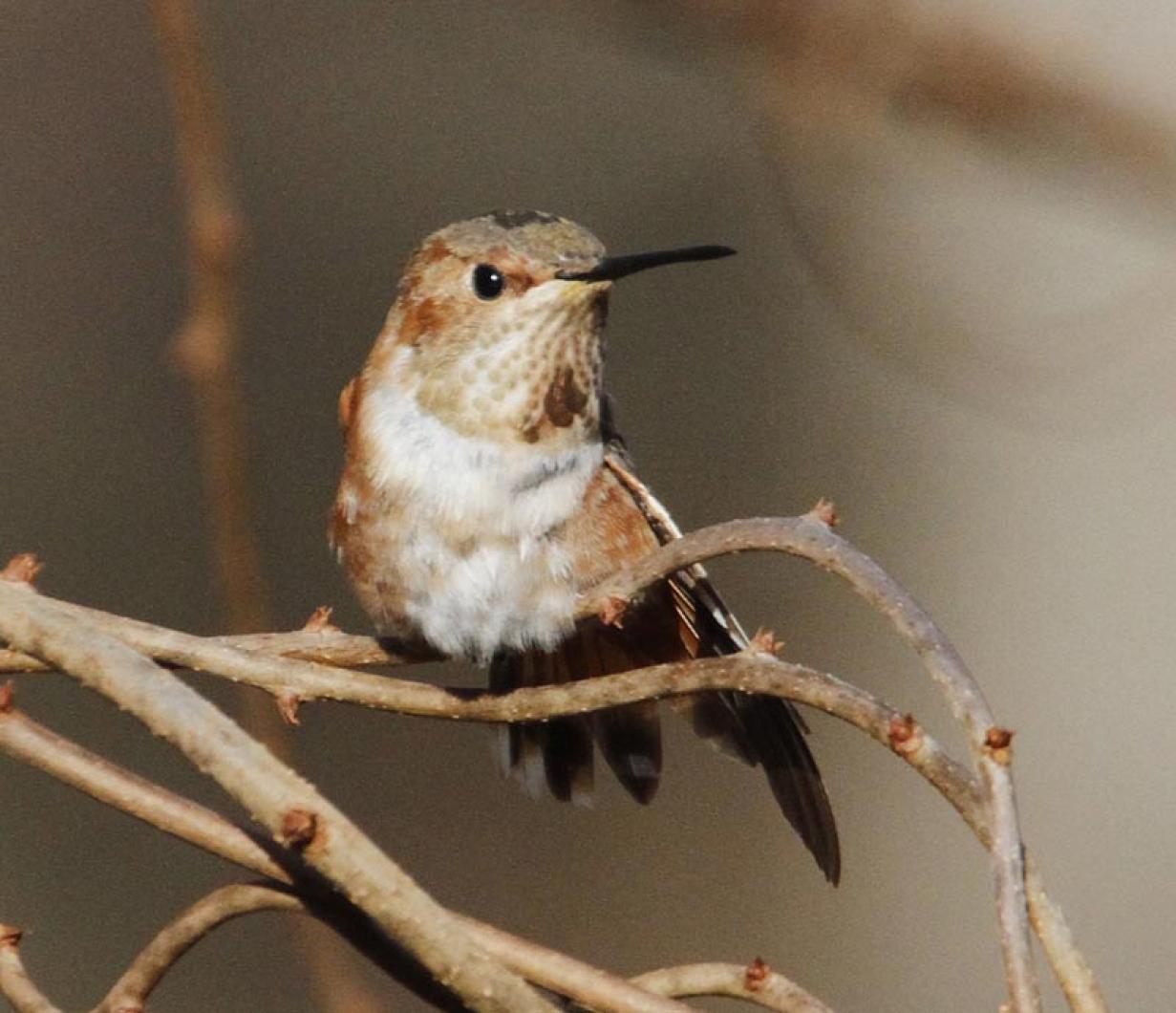
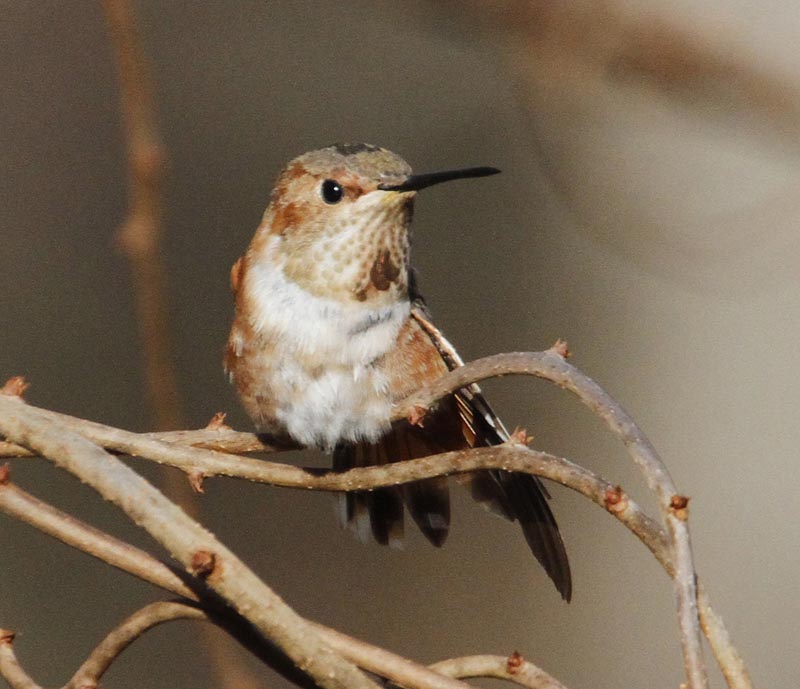
<p>This has been an especially exciting fall for birders, both regionally and on the Vineyard. Since the last Bird News, the bird of the week, year and possibly the decade showed up at the always-birdy home of Penny Uhlendorf and Scott Stephens, off of Lambert’s Cove Road. Recognizing their visitor as a hummingbird, and not the usual one, Penny and Scott put the word out. Lanny McDowell responded first, camera in hand, and took a series of pictures that conclusively documented the Island’s first-ever Allen’s hummingbird.</p>
This has been an especially exciting fall for birders, both regionally and on the Vineyard. Since the last Bird News, the bird of the week, year and possibly the decade showed up at the always-birdy home of Penny Uhlendorf and Scott Stephens, off of Lambert’s Cove Road. Recognizing their visitor as a hummingbird, and not the usual one, Penny and Scott put the word out. Lanny McDowell responded first, camera in hand, and took a series of pictures that conclusively documented the Island’s first-ever Allen’s hummingbird.
The western U.S. features a good diversity of hummingbirds, with about 15 species occurring regularly in the region (as opposed to the East’s lonely ruby-throated hummer). Just a couple of decades ago, all of these birds were quite rare as vagrants in the East. But some combination of factors — more observers, more feeders left out later into the season and a warming climate — launched a steadily-growing wave of hummer records, most from the late autumn, that would have once defied belief.
Of the western hummers, the most difficult ID question may center on the rufous and Allen’s, two closely-related species of the west coast. Rufous, the more northerly breeder, is also the more strongly migratory and hence more prone to vagrancy. The Bay State has dozens of records for this species over the last 20 years or so. Not so with Allen’s, a breeding bird of the California coast that winters in Mexico. This relatively short-distance migrant rarely turns up as a vagrant. As far as I can determine, the Vineyard bird is just the fourth ever confirmed in the Bay State (the third was found earlier this fall in western Massachusetts).
In some plumages, distinguishing rufous and Allen’s comes down to the shape of the outer tail feathers. Not surprisingly, many records of vagrants refer to “rufous/Allen’s,” with the specific ID undetermined. The majority of these, though perhaps not all, were probably rufous. Lanny’s photography caught a diagnostic view of the feathers in question, and several of the state’s best birders promptly and unanimously dubbed the bird an Allen’s. The rare visitor was still present as of Wednesday, enjoying room-temperature sugar syrup, nectar from pineapple sage blossoms and the odd flying insect.
On somewhat more normal turf, we are well into gull season now, and so it was not too surprising when Jeffrey Bernier shot some gorgeous photos of a black-headed gull in Edgartown harbor late last week. This elegant gull, a bit larger than the more common Bonaparte’s gull, falls into the “rare but regular” class in our region. Allan Keith was able to relocate the bird on Saturday. Allan tallied a first-winter glaucous gull at the sea wall near Farm Pond in Oak Bluffs, which unfortunately was nowhere to be found when I scoured the waterfront the next day. Allan also contributed a report of an immature Eurasian wigeon in the large waterfowl flock that has been hanging out at the head of the lagoon.
The brant flock that winters annually on Ocean Park in Oak Bluffs is especially large this year. Perhaps last year’s mild winter resulted in healthier adults migrating north last spring and breeding more prolifically. Bert Fischer counted more than 100. But this species is still outnumbered by our feral Canada geese. A very patient Sally Williams counted more than 200, which would account for the deplorably poopy condition of the park’s grass! Happy Spongberg watched a subset of these brant bathing in Crystal Lake on Tuesday, including one euphoric bird turning barrel-rolls in the water.
As winter sets in, the likelihood of alcids in our waters increases. On Monday Lanny photographed a razorbill off Eel Pond, Edgartown, and Michael Ditchfield added another report of this species from the ferry. Less expected were two dovekies, also observed from the ferry, reported on Nov. 30 by Warren Woessner. This tiny seabird winters mostly on the open ocean and is quite rare here, reported less than annually by Vineyard birders.
Usual for the season but always fun, a substantial flock of horned larks is hanging around Katama (or perhaps more than one flock). John Nelson counted 56 at Katama Farm and Jeffrey Bernier found this species on South Beach. Jeffrey also obtained some stunning photos of a snow bunting at Katama Farm, and a flock of this species was observed last weekend over Ocean Park. Snow buntings are wary and elusive, but can often be found by the alert observer on beaches, bare ground, short-grass fields or as a “fly-over.” Hint: learn the species’ distinctive call notes. Clearly, Vineyard birding stays hot even as the weather gets cold!
Please report your bird sightings to the Martha’s Vineyard Bird Hotline at 508-645-2913 or email [email protected].
Comments
An avid bird watcher in my
Mrs Mary Morris Mattishall , Norfolk , EnglandAn avid bird watcher in my own garden , I was delighted to read about the Allen's Hummingbird. Actually I cheated as I was sent a photo of it on the day!! Penny Uhlendorf is my sister, and we always share photos of unusual birds that appear.
England has also had alot of gales and so much rain that our birds are being blown off course. Many of our birds lost their first broods due to cold and wet conditions. So we had babies of many species appearing on the bird stations in November. I am having trouble keeping up with the feeding they need , to grow and survive what we are beong told will be the worst winter in 20 years coming our way.
I have wonderful memories of a summer in Martha's Vineyard , watching ospreys catching fish to feed their young. Our ospreys are coming back and their nests heavily protected.
Thanks to Penny and Scott I have a wonderful telescope , and as we have a water meadow infront of us , I can bird and animal watch to my hearts content. Everything from watching roe deer give birth , herons , foxes , partridge , pheasant , rabbits - you name it and I will look for it !!
A Happy Christmas to all on Marth's Vineyard - a place I dearly love.
I love that the Island has
Jan Nickerson Cape Cod BayI love that the Island has great birding.... and especially the Chickedee that says I LOVE YOU. That really is the best.
Fascinating! We are thrilled
Suzanne ([email protected]) Gladwyne, Pa.Fascinating! We are thrilled to have a juvenile male Rufus for the first time, identified clearly by his feathers and naturalists. I have lovely pictures if anyone is interested and directions for a light to warm the feeder should the temperature drop. Be sure to keep the feeder from freezing as birds can go into torpor and fall off the feeder.
We bring our feeder to MV in late September and always see a Ruby throated.
Seasons Greetings and Best
Suzanne ([email protected]) Gladwyne, PennsylvaniaSeasons Greetings and Best Wishes for the New Year to all those lucky humans and birds wintering in Martha's Vineyard!
Congratulations and best wishes to Penny and her Allen. Her dedication,observations and pictures are great.
Our juvenile male Rufus hummingbird arrived with a cold front from Canada on 10-19-12. What joy! As far as I know, I had never seen one here in Gladwyne, Pa. I have many pictures I wish I could share. Our Ruby Throated hummingbirds migrated in September and I miss them. Sometimes a new group arrives and stays through October and one time a few groups came through in December. Since then I have always kept a feeder up until January hoping.
He is a feisty little guy. He weighs less then a penny. At first he chased all our birds. Now he saves his energy for the chickadees and roosts in the shrubs with the other birds. They accept him and ignore his annoying chases. He makes a loud squeaky sound and it’s easy to find him. He loves “Summertime” and appears whenever I sing it. He is one smart bird! For those of you who have heard me sing you will appreciate the humor.
Their breeding habitat is open areas and forest edges in western North America from southern Alaska to California. This bird nests further north than any other hummingbird.
Many of them migrate through the Rocky Mountains and nearby lowlands in July and August to take advantage of the wildflower season there. Most winter in wooded areas in Mexico, over 2,000 miles by an overland route from its nearest summer home—a prodigious journey for a bird weighing only three or four grams.
The Rufus is the western hummingbird most likely to stray into eastern North America. In the United States, there has been an increasing trend for them to migrate southeast to winter in warmer climates like Florida or on the Gulf Coast, rather than in Mexico. In the past, individuals that migrated eastward toward Canada and the northern USA in error would usually die, but now they often survive because of back yard feeders. Provided sufficient food and shelter is available, they are surprisingly hardy, able to tolerate temperatures down to at least -20°C. As winter comes birds in these areas normally head to the warmer Gulf coast and Florida. Rufus hummers can use a hibernation called torpor. They wake up and warm up with the sunlight. On freezing nights they conserve energy by dropping their body temperature
There are four recorded Rufus hummingbirds spending the Winter in Pa. One returned three years. I have been lucky to get great advice from hummingbird naturalists and banders. We have a light attachment ready to use should the temperature drop below freezing during the day. We bring the feeder in at night because of a pesky raccoon. This device will keep the sugar water from freezing during the day.
He may leave soon. For now every day is special when we see our little Rufus.
Cheers,
Suzanne
Add new comment